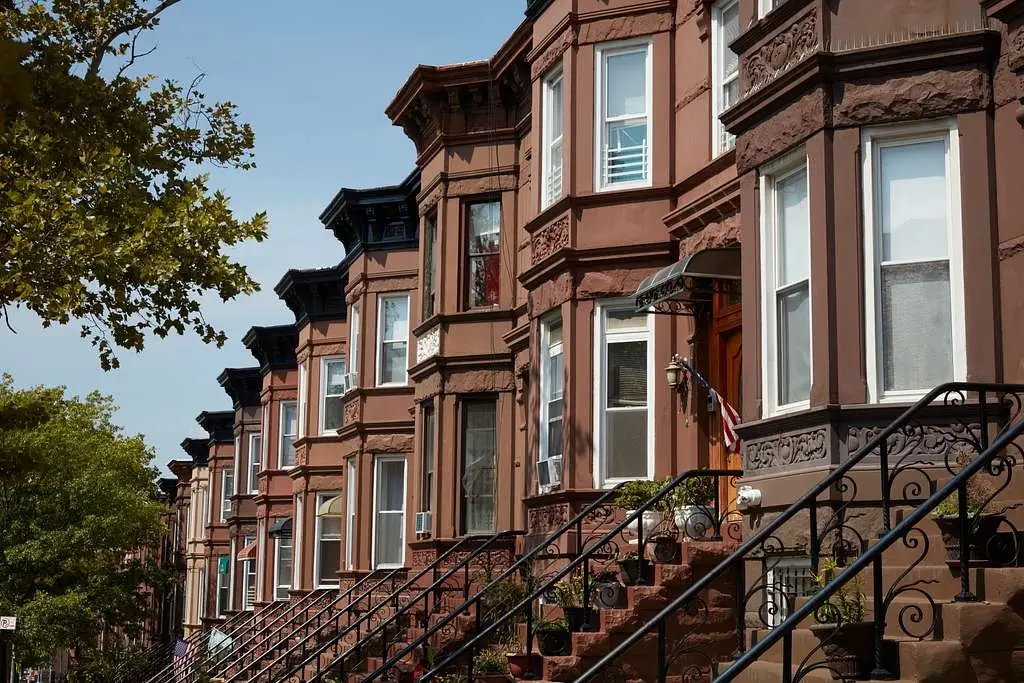
A look at the forces shaping the real estate market and what it means for everyone trying to live here.
The stretch of neighborhoods west of Park Slope, from Red Hook to Dumbo, has become one of the most sought-after pockets of New York City. Tree-lined streets, majestic brownstones, great restaurants, an easy commute into Manhattan—it’s no wonder rents keep climbing and buying an apartment, never mind a brownstone, feels aspirational.
It wasn’t always this way
This part of Brooklyn looked very different in the ‘70s. Buildings were in disrepair, property values had cratered, and the city was on its way to losing nearly a million residents. “There was this initial wave of brownstoners, the people who came in the ‘50s, ‘60s and ‘70s who were buying these old, beautiful historic homes that in many cases were a bit run down, needed work, and restoring them lovingly, creating the brownstone neighborhoods that we know today,” says Lara Birnback, executive director of the Brooklyn Heights Association. “That initial wave of people were very civically inclined. Other people might say that’s really just gentrification with a glossier frame on it.”
Fast forward to today and those same brownstones that once required a leap of faith to buy are now among the most coveted, and expensive, properties in the city. A Carroll Gardens townhouse just went into contract for $8.3 million. Franco Hasou, a broker at boutique firm In the Heights Real Estate and a Carroll Gardens resident, says he’s constantly fielding calls from developers. “In the last three weeks, I’ve had ten developers call me asking for buildings,” he says. “They’ll pay cash right away and close as soon as possible. They’re begging.”
Why prices keep going up
Hasou has a simple explanation for what’s driving price increases: “Limited supply, more demand. That’s what’s been happening for a number of years in this neighborhood, and it’ll never really go down.” The area is bound by water—the East River to the west and the Gowanus Canal to the southeast—which means opportunities to build are limited.
Zoning caps heights, landmark rules limit alterations, and even the most modest of renovations are complex. “The architectural and permitting costs just to do $50,000 worth of work is almost $20,000,” Hasou says. “No regular person can walk in here and decide they’re going to just buy a place and renovate. There’s no way.”
Unable to keep up with rising renovation costs and city directives, some owners are simply “sick and tired,” Hasou says, and willing to sell to the highest bidder. “The city comes along and says, ‘You got to do lead abatement, asbestos abatement. By the way, you can’t raise rents and your property tax went up. Tenants complain, there are violations they have to fix, and they’re like, ‘Who can give me the money the fastest?’ A developer comes along and says, ‘Here, have $5.5 million.’”
Developers often end up converting multi-unit buildings into single- or two-family homes in order to make a proper return on their investment, further consolidating rental opportunities and overall available housing.
So who is buying?
Growing Manhattan families have long seen Brooklyn as a place where they can get more bang for their buck and achieve a more suburban feel without actually leaving the city. “They’re not wanting to go out into the suburbs and have the white picket fence. They still want diversity; they want their kids to grow up in an urban environment. Brooklyn is the best of both worlds,” says Alexandra Gupta, a real estate agent at The Corcoran Group who grew up in Boerum Hill.
Gupta has observed two main buying trends recently. The first is an influx of investor-buyers, though not the corporate kind. “Investors are mostly families who are seeing what’s happening in the area and using their inheritance or their savings to purchase real estate because they’ve seen the growth,” Gupta says.The second is co-purchasing: Two families pool their assets together to buy a brownstone. They split it into two units—one garden, one roof—and share expenses.
Gupta has also seen buyers work creatively within existing zoning and building rules by adding subterranean levels. “In most of these brownstone neighborhoods, there’s usually landmarks or rules against building up or out. So you build down,” she says. “People have been turning [lower levels] into a basketball court, wine cellars, gyms, parking garages. Digging down is a trend.”
The kind of buyer who can afford to do this (many of whom are from overseas) has caught even seasoned brokers off guard. “That’s something I’ve never seen before—the money,” Gupta says. And where is it coming from? Finance, tech, law, and increasingly, family wealth. “The transfer of wealth is happening,” Gupta says. “A lot of folks are just outright paying cash—parents paying cash, families using their trust fund money.”
The K-Shaped market
The K-shaped economy—a post-pandemic economic split in which some households have thrived while others have fallen further behind—is playing out in real time on these streets. Mortgage rates, which dipped to 2.98% in 2020, now hover around 6.6% what Maggie Ross, senior managing director of sales for Brooklyn at Brown Harris Stevens, calls “a complete tectonic shift” and “a huge driver of the change in purchasability.” The effect is a market frozen in place: Owners who locked in low rates won’t sell and give them up, so inventory stays thin and prices stay high. “We have low inventory because a lot of people are holding on to their 3% mortgage interest rates and simply not moving,” Ross says. “There’s also general economic uncertainty. In this micro-market, cash buyers are finding it much easier to enter.”
Those cash buyers aren’t always who you’d expect. “I’ve met a lot of union workers who work for the city or the government, who make $400,000 a year between them and their wife, and own $2 million properties,” says Hasou from In the Heights. Most of his clients, he notes, aren’t financing at all. “Most of the people that we sell to have the cash in the bank. They don’t borrow money.”
For everyone else—the renter saving for a down payment, the first-time buyer watching rates—the math is brutal. Ross puts it plainly: “People who are cash buyers and have more liquid assets have an easier time purchasing.” The gap between those two realities is what defines this market right now.
How to prepare to buy
This is a market shaped by geographic constraint, regulatory complexity, and an influx of wealth that shows no signs of slowing. For would-be buyers, Ross recommends going in prepared: get your broker, your lawyer, and your financing lined up before you find the property you want. In a low-inventory market, the first serious buyer often wins. Co-ops and condos, often overlooked in favor of the brownstone dream, offer the same tree-lined streets and community at a lower entry point—and in this market, they’re worth a serious look.
For renters, the landscape is harder. As long as developers keep converting multi-family buildings and landlords keep selling, the rental supply will continue to shrink and prices will continue to climb. What changes that pattern, and when, is the question everyone is asking and no one can answer.
Want more coverage of the neighborhoods you call home? Subscribe to Court Street Journal on Substack.
News from the neighborhood.
Red Hook & Gowanus
Subscribe to get the Star-Revue’s newsletters throughout the month.
Author

Discover more from Red Hook Star-Revue
Subscribe to get the latest posts sent to your email.