Last month, I expressed pessimism over the future of live jazz in New York. I’m still unsure how many venues are going to survive into Phase 4 of the COVID-19 reopening, much less after, but some of the leading names have been trying to present live music to remote audiences, with the biggest name, the Village Vanguard, starting up their own, highly auspicious series in June.
Live-streaming leaves the viewer/listener responsible for the some of the most important aspects of the experience, sound and vision. Sound boils down to the quality of the digital-to-analog converter connected to the computer and also the quality of the speakers, or the headphones, reproducing the stream. Then there’s the picture quality on the screen, and the fundamental issue of how the signal is getting into the home—do you have a reliable broadband connection to the internet? Here’s a look at some of the most prominent sources for live jazz in (though not always) New York City.
The Village Vanguard: The flagship jazz venue in New York City, and thus in all the world, has launched a weekend series from the empty club. One group plays single sets Saturday nights at 7pm and Sunday 2pm matinées. Access is $7 for a single set.
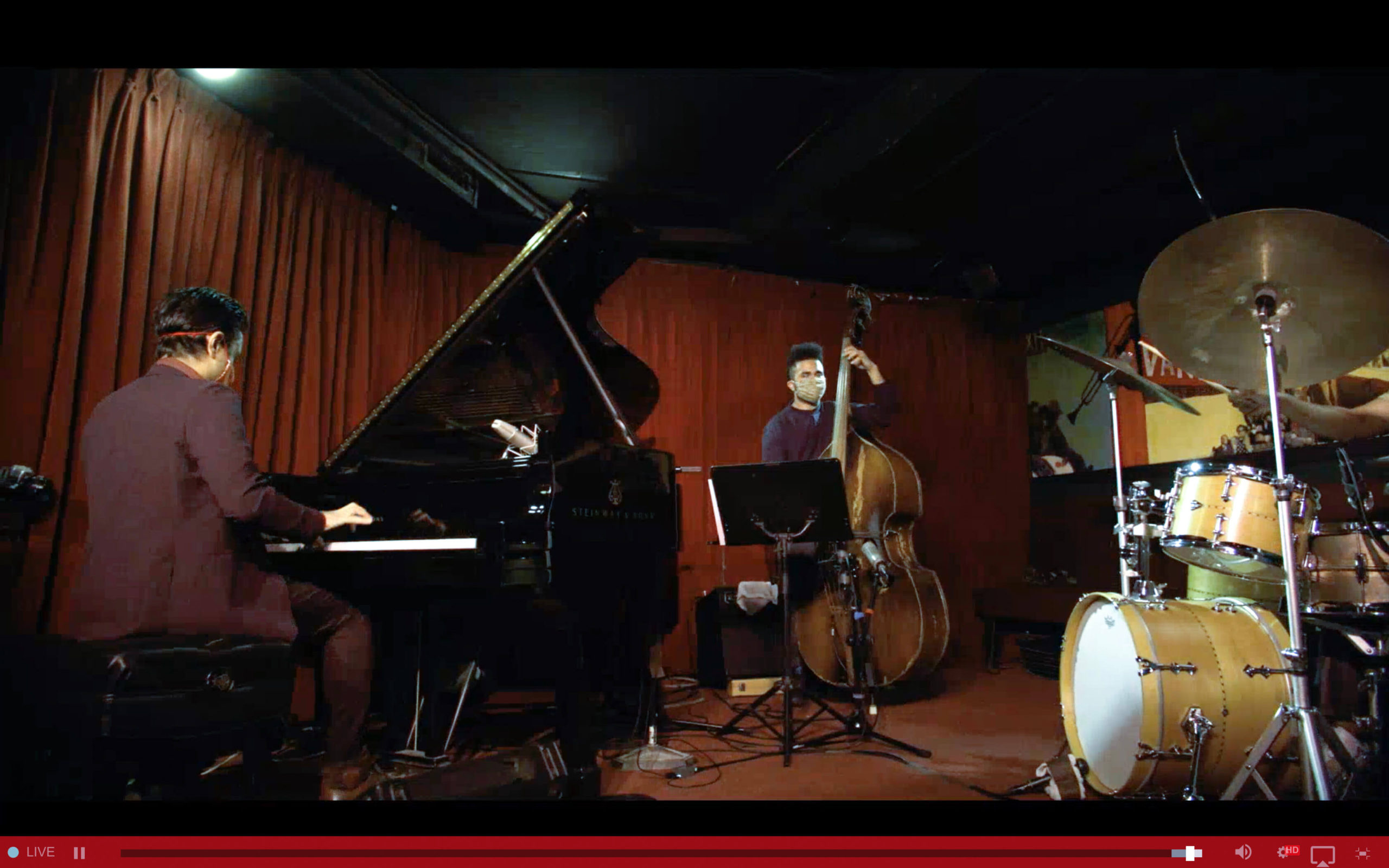
June 20 I caught pianist Vijay Iyer’s Trio—bassist Nick Dunston and drummer Jeremy Dutton—all the musicians were masked. Though not the same as being in the Vanguard itself, this was a satisfying experience, better than putting on a record or even listening to a radio broadcast. The music was of course high caliber, Iyer is one of the strongest and most distinctive pianists on the scene, he has a ringer in Dunston, who is an exceptional young player, and the trio had a fluid response, not only listening to and working with each other in the moment, but following the natural expressive and emotional curves of the music and the set as a whole. It was LIVE JAZZ!
The Vanguard’s production was excellent, bridging the uncanny distance between the remote musicians and the home listener. The lighting was a revelation, the musicians illuminated with a mellow, velvety patina that one could never see in person with standard club lighting, and the camera work was of interest in and of itself, with multiple angles and closeups on the musicians, the viewpoint switching smoothly and smartly, and some hand-held camerawork standing in for the usual Vanguard intimacy. The spell only held while the musicians were playing, announcements meant for the home viewer but directed at the empty club felt absurd—no dialogue but something like captions would be truer and stronger to the experience—and this is only a stopgap measure, but for the time being it’s not only something, it’s something that’s pretty damn good. (July schedule for the Vanguard includes Joe Lovano’s Trio Fascination, 7/3 and 7/5, and the Eric Reed Quartet, 7/11-12). villagevanguard.com
The Jazz Gallery: One of the first venues to respond to the COVID-19 closure, with their (ticketed) interactive Happy Hour Hangs with individual musicians. They also have a Lockdown Sessions series of live shows streamed from each performers remote location, (tickets range from $10-20, generally, with lower cost for Jazz Gallery members). Can’t make a scheduled session? Their extensive archives are also available (ticketed, but if you paid for the live event, you can rewatch using your original code), though once you pay you have to wait for an access code to hit your email, and that process may take a day or two. The Jazz Gallery also has a nice selection of shows on their YouTube page (some are audio only), and these are free but the club does ask for donations for these, the money being channeled by the artists to the NAACP Legal Defense and Education Fund, and similar organizations.
The sound from the Gallery sets is excellent, and the production straightforward and fine. But that’s only for archives, the Lockdown Sessions and Hangs are held from wherever the musicians happen to be located, using whatever equipment they have at hand. Some performers have professional miking, others seem to be using nothing more than a mobile phone, and lack of technical quality can be a distraction. jazzgallery.org
Smalls Live: Smalls has been live-streaming sets for years, and they’ve been continuing this with ensemble performances from the tight confines of their basement location. For those still working from home, sets start at 4:45pm daily (one per day) and are free (you do need to open a free membership account). Smalls massive archives are also available, including a couple dozen sets recorded since the club was closed to patrons, but to view those you need to becoming a Supporting Member of Smallslive Foundation, which helps them pay the musicians—that’s a $10 minimum one-time donation or a monthly pledge, all for the cause. And it’s a good cause.
Smalls streaming system was always meant to augment, not replace, their live experience, so where the Vanguard had to rethink things from the ground up, Smalls still has the weird. claustrophobic fish-eye views, and a sound that’s okay but doesn’t have the depth or image of the Vanguard’s (or Jazz Gallery’s) system. You lose little by glancing away from the Vanguard stream, but the sound from Small’s doesn’t have much grip when you’re not focussed on the screen. And the protocol is worrisome—a recent set from drummer Willy Rodriquez’ Quintet had only bassist Peter Slavov masked, while tenor saxophonist Henry Paz and soprano saxophonist David Liebman were pushing air, and droplets, through their horns and into the enclosed space. smallslive.com
Blue Note at Home Live Stream series: In more popular circles, certainly the most famous name in jazz—the Blue Note club has their own streaming shows. This is a weekly series, accessible via Instagram Live and the club’s Facebook page (that’s also where you can find the schedule and showtimes), with a modest suggested “admission” fee.
At home means just that; as with the Jazz Gallery sessions, the musicians are playing and streaming from their own locations, meaning again that everything from the sound quality to the visuals varies wildly, while being hosted by the Blue Note’s social media. For club ambience, the Blue Note also has made their archives available for a four month window, access to those requires a membership, either $9.99 or $100 per month (the high-end price has perks for when the club can reopen, whenever that might be…). bluenotejazz.com
Author

Discover more from Red Hook Star-Revue
Subscribe to get the latest posts sent to your email.