For over 16 years I have been leaving copies of this paper every month in the news rack at the top of the stairs of the Red Hook Justice Center. Now-retired Judge Calabrese is a huge fan of the paper, as we are of him.
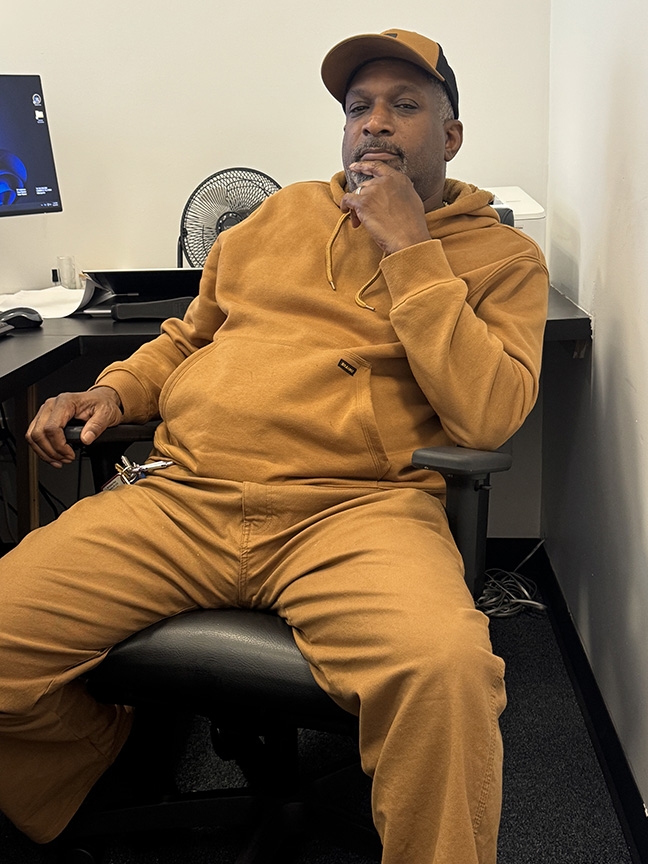
Last month I received an email from a recent Justice Center hire, Andrew Benjamin, with an intriguing message about 9/11. He sent along an old news article about his experience as a volunteer rescue worker during that ill-fated week in September, and he indicated that he has a story for us.
I went to interview him, and my first impression (first impressions are often wrong) was that this large, out-of-breath person had spent his life a heavy smoker. That was a really dumb impression, as the painful fact is that Benjamin, who spent the first six days after 9/11 at the site, digging in the ground first to rescue, then to simply recover human remains, has had health issues, lung issues, mental issues and more as a result of his helping in the face of the disaster.
The interview was great, here are some excerpts.
Andrew: Everybody always talks about firefighters as if they were the only ones there, they were not. Everybody contributed, because there was such need of assistance that everybody who was anybody was there: doctors, nurses, masseuses. I was like, “What the hell, masseuses here? But believe it or not, after a masseuse gets you in a chair for 30 minutes, you’re able to work another three hours. Who else? One man drove from Washington D.C. just to help. Met him on the third day. I wrote about it 25 years ago, and it still goes for today. They talk about the ones that died, but you know what? I’m not being facetious, but forget the ones that died. They died. They’re gone. Focus on the ones that’s alive and suffering.
Star-Revue: What did you do at the UN?
Andrew: I was an executive assistant to an international lawyer. All transportation had ceased. So I had to walk from 42nd Street. By the time I got to 14th it was all smoke. you couldn’t really see the building. Then when I got there, I was able to witness firsthand building seven crumbling. All you heard is a crack, crackling noise, and the crumble. And just like on TV, with the smoke coming towards you, that’s how it was.
The streets were so thick with the dust, you would think you was walking through sand on the beach. Then, the construction workers—I told you—if it wasn’t for the construction workers we couldn’t move the material to get to places. I myself crawled into places, thinking someone had to be down there. The firemen said, “I’m not going down there,” because it was so unstable that if you hit anything, you would die because it was gonna just crush.
I went, and a police officer said, “I’ll go with you. So we crawled down there, but I didn’t find anybody alive. Search and recover, search and rescue became search and recovery. And I can tell you, I don’t know what’s more traumatizing finding someone in whole, or in pieces, because when you find someone whole, you’re now looking at the last expression on their face when they died.
When you find them in pieces, you would think, oh, there’s a body. No, you had to have a hand shovel and dig the dirt, and that’s how you find a body. All right. Well, if this lady’s here, the rest of them should be around here. Can’t find her. Next thing you know, you find the legs protruding from the dirt, that same leg is kicking you out of your sleep, asking you to find the rest of them, because the family is waiting them.
Star-Revue: Let me ask you: so you went down there that first day, and stayed for six days? Didn’t you go home?
Andrew: No. I went home the first day. The second day, I went down to Javits and back down to the site. That weekend I slept at Stuyvesant High School. That was the power base for everybody.
Star-Revue: Did you get signed up as a volunteer? How did that work?
Andrew: You went there. You stood online. It was also online for blood, but you went down there. You signed the papers, and they took you on a school bus to the site.
Star-Revue: And since then, you’ve never been invited to any ceremonies or 9/11 events or anything,
Andrew: Well, I’m in the museum. I’m at the 9/11 memorial for my work. They took copies of all my pictures, my art and my news articles.
Star-Revue: So if I go online, I can find those pictures?
Andrew: No, because they didn’t post them yet. I waited too long, so they had already opened up the museum with everything they had. But when they do a total makeover, mine is gonna come up.
Star-Revue: Tell me about the construction workers, the unions that don’t go to the events.
Andrew: No, because we’re not recognized. I told you, it was first rescue worker, firefighters, policemen, rescue workers. Then it became firefighters and policemen. Then it just became firefighters. Now we did all the work lifting up, using the machinery to lift the girders and everything, and we weren’t acknowledged, you know, just like with the vacations and saying thank you, so now on 9/11, construction workers boycott those Memorial days. So think of it like Thanksgiving.
It’s a sham when I found out Indians don’t celebrate Thanksgiving because look what happened when they came, they slaughtered they slaughtered half the East Coast when they Europeans arrived. So anyway, I myself stopped going to the memorials. I got paid twice, and I may have to get paid a third time. Time is going to come where they’re going to have to award for PTSD.
Star-Revue: How you got to be at the Justice Center and tell a little about your position.
Andrew: I just I just applied for the job. I am a resource coordinator. I make sure that the participants are in compliance with the judge’s orders. if say for instance they get arrested for shoplifting, they go to a shoplifting class. I help them, and then I I take iti another step and find out why there was shoplifting. Many times it’s drugs, and I help them get into a drug rehab. I love the job as I actually help them.
Star-Revue: Had you done this before?
Andrew: I’m a wellness coach. I’ve been doing this for over 15 years, actually 20. I have a YouTube channel. The Truth Hurts channel. Andrew Benjamin or LUV Doctor. I have over 3000 people following me.
I am also a big supporter of Lillith’s Law that would make narcissistic behavior a crime, punishable with reparations and jail time. I am working to get it passed in Congress.
Star-Revue: Let me ask you one more question: How did his experience of volunteering at 9/11 change your life? Aside for the obvious health reasons.
Andrew: I help people. That’s why I actually went down there. I actually went to Ground Zero to hold someone’s hand if they were dying, most people don’t want to die alone. They want someone there with them.
That’s the precise reason why I went.
Author

Discover more from Red Hook Star-Revue
Subscribe to get the latest posts sent to your email.