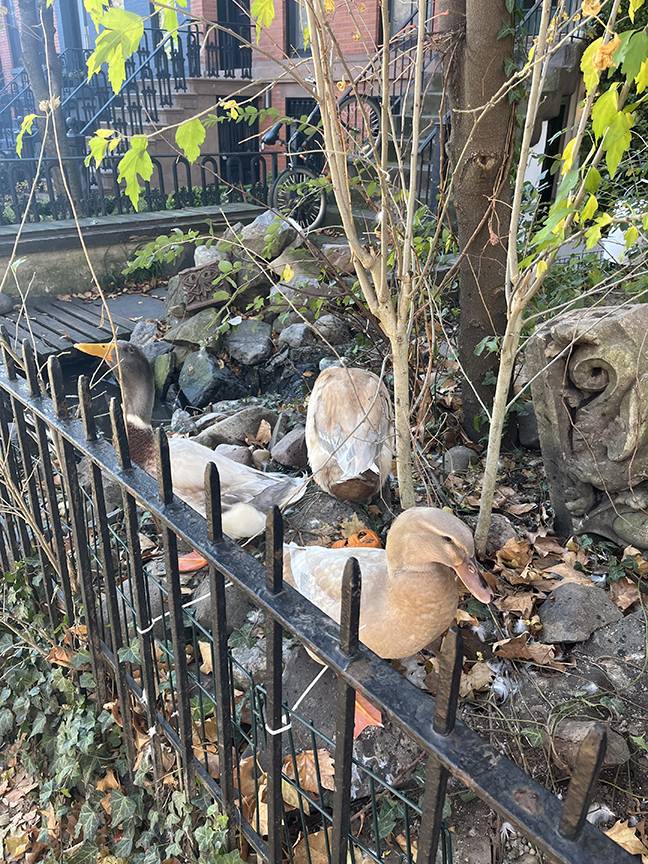
In the front yard of a house on Clinton Street on the Gowanus side of Carroll Gardens is a modest pond with enormous koi—each one easily more than two feet long. A mesh cover protects them, allowing the fish to grow long and fat, free from the prying talons of would-be feasters. The fish—white and orange and so unexpectedly thriving in the middle of Brooklyn—never fail to impress passersby. So, when I stumbled upon another impressive animal sighting in Carroll Gardens, I did a double-take. Three large domestic ducks, nearly the size of geese, huddled together in front of a brownstone on 2nd Street.
If you were to look at photos of each of the houses on 2nd Street and guess the one that features live poultry in front, you’d probably get it right. The brownstone is covered by a living wall—a vertical garden that helps to reduce the heat island effect, while insulating the home in the winter and cooling it in the summer. In the front yard is a small pond, whose water flows beneath a little wooden plank bridge that leads up to the brownstone. A sign on the metal fence notes its designation as a certified wildlife habitat, as defined by the National Wildlife Federation (anyone can receive the nonprofit’s certification by paying a $25 application fee and ensuring that the space “provides four essential habitat elements – food, water, cover, and places to raise young” and that sustainable gardening practices are used).
Gennaro Brooks-Church is the mastermind behind this small, enchanting oasis. A self-declared green builder, he purchased the home in 2008, viewing it as an experiment to see how he could use materials with low embodied energy, therefore eliminating the need for new materials. He renovated the home, using only salvaged materials and added the green wall (he has many blog posts on his website, ecobooklyn.com, about the benefits of living walls). The backyard is filled exclusively with native plants and there’s another pond in which he likes to take a dip in each morning. While he and his family live in the garden basement, he rents the main three floors of the house for $12,000 a month, according to StreetEasy.
Maybe I need ducks
The ducks, however, were a more recent idea. “One day I was kind of feeling down, and I was just like, ‘You know, maybe I need ducks. Maybe that’ll liven up my life,’” he told me. “And it really has.” Last spring, his former assistant researched duck ownership and believed it was legal in the City (he later learned that it is not). He found a farm online and ordered three, since they’re social animals. Soon, a box of little yellow ducklings was delivered to his door.
The ducks are Saxony ducks, a breed first developed in Germany in the early 1930s. They weigh up to 8-9 pounds, and while the females are a gentle cream and brown color, the drake has distinctive blue-gray markings. They’re known to be gentle, calm birds and cannot fly.
Gennaro admitted that neighbors have complained about him and the ducks via 311, but he is proud of the setup he has created for them, including the pond and a small hill with bushes that they sometimes hide in. Some people worry that they don’t have enough space, but he countered that they are domesticated ducks, many of which are kept in far worse conditions. According to him, many people appreciate the opportunity to watch the animals. Groups of students from nearby schools have walked past to observe the ducks, and somehow even tour groups of Europeans sometimes stop by to see the animals.
Despite his best efforts, Gennaro is worried that sooner or later complaints will cause him to lose the ducks, which he sees as a shame, given the joy that they bring to many: “Not only do they not bother anyone, but people are actively able to enjoy them and kids learn from them potentially. It’s huge…they all smile… That’s the one thing they all have in common, you know, it’s different people, different ages, different everything, but that’s the one thing they do—they smile.” My heart went out to this eccentric local and his beautiful ducks. Then I uncovered a whole new chapter of the story…
Follow along next month for more.
Discover more from Red Hook Star-Revue
Subscribe to get the latest posts sent to your email.