
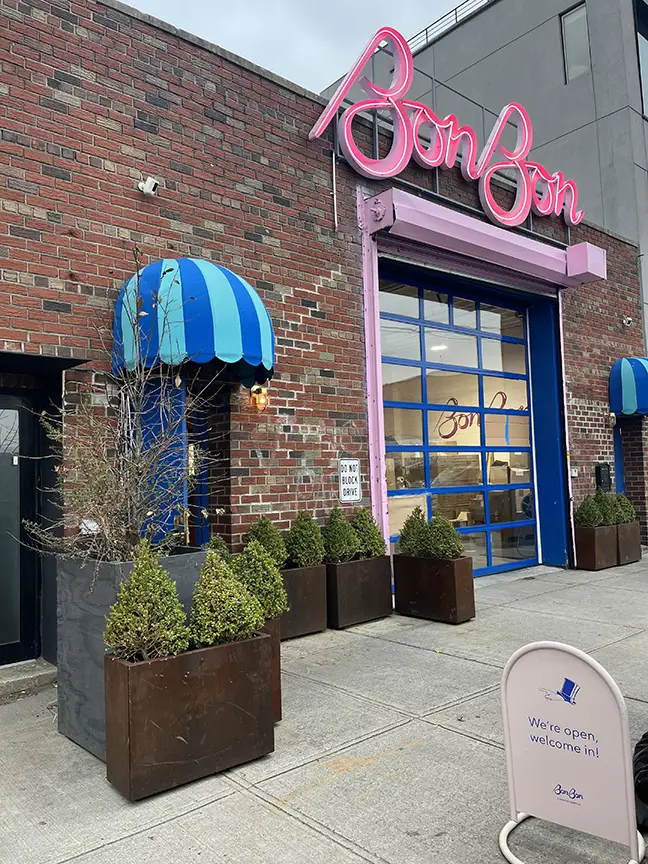
In 2017, three Swedish transplants living in New York started BonBon—a company that imports Swedish candies. The brand became popular fast, thanks to their fun branding (light pink packaging with “BonBon” in blue cursive), a wide selection of craveable candies (Swedish candy typically uses higher-quality ingredients than those found in their American counterparts, often with fewer dyes and artificial flavors), and TikTok. It wasn’t until 2024, though, that the company opened its hybrid warehouse and “candy library” location in Red Hook (Columbia Street Waterfront at 66 Degraw Street; open Friday to Sunday, 11am – 7pm).
This past month, the Red Hook Star-Revue staff finally decided to try the viral candy, and to get the thoughts of our staff Swede—Red Hook Star-Revue writer Eric Newstrom (born and raised in Uppsala).
Visiting BonBon’s Red Hook location, you might be surprised by the bustle of the back warehouse, where, on a recent Friday afternoon, 20-odd employees hurried about packing candy. In the front, dark wood paneling surrounds cases with over 70 types of candies (mostly gummies, as well as chocolate and licorice).
Grab a clean scoop and a wax lined bag to start filling up. The bags of pick-a-mix are $4.50 for 4 oz and the shop also sells its own brand of original candies, which comes in 4.2 oz bags (choose from salty licorice twists, Pippi Longstocking’s golden coins—which are pineapple and peach-apricot flavored—or several flavors of fish candy). The shop also sells a few staples that Swedes apparently love: Pucko (chocolate milk), Kavli Mildost (spreadable cheese), and Felix Smörgås gurka (pickle slices).
You can also find Swedish gummies locally at the Ikea in Red Hook, which sells store brand candy in sour cola, salty licorice, sour berry, and assorted flavors ($2.19 for 4 oz), as well as Bilar-brand car-shaped foam gummies ($5.99 for 4.4 oz). Eric noted that while Bilar is his favorite candy brand, Ikea sells his least favorite variety, leading him to philosophize on whether Sweden is offloading its poorest performing candies on undiscerning Americans.
Kolsvart brand Swedish fish are also available in multiple stores in Brooklyn (we snagged ours at Tavola Italian Market on Court Street at a pricey $8.95 for 4.2 oz). Each flavor (like sour blueberry and elderflower) is shaped like a different Swedish fish (turbot, pike, etc.) and part of the proceeds of several of their products support the restoration of the real species’ habitats.
If you’re so inclined, you can also visit the Church of Sweden in Midtown Manhattan where you can find an assortment of Swedish goodies, including marshmallow santas (or as Swedes would say, “Juleskum”).
Sampling all of these candies, here were Eric’s thoughts on his favorite candies:
Marshmallow Santas (Cloetta brand): I purchased these myself at the Church of Sweden in Midtown Manhattan, which has a Christmas market each year. A heavy dose of nostalgia factors in here, certainly, but their perfect chewiness in the beginning before they melt in your mouth make this candy the perfect Christmas candy to gorge on without getting overwhelmed.
Pippi Longstocking’s Golden Coins (BonBon brand): The best gummies we tried. These are meant to be pineapple and peach-apricot, and all those flavors are clearly noticeable, without any one becoming overwhelming. They were also much nicer to chew on than some of the other gummies.
Sour Chestnuts (sold at BonBon): Flavors trigger memory, and these certainly did. While these oval, sour candies didn’t look like anything I’ve had before, the flavor and texture reminded me of three different candies I grew up eating. Not the most delicious by any stretch, but definitely the most evocative.
Some of the candies also awoke Eric’s latent frustration around Swedish candy’s reputation outside of its homeland. Kolsvart brand gummies, in particular, use more natural ingredients (like carrot concentrate), clearly capitalizing on the assumption by some Americans that Swedish candy is “healthy.”
According to Eric, he’s always seen Sweden as having a distinctive candy culture. Grocery stores in Sweden usually have a whole candy section with 50-60 different types of candies available near the registers, and they’re popular with both children and adults. He did, however, note that these candies are not always as fresh and chewy as the ones we tested, as they likely sit longer on the shelves. Another aspect of Swedish candy culture is “lördagsgodis,” which translates to “Saturday sweets.” In 1959, the government spearheaded a campaign to prevent tooth decay, and the tradition of children only eating candy on Saturday has continued ever since. Eric confirmed that as a child, in classic Swedish form, he only ate candy on Saturday.
For those looking for a savory Swedish treat, BonBon’s Red Hook location sells “Swedish hot dogs” on Sundays (noon until sold out). The dogs are topped with sweet mustard, your choice of creamy remoulade or shrimp salad, pickles, and fried onions. “That’s a very, very Swedish kind of hot dog,”
Eric confirmed. “The best way to eat one is to go outside into the woods. You set a little fire and you have to cook them that way.” And while eating a Swedish dog in the woods may be ideal, BonBon is about as close as you can get without booking a trip to Scandinavia.
Author

Discover more from Red Hook Star-Revue
Subscribe to get the latest posts sent to your email.