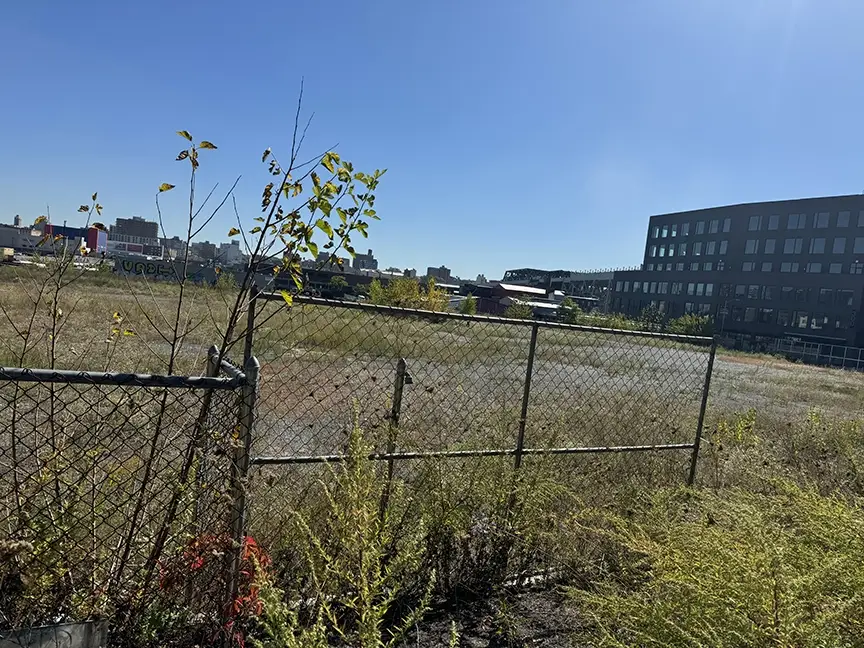
Almost 20 years since the first decision document outlining the remediation plan for Public Place, a site along the Gowanus Canal which used to be the site of the Citizens Manufactured Gas Plant but now was supposed to become the flagship development of the rezoned Gowanus, with affordable housing and green space, sits desolate.
As one of the most polluted sites in Gowanus — a neighborhood infamous for its polluted canal and upland areas — Public Place has become a hotspot for debate between community members concerned with the health risks associated with the cancer-causing coal tar sitting mere feet below the surface, and city, state, and federal officials who contend that whatever final plan is put in place for the remediation will sufficiently protect human health and the environment.
At some point in the future — no one knows when, as both legal processes and differences of opinion around the remediation stand in the way — Public Place is set to become Gowanus Green, a development of 955 affordable housing units, a school, a playground and a public park. But the housing development will likely sit above over a hundred feet of coal tar, a liquid by-product of the production of coal gas that contains a number of harmful, volatile or semi-volatile chemicals.
How — or if — all that coal tar will be dealt with, is uncertain. The site is currently in New York State’s brownfield program, a voluntary program that offers incentives to developers who agree to clean up properties so that they can be utilized. In 2007, National Grid — the energy company responsible for the remediation of the Gowanus Canal and several upland sites, including the former Citizens Manufactured Gas Plant — was directed by the State’s Department of Environmental Conservation (DEC) to remove any structures left from the polluting plant, as well as any contaminated soil around those structures. National Grid was also ordered to excavate any contaminated soil present within eight feet from the surface.
12 years later, however, this plan was scaled back; the DEC had determined that only targeted excavations were needed. The order for site-wide soil-removal was replaced with a requirement of a soil cover, which included a demarcation layer (used to clearly indicate where clean soil ends and contaminated begins) and at least two feet of clean dirt.
So far, only the targeted excavation has been completed, along with the installation of a steel bulkhead along the canal and recovery wells that continuously collect coal tar from the site. Work has largely been paused since February last year, however, after National Grid disagreed with DEC over a set of new directives regarding groundwater contamination.
Writing to the Red Hook Star-Revue, DEC stated that negotiations with National Grid are ongoing and that there is no specific timeline for National Grid to submit a supplemental plan that’s compliant with DEC’s new directives.
In a statement to the Star-Revue, National Grid spokesperson Alexander Starr wrote, “The discussions with NYSDEC are progressing and National Grid is actively participating in the process. Our position on specific remediation plans required for protecting public health and the environment is well documented in our correspondence on this matter with NYSDEC.”
Controversy over cleanup
Since the first remedy was ordered in 2007, the clean-up efforts have been met with criticism, from various directions. The original plan made little sense to many, including Christos Tsiamis, who for 13 years (until he retired in 2023) was the Environmental Protection Agency’s remedial project manager of the Gowanus Canal Superfund site. Given that contamination primarily had been found between seven and 150 feet, Tsiamis, during an appearance at December 2020 meeting for the Gowanus Community Advisory Group (CAG), questioned the decision to excavate eight feet of soil.
From his point of view as the person in charge of the canal cleanup, and in the interest of protecting the work EPA was doing, Tsiamis told meeting attendees he’s advocated to his state counterparts to excavate “what was practical,” which in his book meant 20 to 30 feet. He also recommended in-situ stabilization, which means that cement or another binding agent is mixed with the contaminated soil to freeze chemicals in place and, thus, preventing migration.
Tsiamis also raised concerns about toxic vapors leaking into future buildings at the site, which include housing and a school. “If you put [up] a structure like a school or a building, those compounds that are eight, 10, 15 feet down, they will volatilize and they will find a path and they will come inside the closed structure. So it’s a concern,” he told the CAG.
Since then, DEC has not budged on its excavation requirements for Public Place. About 80,000 tons of soil have so far been removed, but no site-wide dig appears to be in the cards.
DEC told the Star-Revue that excavation of all contaminated soil is not necessary to precent on-site or off-site exposure, and that the state agency typically doesn’t require such extensive excavation of contaminated soil. The number of trucks and dewatering required for such an effort, as well as the need to protect sensitive structures like the above-ground subway tracks, also contribute to making a massive excavation infeasible, the agency added. Instead, the completed soil removal, the bulkhead along the canal and additional cleanup techniques to prevent further mobilization and migration of the coal tar, provide sufficient protection of public health and the environment.
Some community members and environmental advocates have called for the removal of all contaminated soil at Public Place, to make certain no chemicals can migrate into the canal or the surrounding neighborhood. In 2021, three Gowanus residents wrote in an op-ed that, “Public Place must be remediated and monitored in perpetuity regardless of its future use, but without a full removal down to bedrock, significant toxins will remain. Given the potential for public health risks and ongoing contamination of the Gowanus Canal, environmental activists and community members call for full remediation.”
Walter Hang, founder and president of Toxics Targeting, an Ithaca-based environmental data firm, noted that if the toxic chemicals aren’t contained and removed, a risk remains that they will spread through the porous Gowanus soil and enter utility lines.
“That’s a preferential pathway for the coal tar. It just follows it, basically like a little drain, he said. “So you got to remove the pollution. It’s just no question about it. You can’t contain it. It’s just no dispute about this.” Building a school or an apartment complex on top of the pollution would be irresponsible, he added.
For decades, Hang has worked to enforce environmental laws in New York State and fought alongside communities, including in Gowanus, for more comprehensive remediations.
He also shares the concern that Christos Tsiamis raised at the 2020 CAG meeting: unless more soil is dredged, coal tar will find its way back into the canal, potentially ruining the massive cleanup effort happening there. According to a map compiled by Toxics Targeting based on federal and state data, the coal tar that originated at Public Place has now spread underneath the canal and into the soil on the other side.
But excavating all contaminated soil within the boundaries of Public Place would be an enormous undertaking. The property is just shy of six acres large. Digging up every piece of dirt down to 150 feet would, thus, create almost 38 million cubic feet of soil. That’s enough to fill up the Empire State Building.
And that’s not even considering the cost of such a project.
“The money alone for trying to do that — astronomical. It would cost billions of dollars to be able to do something like that in the city,” said Greg Moorman, Principal at Ancora Engineering, a design and engineering firm in New York City.
Heavy equipment would be needed, and the site might have to be tented to contain the toxic fumes that would emanate from the excavated soil, which would further complicate the process.
“You need trained professionals that have been in the field of drilling and excavations and heavy construction, who understand the logistics aspects,” Moorman said, adding, “There are not that many qualified contractors with the capabilities of going that deep.”
Just the excavation would take 18 to 20 months and the return on investment is very low, especially as there are alternative remedies that are more cost-effective, he said.
Research seem to back this claim. In recent years, scientists have begun looking more seriously at alternative methods to remediation of contaminated soil, and now increasingly recommend a combination of methods. One study investigated a brownfield cleanup in New Jersey, and found that a combination of excavation of the most contaminated soil and in-situ biodegradation, resulted in a safe site and 50 percent reduction of the initial remedial cost estimate, which only included removal.
In 2008, a team of researchers reported that biosparging — injecting air into the saturated zone to promote biodegradation of oil pollutants — can be effective in remediating some toxins deep into the ground, including benzene, toluene, ethylbenzene and xylene, which are all present in the soil beneath Public Place.
Excavation is generally not considered cost-effective, and also carries significant carbon emissions. (One study suggested that conducting excavation to clean up another brownfield site in the Garden State would emit 2.7 million tons of carbon dioxide, the equivalent of two percent of the state’s annual emissions.)
Several bioremediation, biodegradation and other advanced approaches have instead emerged “to transmute PAHs to less toxic or nonhazardous compounds in greener and more cost-effective way [sic]. They also minimize the carcinogenicity, mutagenicity and teratogenicity of PAH in polluted soils and sediments,” a 2021 study concludes. (PAHs stands for polycyclic aromatic hydrocarbons, a group of over 100 different chemicals that are formed when oil and coal — among other things — are burned.)
Hang argues that to protect the public, there’s only one thing to do: “If you leave that pollution down there, it’s going to continue to threaten public health, and it’s going to continue to spread.
That’s exactly what it’s been doing for decades,” he said.
Author

Discover more from Red Hook Star-Revue
Subscribe to get the latest posts sent to your email.