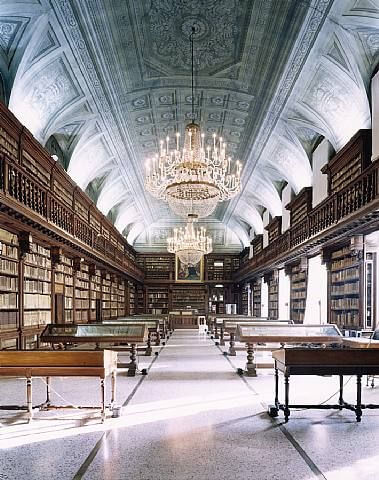
The Brera Library, as known as Braidense, is the Italian national library, founded in Milan in 1770 by the Hapsburg empress Mary Therese when Italy was not united and Lombardy was under Austrian control.
Today it is one of the main book depositories in Italy as it collects all the publications printed in Milan, where the majority of Italians books are published. This role is very ancient, a role the library has had since 1788.
Every year twenty thousand publications (books, revues, pamphlets) enter the library to be preserved for posterity in a rampart of the Italian culture. At this point, it contains over a million and a half volumes. For comparison, the US Library of Congress houses 16 million.
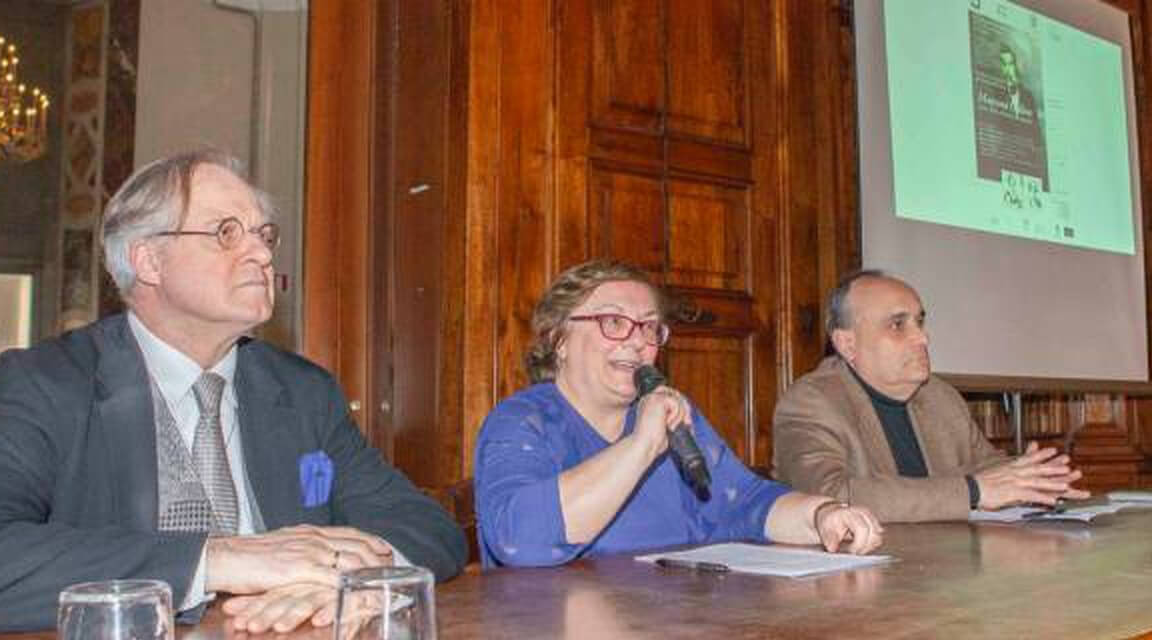
“Our Library is really alive,” comments Mariella Goffredo, directress of this institution, “We have modern materials, as well as ancient ones, like manuscripts, books of the 15th and 16th centuries, collections of drafts and private letters written by the most important Italian authors. Many times I saw people excited by seeing our heritage because on the drafts we own they are able to read the personal notes an author wrote before publishing some masterpiece”.
The authors Goffredo alludes to are not simply writers, but national heroes in the Boot, where they are still regarded as fathers of the nation in different fields, like language, political thought and art.
One of them, probably the most famous, is Alessandro Manzoni, whose historical novel, “The Betrotheds” (1827) has been translated into numerous languages, with thousands of copies on the desks of scholars and students from all over the world.
Brera sports the biggest cache of Manzoni’s output, where many of his own autographed works are contained. “Here the Italian students, who have studied him from primary school to university, can see how vital was his work because at school many times there’s no evidence of this in the oft-repeated notions, learned by heart,” remarks Goffredo.
In this library people can study from the original manuscripts, as have some of the world’s most famous writers and historians, Manzoni included.
“The Betrotheds” is a historical novel set in Lombardy during the 17th-century plague. Manzoni researched the period by studying documents kept in the Braidense, which has both helped him in his work and then preserved it after he passed away in 1873.
That’s just one reason we can say that this library is the mother of modern Italian literature.
In its rooms, modern books are often accompanied by ancient manuscripts, like the “Hexameron” (387 AD), where its author Saint Ambrosius, patron of Milan, described the creation of the Earth by God.
Such a holy book, whose title means “six days”, later influenced Italian writers for ages.
One of them was Boccaccio, the writer of the “Decameron” (1349-53), a story set during a plague (it sounds contemporary) with ten young adults obliged to stay together at home in order not to get infected. The only way they could entertain themselves was telling stories and the “Decameron” collects those told during a period of “ten days” (the meaning of “Decameron”) of “lock-down”.
Boccaccio started a genre, the collection of stories. Without him (and without Saint Ambrosius) probably today we would not read the Chaucer’s “Canterbury Tales” (1387-88) and maybe the “Forty-nine stories” (1938) of Ernest Hemingway.
So, in the Braidense, the literature reveals its true shape, which is that of a chain tying writers of different ages, whose actions have always been fundamental for the development of the human culture.
Since its foundation, Brera has the purpose to teach people how literature is a living power, made up of intellectuals who spent their life to make it evolve.
The heritage of the library is public, and the librarians love working there, maintaining the collection of both ancient and modern books, regardless of the author’s political background, race or gender.
Here only the culture matters.
Author

Discover more from Red Hook Star-Revue
Subscribe to get the latest posts sent to your email.