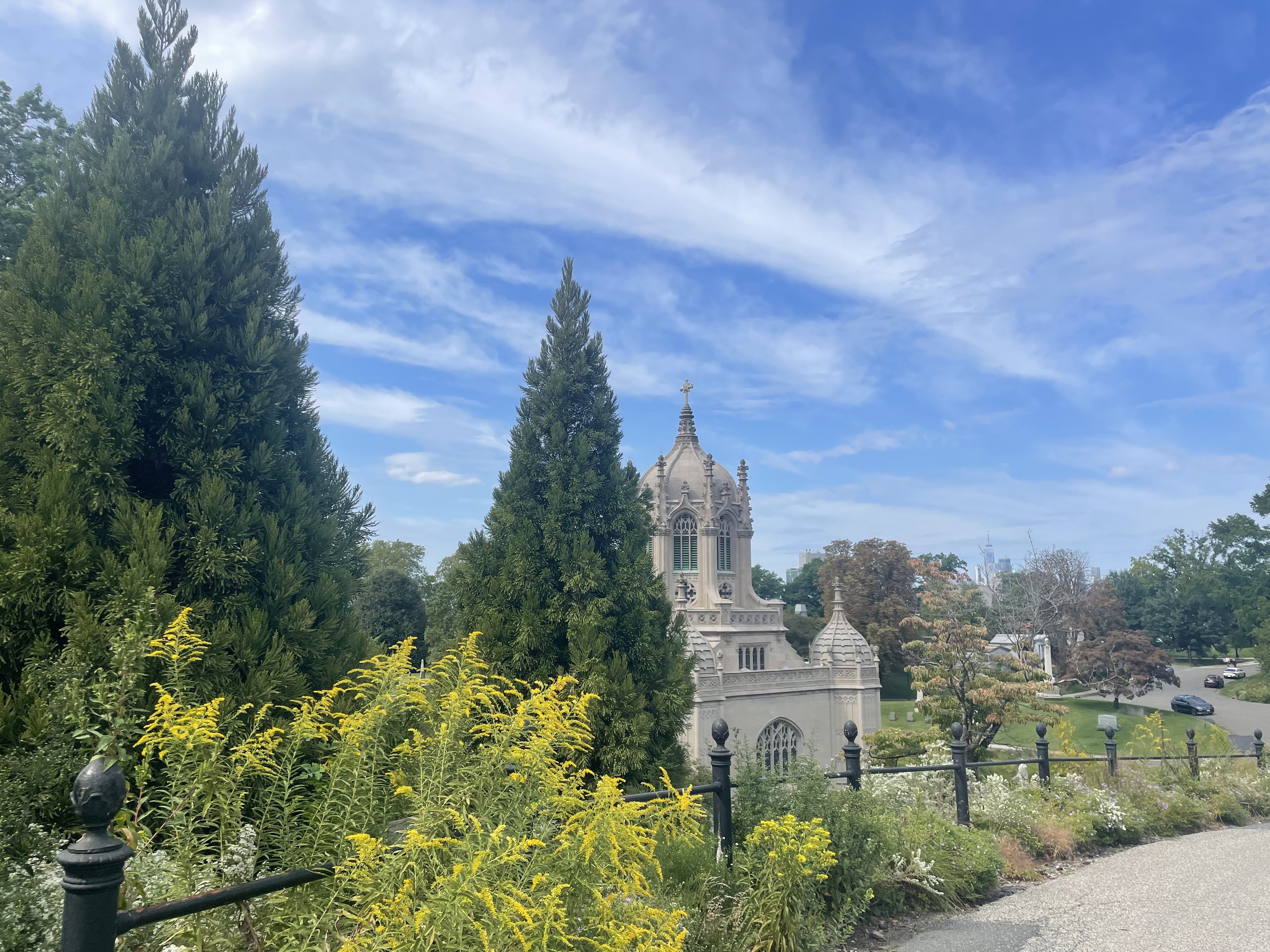
The observed nature in Green-Wood Cemetery ranges from hefty slunking woodchucks to blue herons wading in the koi ponds, and, depending on who you ask, that giant bronze bear straddling William Holbrook Beard’s gravestone. But what about the less-observed nature that comes out after dark? It wasn’t until bat expert and bioacoustic specialist Nic Comparato requested to set up sonar recording devices to measure bat populations in the cemetery’s grounds that Green-Wood had a better sense of bats’ nocturnal activity.
Comparato, founder of Urban Bat Project NYC and a PhD student at Rutgers University, offers bat walks (think birding walks, but at night) and lectures while researching NYC’s bat populations through sonar recordings. Comparato’s project currently has a network of six bat detector locations throughout NYC (Green-Wood Cemetery, GrowNYC’s teaching garden on Governor’s Island, the Manhattan Healing Forest on Roosevelt Island, McCarren Park’s Demonstration Garden, the Greenway Botanical Garden at Naval Cemetery Landscape in Williamsburg, and the Brooklyn Botanic Garden in Crown Heights), which record sonar activity that would otherwise be impossible for the human ear to hear. These sounds, via frequency and tone, give clues as to what kind of bat has approached the microphone.
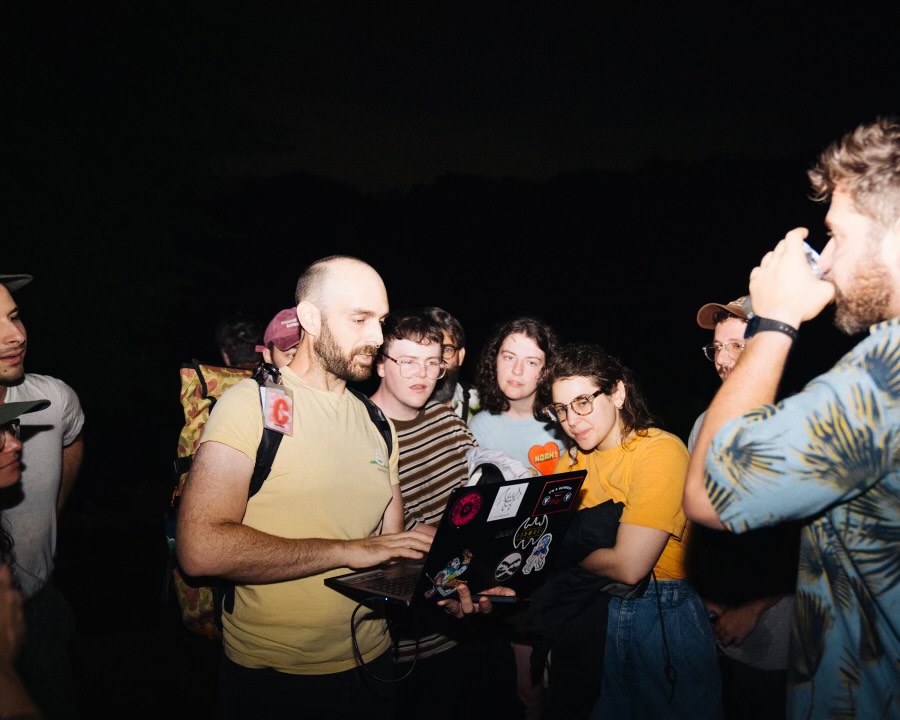
While leading a fully-booked Bat Bioacoustic Volunteer Training Session with over a dozen participants, Comparato explains how sonar works via physical example: “I can show you guys in arguably the coolest way anyone will ever do this—with a tattoo.” Then Comparato offers their arm towards the group. “I hate doing this because I should have photos, but like…”, Comparato begins, before pointing to the visualized sonar waves on their arm. “This is a flying fox that does not actually use sonar, and this is why you should ask for proofs before you get the tattoo. But you know, whatever, that was $800 ago.”
Comparato goes on to explain how to translate the sonar frequency data that is collected by these machines and how the variance of high or low pitches give clues about which species’ sounds are being captured. Consistent sonar waves usually belong to big brown bats, whereas eastern red bats’ sonar tends to be higher pitched and bouncy. “If it’s really, really low-pitched and really bouncy, I know it’s my favorite bat,” Comparato shares. “Don’t anyone make fun of her name … It’s the hoary bat.”
Living in an urban environment, these sonar detectors are often picking up more than just nocturnal animals: Birds, rats, and other city sounds can also trigger the sonar of the recording device. “I have detectors on the High Line that record squeaky breaks, jingling car keys, somehow babies lately, which is just amazing.”
Green-Wood’s green light for Urban Bat Project NYC’s bioacoustic devices in 2024 opened more doors for the mission and soon the Quaker Cemetery in Prospect Park was eager to hop on board and also allow bat sonar detectors to be installed.
“I reached out to Green-Wood on a whim, and I was just like, ‘Hey, would you guys be okay if I set up a bat detector?’ And they were like, ‘Oh yes.’ They were so stoked,” says Comparato.
Bat population numbers have been scantily recorded in previous years due to the complicated nature of tracking nocturnal animals and white-nose syndrome, which has killed off nearly 78% of North American bat populations. In 2006, the fungal disease (named for the white bacterial growths that appear on bats’ muzzles and wings), originated in Albany, NY, then began to spread, decimating millions of bats across the United States and Canada. The disease, which is primarily found in caves and underground mines, disrupts hibernation, which depletes a bat’s fat reserves too quickly before spring arrives. Bat populations are still finding their way back to stasis, but some research points to possible advantages for city bats, thanks to green roofs, access to bugs drawn to lamplight, smaller localized structures for hibernating, and an excess of lanternflies.
Meanwhile, Urban Bat Project NYC has been documenting how varying landscapes in the city attract different species of bats, the five most commonly spotted species being the eastern red bat, big brown bat, hoary bat, silver-haired bat, and tri-colored bat. Comparato’s research is showing that the tree canopies in Prospect Park versus Green-Wood effect which bat species make the park home. Small bats, like the eastern red bat, may favor tighter canopies, whereas the diversity of open space in Green-Wood may be more favorable to speedier bats, like the big brown, which is five times more likely to be in the cemetery’s grounds than Prospect Park. Recent bat population numbers that have been tracked throughout the city have mirrored similar data found in the Adirondacks.
For those hoping to catch sight of an eastern red bat around Red Hook, Comparato recommends watching the sky near the Red Hook Recreation Center during the first two hours after sunset for optimal activity: “You have the Red Hook running track and some baseball fields: lots of feeding opportunities and the big, bright lights that tend to be on these fields can pull in a lot of insects.”
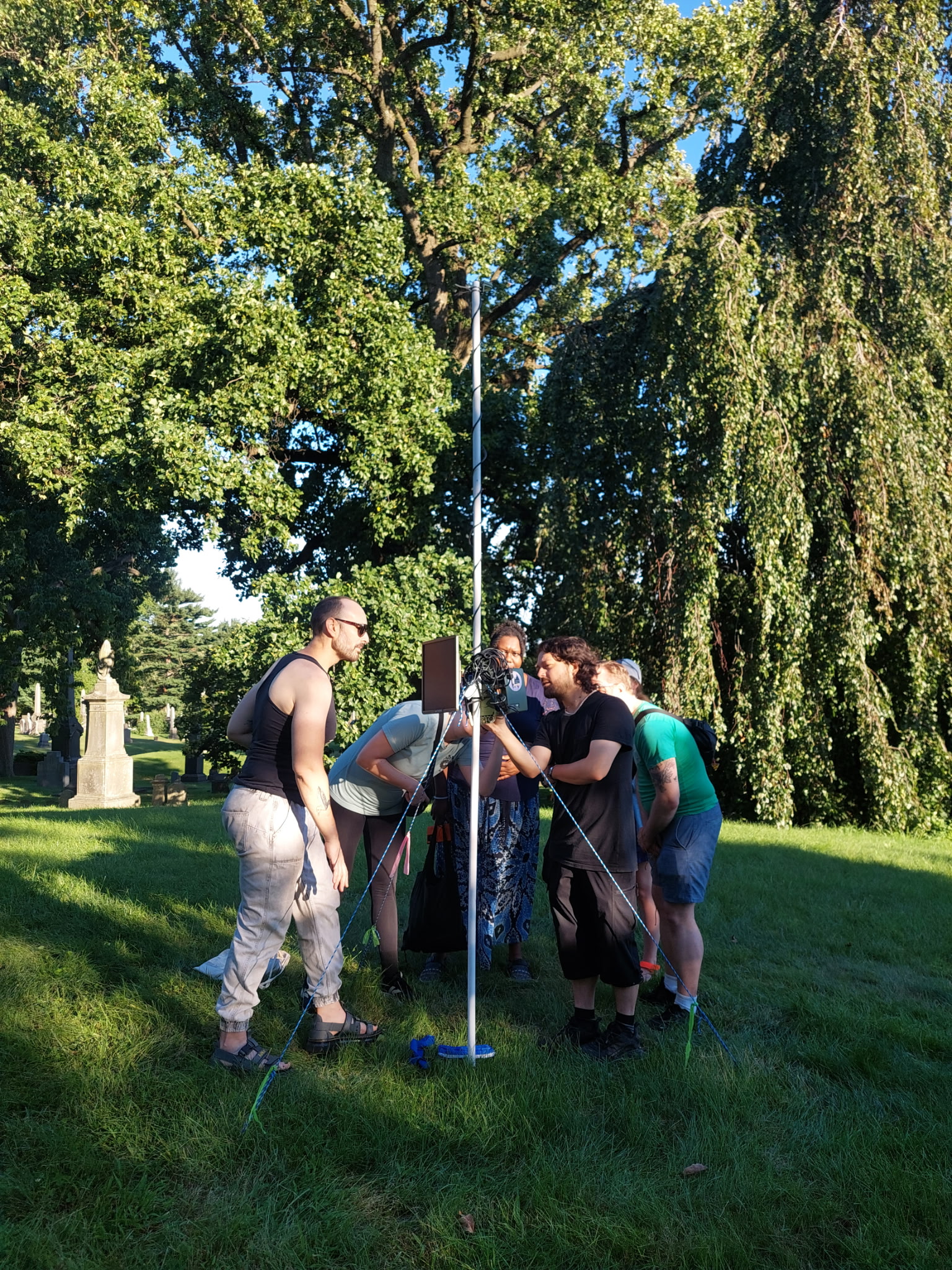
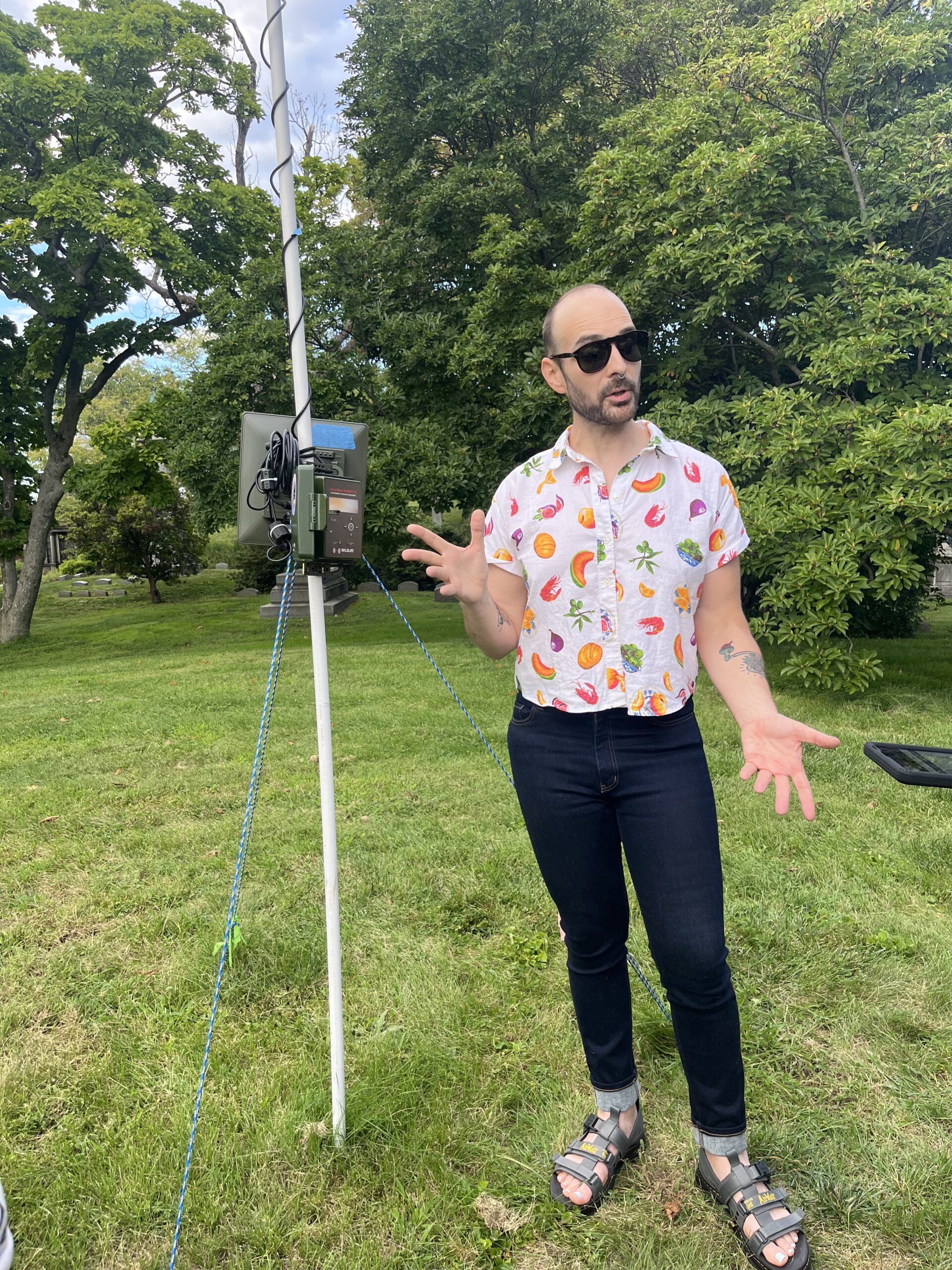
During the Bioacoustic Training Session, it’s made clear that Comparato’s volunteers have three simple, but critical, tasks. Firstly, to ensure that the bat rods remain upright (the microphone must stay elevated off the ground in order to capture the highest quality of sonar waves); secondly, to transfer data off of the memory card (routine check-ups and downloads off of these devices keeps the research tight); and thirdly, to master a half-hitch knot that’s used to keep the rod taut. “The faster I know [a microphone is no longer elevated], the quicker I can get out and stop losing data,” explains Comparato, adding that a week’s worth of data in peak bat season can range from 5,000-6,000 recordings.
The greatest challenge for Comparato’s research expansion is finding secure and trusted places to add additional bioacoustic rods around the city. “Parks that are kind of further off the beaten path, parks that are along the coast is something I’d like to get into more.” And although most of the city’s bats are migratory and will therefore head south as the temperatures continue to drop, Comparato will leave the detectors up over the winter season, given the influx of volunteer interest. “Classically we didn’t really think that bats were active in the winter. We’re learning that they are, just not a lot.”
That night, after the volunteer session ended, Urban Bat Project NYC partnered with Queer Walks and Hikes to host their final, largest, and briefest bat walk of 2026 in Prospect Park. Between 300 and 600 eager bat enthusiasts arrived ready for the hike before the NYPD arrived to break up the massive horde mid-walk. There’s a sense that this type of dedicated attention to bats may help make serious strides for their advocacy, and beyond that, the interest in these flying mammals is bringing young people together for a wholesome activity in a way that little else can.
Future bat walks with Urban Bats NYC will be planned for spring 2027. In the meantime, you can keep in the loop for future bat walks and volunteer opportunities through their website www.urbanbatsnyc.com.
News from the neighborhood.
Red Hook & Gowanus
Want more news and features like this straight to your inbox? Subscribe to our newsletter below.
Author

Discover more from Red Hook Star-Revue
Subscribe to get the latest posts sent to your email.