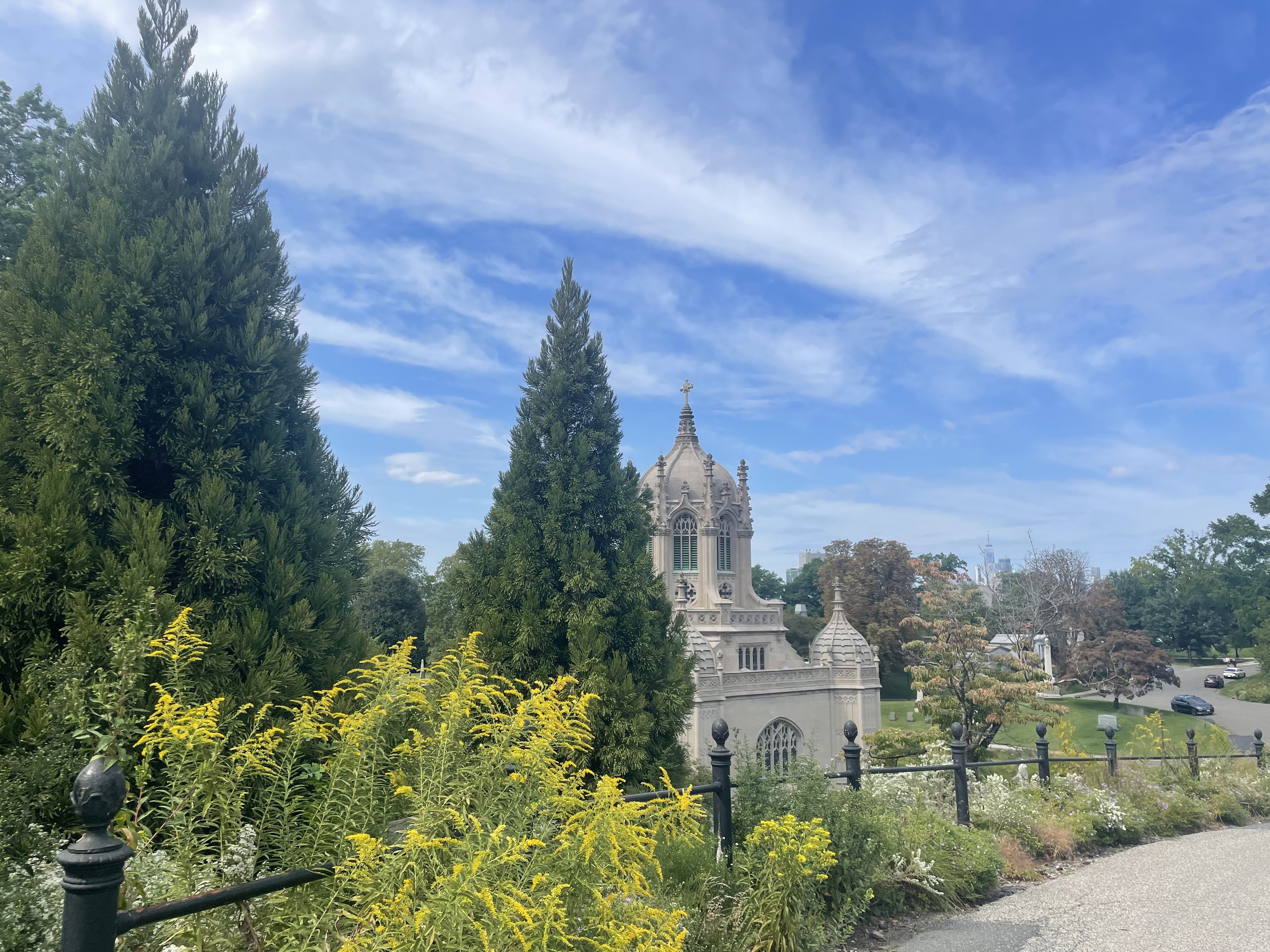
On a Friday in September, walking into Green-Wood Cemetery felt like the precise beginning of fall. I heard what I assumed were ravens squawking in the belltower of the Gothic archway—until I saw lime-green and realized they were parakeets. This was the first sign the cemetery wasn’t what I’d expected. The second came when I heard cheers and the beginning of the Talking Heads’ “Burning Down the House.” It was the beginning of “Grief Karaoke,” where people were invited to perform songs that reminded them of loved ones lost.
From Sept. 18 to 20, Green-Wood Cemetery organized a weekend dubbed “Mortal Matters,” three days of free public programming that brought together artists and experts from the fields of physics, ecology, history, and more to discuss grief and mortality from wildly different vantage points. Offerings included guided walks and trolley tours; lectures exploring the biology of grief and death; and presentations and workshops from artists concerned with remembrance.
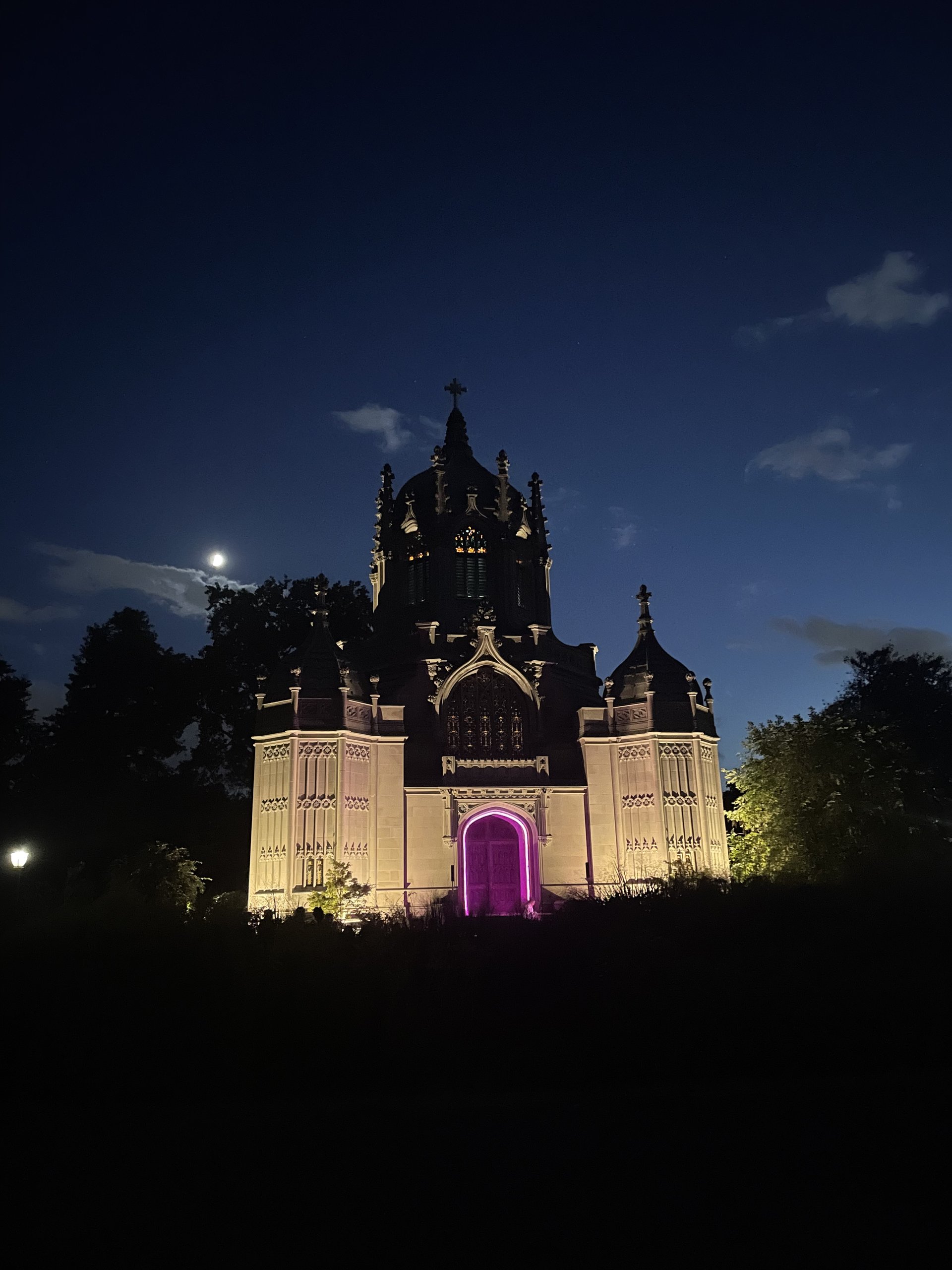
Green-Wood Cemetery was founded in 1838 during the rural cemeteries movement, which sought to redesign burial grounds as parks in response to overcrowded urban graveyards. Ever since, the cemetery has been a beacon for tourists and residents in the city, even serving as inspiration for Central Park, which opened 20 years later. Green-Wood now hosts tours, concerts, and more. It’s also an active burial site, not just a historic cemetery—about a dozen people are cremated every day, and in 2027, terramation, a form of natural burial legalized in New York State in 2022, will be offered.
I had been to Green-Wood before, on walks when I needed a break from the city, or to summer events like the Rooftop Films screening of documentary shorts. I have friends who are practically religious about birding there. But the space essentially serves as a park for all of these activities, so I was curious to see how Green-Wood would engage the public with its primary concern: the end of life.
For a historic institution, Green-Wood has gone through its fair share of change in the past several years. In 2021, it began an Artist-in-Residence program, and in 2025, former Deputy Mayor of Operations Meera Joshi joined as its new president. Since then, Green-Wood has expanded with new hires in its communications, programming, and public history departments.
Daniela Ochoa-Bravo, manager of communications, told me “it feels like there’s finally the infrastructure to bring a lot of our ideas to life.” A key part of that infrastructure is the Green-House at Green-Wood, a visitor center that opened in April. Another seems to be the collaboration with the Simons Foundation, a philanthropic organization that has provided funding to the cemetery to support public engagement with science.
Considering its biodiversity alone, it’s easy to see why the Simons Foundation chose Green-Wood to promote science education. As Harry Weil, vice-president of education and programming, put it in a lecture introduction, the place is “so active and so alive.” Along the paths, I spotted lizards and groundhogs, and Jia Sung, current artist-in-residence, told me she finds inspiration just walking around her studio in the cemetery’s Fort Hamilton Gatehouse.
The Simons Foundation worked with Green-Wood on its partial Solar Eclipse party in 2024, and on MoonFest last May, an evening dedicated to all things lunar. But this weekend’s programming challenged Green-Wood, non-sectarian from its beginning, to work through the question of “how to memorialize things that feel so far out of reach,” as Weil put it, by connecting the personal experience of loss with concrete ideas of science.
One might guess that visitors would be more drawn to movies and stargazing in Green-Wood than to discussing something many of us notoriously hate to dwell on. But people showed.
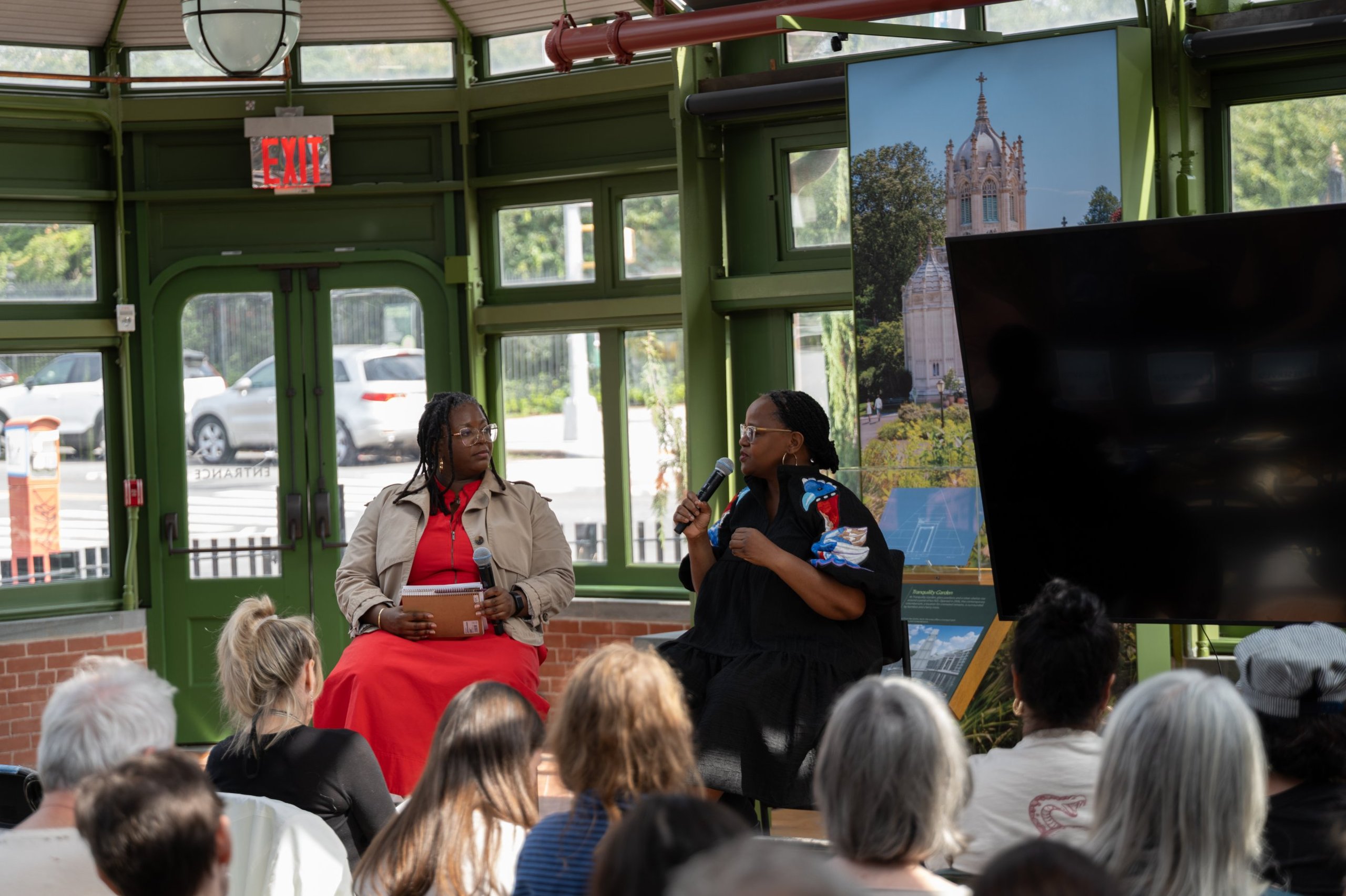
I nearly didn’t snag a seat at a talk in the Green-House with Edwidge Danticat. Danticat was there to discuss her novel, Dèy, long-listed for the National Book Award, which takes its title from the Haitian Creole word for mourning. She spoke about grief and connections that span time and place. Her conversation partner, physicist LaToya Anderson, responded with an explanation of quantum entanglement: when the measurement of one particle affects that of another, even if they’re a great distance apart. As the conversation shifted towards ritual, I watched through the window as a truck drove up the entrance, its bed overflowing with pink and orange flowers.
The weekend could get away with unlikely pairings because when a cemetery talks about these big questions, it isn’t really in the abstract. It all coalesces around the physical space of Green-Wood.
Gabrielle Gatto, manager of public programs, said about the cemetery’s aspirations: “We’re trying to recenter and really remember: why did Green-Wood open in 1838? To be a place to remember and a place to gather. So using that to think forward, it’s a no-brainer to always help people metabolize death, dying, grief, and loss, while also really enjoying their lives.”
On Sunday, I boarded a green trolley for a tour. It felt like an uncanny Disney World: a city with street names like Linden Ave, nostalgic old transit, and no residents.
My guide shared that Green-Wood initially had two entrances, one for mourners and one for visitors. The leisure and loss were kept separate. It wasn’t until the surrounding neighborhood developed in the mid-19th century that Green-Wood constructed the Gothic arch to define its presence more formally.
Now, it is making an even bigger welcome with its center across the street: the Green-House. The focal point is the restored green iron frame of the Weir flower shop from the 1880s, complete with a copper and wire replica of the original sign, and a detailed map of the Green-Wood grounds on the floor. The greenhouse is nestled into an L-shaped modern building of red panels, which houses galleries, classrooms, archives, and offices.
The Green-House preserves more than just the old sign. Historically, New Yorkers stopped at the shop before walking up 25th Street, preparing to visit and mourn. The Weir shop was one of several storefronts making up a floral row between 24th and 26th Streets in the late 19th century, as florists and stoneworkers operated around the cemetery. Nowadays, besides the flowers sold in the new Green-House there’s only one florist (over by the Fort Hamilton entrance) within a block of Green-Wood’s borders.
Around the cemetery, greeters were friendly and warm. One high school student said she was volunteering at Green-Wood after taking an elective on how we think about death, immediately qualifying: “not as emo as it sounds.” This was also the wording I’d used when I’d left my friends that Friday afternoon. Talking about grief for a weekend is, undeniably, heavy. But not necessarily morose.
“We really do see it as an invitation,” Gatto said when I asked how the team balances what the cemetery calls “death education”—resources that promote conversations about mortality and span everything from child bereavement groups to funeral services—and other public programming, say, a birding tour. “We could be a bright spot in your day, week, year, but we’ll also be here on the other side of things for you as well.”
The weekend ended, and I never wanted to think about death or loss or burial ever again. But I feel grateful to know that, when I inevitably do, Green-Wood will be there. And in the meantime, I’ll visit to marvel at parrots, wildflowers, and all the very rich life around me.
New Yorkers interested in more free programming at Green-Wood can attend artist Laura Anderson Barbata’s Reposo y Recuerdo, an installation from Oct. 9 through Nov. 15 that will decorate the Historic Chapel, as well as a Día de Muertos celebration on Nov. 2.
News from the neighborhood.
Red Hook & Gowanus
Want more news and features like this straight to your inbox? Subscribe to our newsletter below.
Author

Discover more from Red Hook Star-Revue
Subscribe to get the latest posts sent to your email.