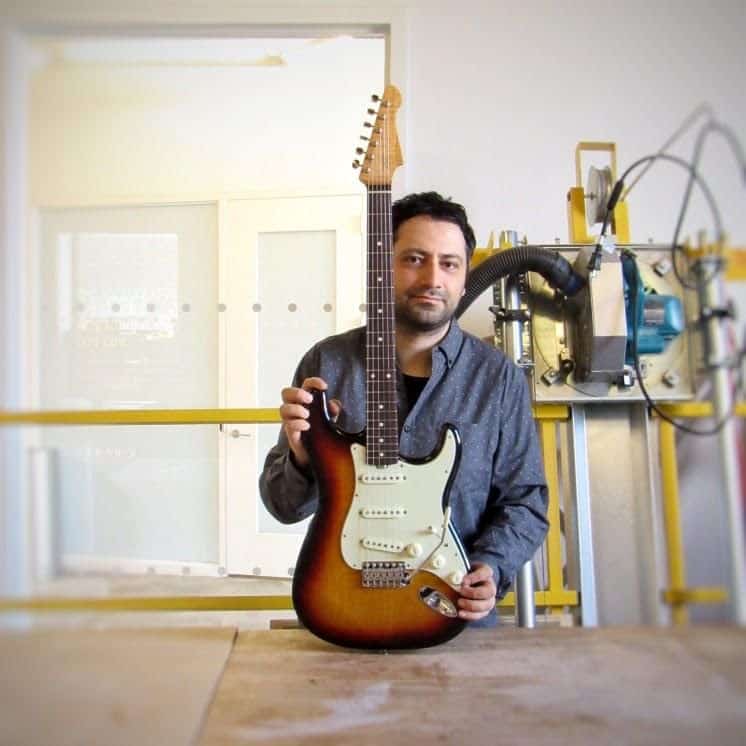
Of course, everything’s different now due to the COVID-19 pandemic. So instead of walking over to the shop, I called Farhad Soheili, owner and founder of F.S. Lutherie in Brooklyn. F.S. Lutherie is a custom guitar maker and guitar repair workshop started by Farhad. Originally from Los Angeles, he has spent the past two decades repairing, restoring, and building custom-made guitars, first out west and now in New York City.
“Did you come from a family of luthiers?” I asked.
“Actually, I started doing repairs as a kid,” said Farhad. “I used to go to the guitar repair shops. I was so young my mom had to drive me. I asked a ton of questions. I watched everyone and learned as much as I could.” At that time, he learned how to do guitar setups and make string nuts and began to grasp the fundamentals of basic wiring. By twenty, he began doing his own guitar work.
Then, in 2007, Farhad moved to New York City, hoping to be a session musician. But what he found was that his true passion was making and repairing guitars, not gigging.
“Do you focus only on electric guitars?” I asked.
“I custom-make only electric guitars, but I repair acoustic guitars as well. I used to do violin and other string instrument repairs, but now I just focus on guitars.”
“Who are some of your favorite luthiers?” I asked.
Farhad said he was inspired by the work of Ken Parker, Ric McCurdy, and Dan Erelwine. He watches their online videos and sees them at luthier conferences and shows. “You can never stop learning in our work,” he added.
“How has the coronavirus impacted your business?”
“I’m not accepting new repairs now. I’m only working on things that were in the queue. Custom guitars take months to build.”
“When did that start?”
“Well, in January and February, business was booming. Then, in the first days of March things started to change.” He explained that on about March 12, the public awareness of the virus slowly altered his behavior and the behavior of customers. It was a daily evolution.
He began disinfecting guitars both received and prepped for pickup. Then some people, particularly older customers, or people with health conditions, didn’t want to risk coming in. Then his woodshop closed. Eventually he had to tell customers who had ordered custom made guitars that all work would go on a pause. “They were all really understanding,” he noted. “Like we were all in it together.”
“When do you see yourself opening?”
He said that maybe they can consider opening again in May. “I’ve always done everything by appointment. But now we could do something like scheduling a pickup or drop-off at the entrance downstairs. We can coordinate everything via email and phone. Customers could make payments electronically.”
Farhad explained how interconnected his business is with other small businesses. “When musicians have gigs, they need guitar setup, repairs. Not to mention all the workers that are involved in guitar production. People who paint the guitars, the companies that supply wood. The occasional skilled help I hire. As mentioned, even the woodshop where I do the wood cutting is closed. So many people are affected.”
“How do you see this impacting you for the next few months?”
“A luthier’s work is reliant on other people having jobs and a good economy. If musicians aren’t working, there isn’t as much regular work. Not to mention that a custom guitar is a luxury spend. It’s certainly not a priority. I see custom guitar work on a lull at least until the end of 2020.”
“Do you see yourself needing to change what you do?”
“No,” said Farhad. “I’m a luthier. It’s what I do. It’s what I love. And my health hasn’t been affected, thankfully. When this tragedy comes to an end, I’ll resume the custom guitar making and repair work I’ve done. Despite the long-term impact on small businesses and people’s lives, we’ll all have to get back to work. Get back to our lives.”
Then he paused, let out a sigh. “I’m really looking forward to that.”
Author

Discover more from Red Hook Star-Revue
Subscribe to get the latest posts sent to your email.