
If one could go back in time and visit Red Hook in the 1940s, one would, at about 4:30 am, find a scene of desperation on its crowded waterfront.
 Days began with “longshoremen huddling in doorways in rain and snow on Columbia Street facing the piers, waiting for the hiring boss, on whose arrival they surged forward and formed up in a semicircle to attract his pointing finger and the numbered brass checks that guaranteed a job for the day. After distributing the checks to his favorites, who had quietly paid him off, the boss often found a couple left over and in his generosity tossed them into the air over the little crowd. In a frantic scramble, the men would tear at each other’s hands, sometimes getting into bad fights.”
This description comes from the autobiography Timebends by Arthur Miller, who as a young playwright became intrigued by the real-life story of Pete Panto, a dockworker and union activist whose body ended up in a ditch in New Jersey after he led an unsuccessful revolt against the mafiosos controlling the Brooklyn waterfront. A few years later, Miller visited Red Hook and witnessed the grim resignation of the International Longshoremen’s Association (ILA) workers who, for a chance to earn their daily bread, had no choice but to offer the local gangsters kickbacks.“It was as though they had lost the mere awareness of hope,” Miller wrote.
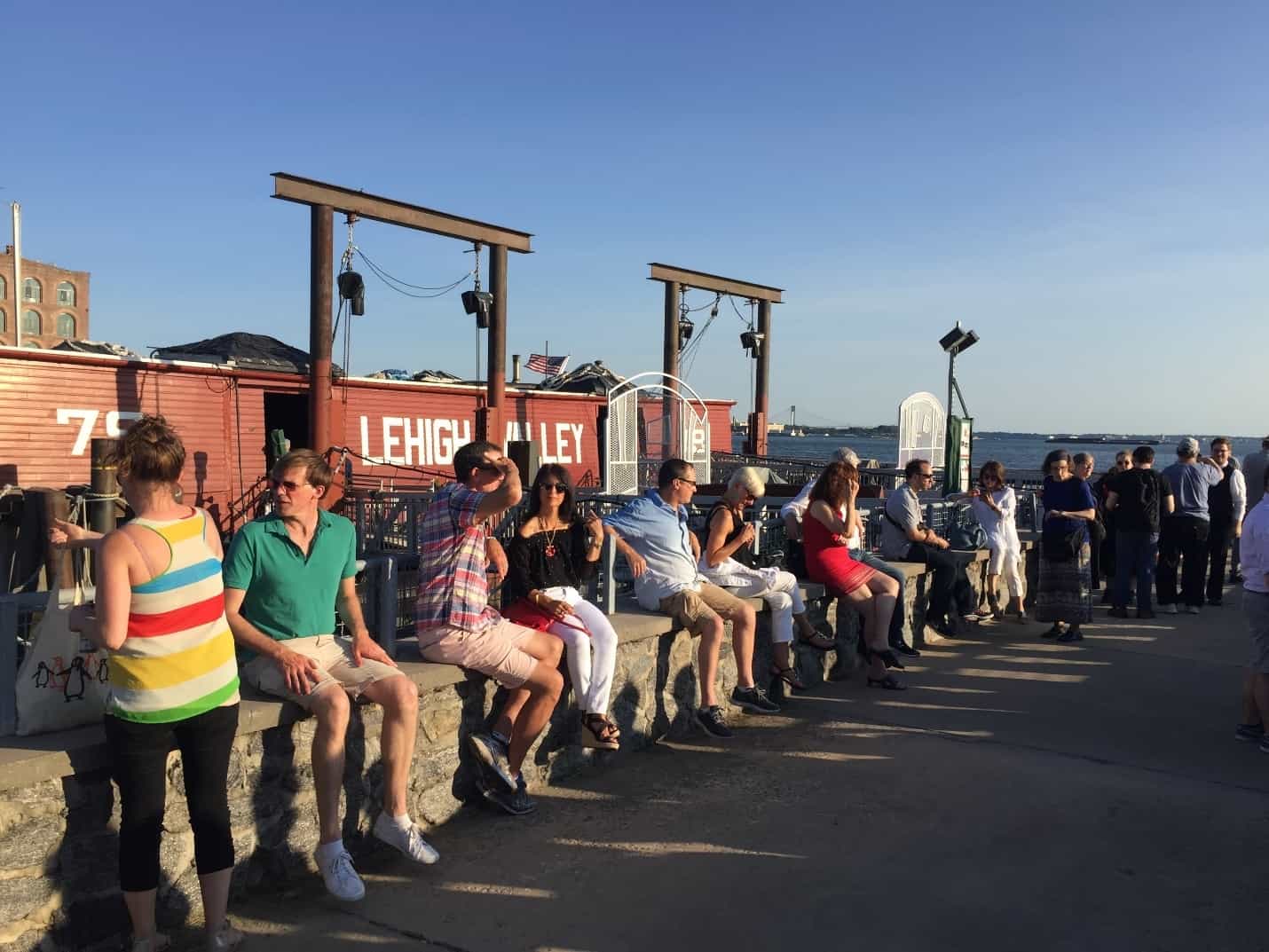
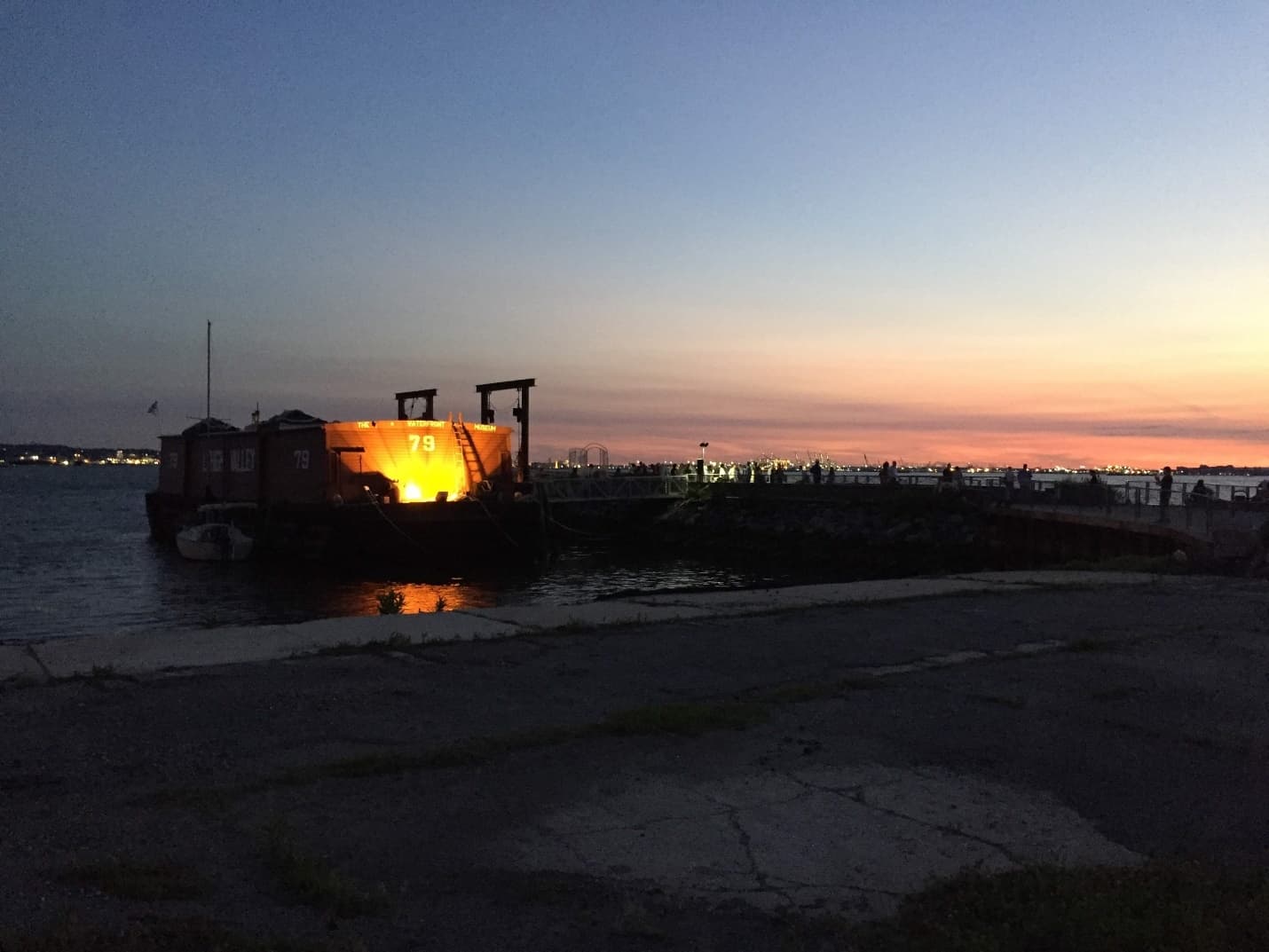
On June 22 and 23, this scene played out again on Pier 44 during Brave New World’s sold-out performances of The Hook, an unproduced 1949 screenplay by Miller whose story of a Panto-like figure subsequently unfolded, in a theatrical version by Ron Hutchinson, aboard the Waterfront Barge Museum, a circa-1914 vessel that has docked in Red Hook since 1994.
Miller came of age during the Great Depression, which produced a new brand of populist, left-wing dramaturgy by New York’s Group Theatre and the New Deal’s Federal Theatre Project. Inspired by the social realism of Clifford Odets, Miller brought new depth and artistry to the agitprop of the 1930s stage, becoming the American theater’s bard of the common man in the following decade with All My Sons and Death of a Salesman. He wrote The Hook in the same period.
Six decades later, productions of Death of a Salesman continue to fill community theaters across the country, but since the playwright died in 2005, it’s not every day that one gets to see the U.S. premiere of an Arthur Miller script. That’s what happened last month, however, when Brave New World imported Hutchinson’s adaptation from the UK (where it first played in Northampton in 2015) for a series of staged readings. The company’s full production will take place in 2020 in the same spot, but already the expressive cast rarely had to look down for lines.
The Hook brings to life an expansive New York landscape of hopeful immigrant families, greedy kingpins, guilt-ridden henchmen, defiant heroes, forlorn cowards, and everyone caught in between. Miller finds color, wit, and even poetry in the tough language of working men. His villain is a thin caricature, but his protagonist carries an almost mythic aura.
Driven to fight the corruption on the waterfront by an internal force incomprehensible to himself, the longshoreman Marty Ferrara would rather leave the docks behind than organize them, but a fire in his gut forces him to put his life on the line for dignity and justice. Not much given to speechifying, he experiences his own morality primarily as rage.
At the Waterfront Barge, Ferrara’s Red Hook blends into ours. Audience members may be of one mind or another regarding site-specific theater: I once saw a performance of Macbeth amid wind and fog in an abandoned seacoast fortification beneath the Golden Gate Bridge, but the immersive character of the production, which shuffled from one room to another within the atmospherically desolate military structure, didn’t necessarily empower the material. Some playgoers may argue that any reminder of the outside world functions as a diminishment of the play’s interior world.
For others, the creative use of a relevant location as a non-traditional stage may draw out new resonances from a work of theater. It’s hard to imagine a more appropriate site for The Hook than the preserved maritime landscape of Red Hook’s shoreline. The actors in their newsboy caps and suspenders seemed to enjoy yanking ropes, and hauling sacks as waves occasionally shook the Lehigh Valley Barge Number 79.
I wish Brave New World well as the talented company continues to develop The Hook, but someday I’d also like to see the movie that Miller originally intended. On the stage, one can sense the set pieces that have gone missing owing to its constraints: a deadly workplace accident, a large-scale labor strike.
Reportedly, Miller traveled to Los Angeles in 1950 with Elia Kazan, his prospective director, to pitch his screenplay to Harry Cohn, the president of Columbia Pictures. After a meeting with a Hollywood union boss, Cohn asked Miller to revise his script to change the bad guys from racketeers to communists. Miller refused. (In The Hook, it’s precisely the ILA’s collusion with the capitalists – the ship owners – that defines its failure in its gangster incarnation.)
Returning to Broadway, Miller would earn his only original screenplay credit in 1961 when he penned John Huston’s raw, doomy masterpiece The Misfits. Meanwhile, Kazan held onto Miller’s earlier story idea and hired Budd Schulberg to redevelop it into the Marlon Brando classic On the Waterfront (1954), which moved the action to Hoboken. Ultimately, Miller’s pro-worker screed became a reactionary, self-justifying allegory for a filmmaker who, by then, had ratted out his leftist colleagues to the House Un-American Activities Committee.
Miller would symbolically condemn Kazan’s testimony in 1955 in A View from the Bridge, another drama set in Red Hook. But despite its director’s political infamy, On the Waterfront’s portrait of the mobbed-up Port of New York and New Jersey of the 20th century has become legendary.
In reality, the ILA wasn’t the only labor union whose rank-and-file suffered when parasitic thugs invaded its leadership positions, but the others didn’t get the Hollywood treatment. In 1952, state and federal officials created the Waterfront Commission of New York Harbor to root out corruption, and today, ILA Local 1814 continues to represent the workers at the Red Hook Container Terminal.
On the Waterfront diagnoses more or less the same social problem as The Hook: criminals controlling the union. In the former, their sin is murder; in the latter, it’s oppression. Only The Hook hints at a vision of liberation for the workers, who demand democratic control of their workplace. Unfortunately, their courage fails them in the end.
Some theatergoers may mistakenly regard The Hook’s attitude as anti-union. But in fact, Miller’s recognition of the vital importance of strong labor unions motivates the work’s condemnation of their corrupted iteration. He’d like to see them reformed but fears the worst. The beaten-down workers manage only spurts of revolutionary spirit; otherwise, they settle for half-measures. Their main concern is keeping their jobs, whatever the conditions. It remains a pertinent warning.
Last year, Brave New World staged Miller’s A View from the Bridge at the Waterfront Barge Museum. The production returns for 12 more performances on September 12, 2019.
Brett Yates is a staff writer at The Red Hook Star-Revue.
Author

Discover more from Red Hook Star-Revue
Subscribe to get the latest posts sent to your email.
One Comment
A well-deserved write-up of Brave New World’s production of The Hook, which was quite an achievement. Although the article accepts Miller’s account of the genesis of On The Waterfront (it actually began life as a movie about NY Sun reporter Mike Johnson’s “Waterfront Jungle”), it digs deep enough to try imagine the hard world that inspired these memorable works of protest by Miller, Kazan, Schulberg and others. Good for the Star-Revue.