“This road was a mistake 70 years ago. You’re perpetuating a mistake,” said one Brooklyn resident, glaring at the BQE Central diagram and the New York City Department of Transportation employee behind it. “The impact on the people who live here … It’s whole childhoods you’re ruining.”
That was a recurring sentiment at the first in-person info session for the BQE Central Project, the DOT’s long-awaited $4-billion plan to repair the triple cantilever highway that cuts through Brooklyn Heights and Downtown Brooklyn. Held late last month, the session brought a packed crowd to Borough Hall to hear about the project, as well as confront the politicians and DOT employees charged with making it happen.
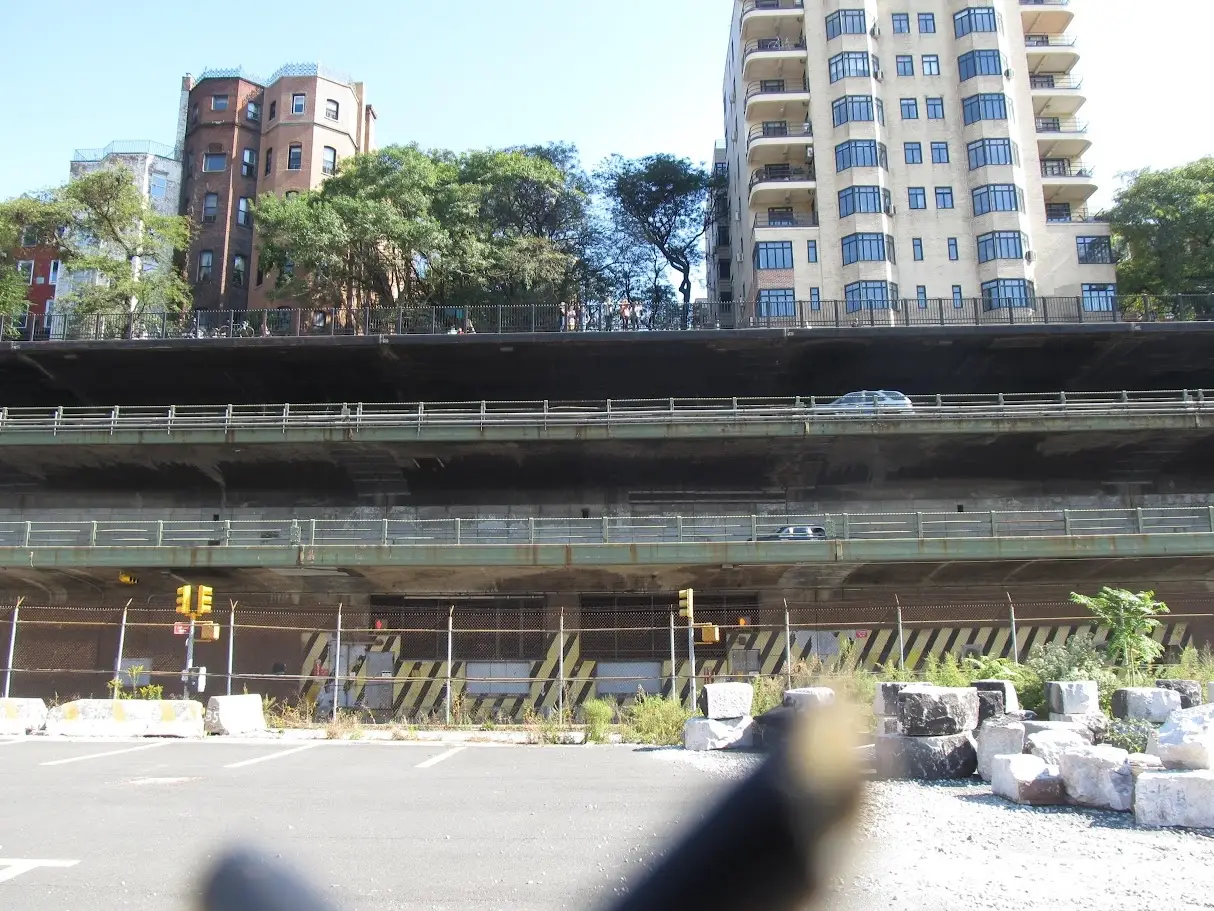
The BQE Central Project will involve building a temporary double-decker “bypass” highway next to the existing structure. This proposed bypass travels along Furman Street until it curves at the river, at which point the Queens-bound level rises to pass over the Brooklyn Bridge approach. Once built, the bypass will carry all of BQE Central’s traffic (about 130,000 vehicles daily) so repairs can begin on the existing highway. The project is expected to take about 11 years, ending in 2040.
The DOT says that construction could “affect [street] traffic, parking, noise, air quality, sidewalks, bike routes, parks, views, and access” to areas like the Brooklyn Heights Promenade. The bypass will also loom over Squibb and Hillside Dog Park, and require a complete overhaul of both the Columbia Heights Bridge and Henry Chapin Playground.
DOT Commissioner Mike Flynn called this plan “the only feasible choice.” But no one seems happy with it, from the impacted citizens, to Mayor Zohran Mamdani, to Flynn himself. It has resulted in anger across Brooklyn, as residents both local and remote push back against a project they feel destroys more than it repairs.
Several local politicians spoke at the info session. But instead of trying to sell the proposed plan to the attendees—as would typically be the goal of official events like this—they went the opposite route, with Councilmember Lincoln Restler describing the project as “a bad option,” and admitting that he doesn’t think “anybody likes what the administration has put forward.”
“We have just as many concerns as you do,” said State Sen. Andrew Gounardes. Assemblymember Jo Anne Simon added that she is “convinced that there’s a better way.” When asked, however, the same politicians couldn’t articulate what those better ways might be, with Restler and Simon both saying their offices don’t have the engineering expertise to come up with plans of their own.
The info session proper didn’t reveal anything that the DOT hadn’t already made public. DOT Chief Strategy Officer Tiffany-Ann Taylor explained the project, its proposed scope, and its timeline, while the audience groaned or grumbled under their breath.
It was when the speeches ended that sparks truly flew. The audience, encouraged to file around the room and talk to the various DOT officials in attendance, took the opportunity to vent all the anger they’d been holding in since the Project’s first announcement.
“We came to a meeting before and there were these different ideas put up,” one attendee told Hilary Semel, Director of the Mayor’s Office of Environmental Coordination. “And then we come back and the worst idea of all of them is the one we’re looking at.”
Worse than the devil
“It’ll destroy our way of life,” said Migdalia Cruz, an attendee who lives on Furman Street. She described the existing structure as a “nightmare,” and claimed the bypass will sit only a few feet away from her window. When asked what she’d prefer, Cruz advocated for putting BQE Central underground, similar to the “Big Dig” in Boston. “I want to see it disappear. I don’t want to look at it. I don’t want to see it. I don’t want to smell it.”
Many of the most passionate attendees flocked to William Ullom, a deputy director at DOT. Over the course of the hour, he defended the DOT’s plan with Spartan resolve, trying to keep calm under a barrage of angry comments. After an attendee insisted the BQE doesn’t need repairs, he explained that “it’s structurally at a point where if we don’t do that … no one will be able to go on it and it might collapse.”
Eventually, Ullom lifted his enlarged diagram of the bypass high into the air, so the crowd gathered around could all see it. It didn’t pacify them.
On the other side of the room, attendees drilled Albert Silvestri, DOT’s director of community and intergovernmental affairs, over a giant 3D model of the bypass.
“Why is this taking so long?” asked John Leyva, vice president of the Columbia Street Waterfront Association. “I’ve seen whole highways get built during this time.”
Next to him, a Hicks Street resident spat, “Because nobody knows what the hell they’re doing.”
The event ended with DOT employees reading the questions they received, some of which went unanswered, and some of which received responses from Taylor, Semel, and Flynn—the last of whom was a surprise guest. Flynn tried to assure the crowd that the DOT is listening, and despite these detailed plans, nothing is set in stone yet. “Any and all ideas are on the table,” he said. “We just need to find things that are feasible. So, the bypass, that’s a starting point.”
Members of the public were encouraged to submit ideas via post, email, or an online comment form. But attending officials couldn’t clearly explain how submissions are evaluated, or what the chances of switching to a new plan this far in might be.
And when DOT officials announced that there would be another public hearing on Nov. 10, it only seemed to incite the crowd more. To the citizens who’d made the trip to Borough Hall, it sounded like another case of politicians kicking the BQE can farther down the road.
“That’s not an opportunity, it’s a sidetrack,” said the Hicks Street resident. “We don’t trust this process at all anymore. It’s bullshit.”
Residents are angry, but they’re also exhausted. They want the project done quickly, but they don’t actually want it to start and disrupt the neighborhood with noise and air pollution. The triple cantilever’s crumbling facade has hung in their minds for too long. It’s a smoggy concrete albatross.
“I attended a meeting in 1999 about this,” Sidney Meyer, Brooklyn Community Board 2’s Transportation & Public Safety Chair, told Ullom at one point. “I want to live long enough to see the BQE repaired.”
“If you live until 2040,” Ullom replied, “you’ll see it.”
“Well, I’ll be 100 at that point.”
“I wish you the best of luck at making that.”
Author

Discover more from Red Hook Star-Revue
Subscribe to get the latest posts sent to your email.