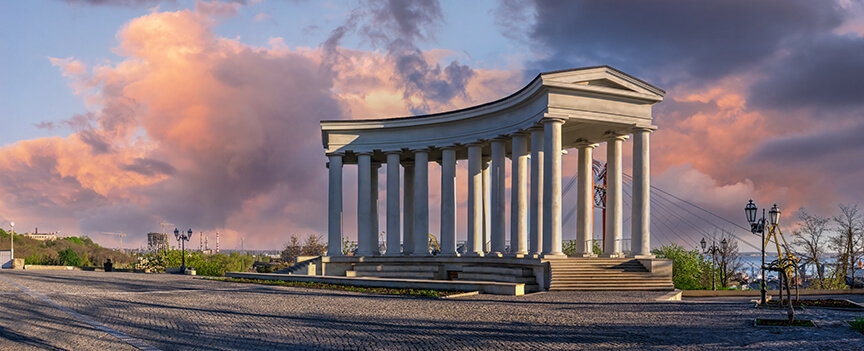
On October 21st, almost 150 (mostly Ukrainian) intellectuals signed an open letter to Unesco encouraging the international organization to ask President Zelensky to defer some decisions about Odessa’s World Heritage sites until the end of the war.
Odessa, in southern Ukraine, is a multicultural city with a strong Russian-speaking component. There has been pressure to remove historical sites connected to Russian, for obvious reasons. Other measures directed against the memory of historic Russian Odessans sparked outrage. People such as Ivan Bunin, an anti-Soviet Nobel laureate; Konstantin Paustovsky, a writer who refused to be a member of the Communist Party; Alexander Pushkin who was exiled to Odesa for anti-tsarist activities; and Odesa’s most famous writer Isaac Babel who perished in Stalin’s purges.
‘Odessa is the most European and international city of Ukraine, built by Ukrainians, Italians, Greeks, French, Austro-Hungarians, and also Russians,’ says Ugo Poletti, an Italian entrepreneur who is also a signatory of the letter and the editor of the second largest English newspaper of the country, The Odessa Journal. ‘The 2023 law on decolonization, passed by the Ukrainian Parliament, promoted an extensive derussification of landmarks and toponyms, creating huge problems in Odessa. The prevailing governmental attitude is to deny everything that happened before the independence of the country. It is a top-down policy which lacks community input.
In Odessa a large majority of citizens who speak Russian has historically been deeply tied to its heritage. Nevertheless, the population cohesively condemned Russian invasion in 2022, and thousands of Russian-speaking Odessans currently serve in the Ukrainian Army. When the war will end, the danger is that these people will feel betrayed and humiliated by a policy preventing them from living their culture and language.
In other words, the danger behind the derussification process is that, as soon as a peace treaty is signed, a civil war may erupt between the Ukrainians, mostly based in the Galicia region, and the Russian Ukrainians of the southern and eastern regions. Similar situations started wars in Yugoslavia and Kosovo as well as, going far back in the past, most national conflicts in Europe in the 19th and 20th centuries.
Civil war?
‘A new social conflict is going to unfold, with the worst case being a civil war,’ says Poletti, ‘Even without a linguistic cleansing Ukrainian would eventually become the prevailing tongue, but today the attitude is too extreme: whoever speaks Russian would be found and opposed.’ A similar denial of protection to bilingualism would hinder Ukraine’s accession to the EU, which considers the guarantee of minority rights as a pillar. Similarly, the specter of political chaos would prevent necessary foreign investment.
Reconstruction is not only an economic challenge but also a political one. Many public officials in Kyiv are influenced by the most nationalist interest groups, ignoring the presence of Russians who account for 22% of the population. That is why, according to Poletti, after the war is ended ‘Zelensky should disappear as Churchill did, preserving his image as the Savior of the Nation, without exploiting that fame to keep power. Lots of Ukrainians are losing confidence in his abilities to govern the country in daily issues: disorganization, corruption and inefficiency are still features of the public administration. Moreover, Zelensky’s public stance is too linked to war rhetoric and people will probably desire an impactful image change.’
Indeed, according to US Gallup’s polls more than half of the Ukrainians (52%) think Kyiv should negotiate a quick end to the conflict, renouncing to the regions under Moscow’s control. After last summer’s military advance failed, there are no sparks of hope to turn the tide of the war.
‘Those who want a negotiate are proud of how Ukraine fought but see how they are losing ground. The minority sees any sort of negotiation as a surrender, they are more radicalized and influential on politics.
Nevertheless, if two years ago speaking about peace was considered treason, today it is normal and allowed,’ argues Poletti, ‘but many corrupt groups advocate a continuation of the conflict for the sake of their own interests. There have been scandals concerned military recruitment officials asking for bribes to ignore potential soldiers. In Odesa some of them have bought houses and apartments worth millions of euros.
What’s next?
Choices about the internal politics of Ukraine will determine its future in the EU and its economic success. Episodes like the ones in Odesa are crucial knots where Ukrainians should determine what kind of future they want. In the country a post-Soviet mindset makes it uneasy to discuss the government’s choices and, indeed, the letter to UNESCO was a big subject of discussion, being one of the first major voices of opposition towards the current Zelensky administration. Nevertheless, according to Poletti, the post-war period could be an occasion for further democratization, as new elections will be held. On the other hand, the derussification did indeed reduce the power of those oligarchs who have long exercised their control over the Parliament. Challenges are numerous, last but not least the new Trump’s administration which is perceived as a total incognita. ‘Kyiv has only contacts with the Democrats, and notably Zelensky refused to prosecute Hunter Biden when asked by Trump during the 2020 campaign. The feeling is that the tycoon will take his revenge,’ states Poletti, who is however confident that the worst won’t happen, ‘nothing of what I said should scare people from supporting the reconstruction in Ukraine both financially and culturally. The population cannot move on alone after the war ends, there is the need for a strong international cooperation fostering growth and peace among the different components of Ukrainian society.’
Author

Discover more from Red Hook Star-Revue
Subscribe to get the latest posts sent to your email.