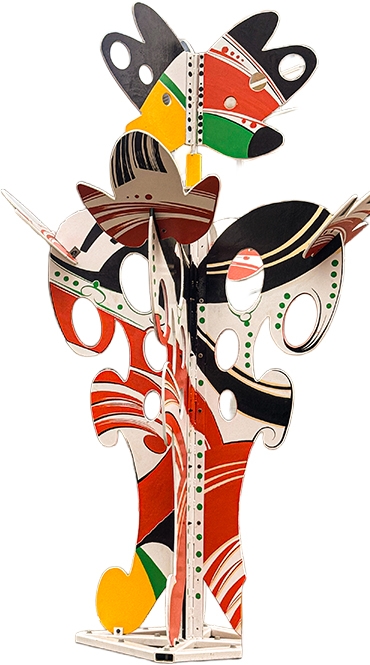
“Hurly Whirly,” a freshly-installed sculpture on 4th Avenue, brings a playful and dynamic energy to Gowanus.
Towering large at 11 feet tall and eight feet wide, the plywood sculpture stands out along the drab strip at the intersection of 2nd Street and 4th Avenue. The piece is composed of three-dimensional cut-outs, perfectly fit together and painted in an eclectic pattern of black, orange, yellow, green, and white. Local artist David Barthold designed the piece as “a riff on the tradition of whimsical roadside art” that is “meant to invoke the same sense of wonder” for pedestrians, bikers, and cars alike.
Appropriately, the sculpture is located kitty-corner to the popular J.J. Byrne Playground, teeming with toddlers and lower-schoolers, and just a few blocks from M.S. 51, a preeminent middle school in Park Slope. Come noon, the park is swarming with children and tweens jumping on play structures or running around a large turf field.
The sculpture embodies this rambunctious energy through its colors, shape, and motion. Just like a pinwheel, the sculpture’s top spins slowly with enough wind, catching the eye of passerbys along the busy avenue.
“People take that stretch of 4th avenue for granted. It’s kind of bland, and there aren’t really improvements, and yet there’s all these crystal palaces going up,” noted Brian Cohen, director of Beam Center, an organization dedicated to helping teens build technical skills through collaborative projects.
In the past 23 years, over 30 new buildings of up to 12 stories have been built along 4th Avenue. Despite the neighborhood’s rezonings, which took place in 2003 and 2021, the landscaping and surrounding design have changed little. The strip, a small median dividing four lanes of car traffic, can feel inhospitable; it is known as a site of deadly vehicular crashes due to its heavy congestion.
“Hurley Whirly” livens up the street while it waits for a larger redesign. As Cohen observed, “One of the beauties of the piece is that it feels impromptu, even though, obviously…it’s not. But in the midst of all of this sort of infrastructural neglect…and this developmental splendor, I think people are just like, ‘that’s cool, that’s a breath of fresh air.’”
The sculpture’s presence also harkens back to the neighborhood’s history as a hub for artists. Gowanus, historically a manufacturing and industrial district of southwest Brooklyn, became a creative corner in the 1990s. It is home to over 400 artists, as well as many studios, collectives, and arts-focused organizations.
In fact, the sculpture was made possible thanks to the support of a collective of local partners promoting the arts: Why Not Art?, Arts Gowanus, Forth on Fourth Ave (FOFA), and Beam Center.
The Gowanus BID Formation Committee, Gowanus Neighborhood Arts Advisory Committee, and the Old Stone House all provided additional support. The NYC Department of Transportation streamlined the permitting process and grants permission through their Art Partners Initiative, a program that works with community organizations to install public art on city land. Participating works can be exhibited for up to 11 months.
Beam Center added an educational component to the artwork, taking on teenage apprentices to help build out the project. Five students worked on fabrication, including sanding, painting, and installing the sculpture on the avenue, while receiving mentorship and experience building other skills like project management. As Cohen noted, “We forget that as a teenager, being able to drill a hole in the ground in the middle of the city, is fairly empowering.”
Although “Hurly Whirly” is temporary, Grace Freedman of Why Not Art? is seeking partner funding to turn the “pilot project into future multi-year public art installations.” According to Cohen, Freedman was responsible for the project’s vision and hopes it will create a preceden for more public art on 4th Avenue.
Participatory Budgeting?
One potential source for funding may be the City Council’s participatory budgeting initiative, which has supported public art projects in the past. The citywide program allows residents of participating council districts to vote on how public money is allocated in their district. The initiative reopens in the fall for idea generation, which could provide more opportunities for 4th Avenue to host artwork.
Author

Discover more from Red Hook Star-Revue
Subscribe to get the latest posts sent to your email.