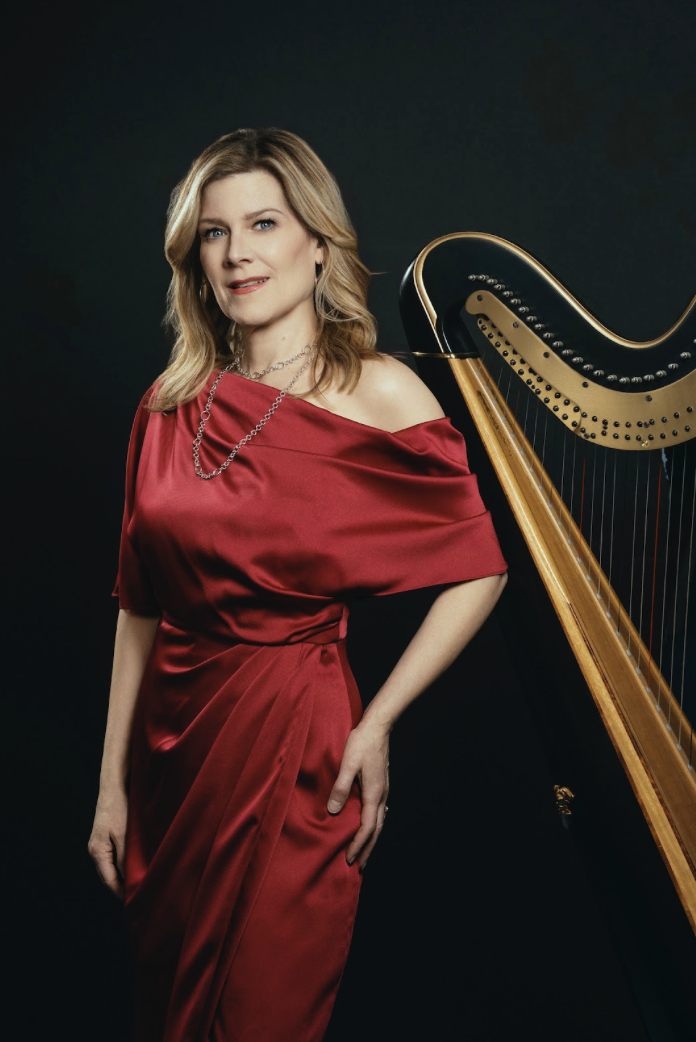
When harpist and composer Kirsten Agresta Copely talks about Kuruvinda, her latest album, she does it with the same focus you hear in the music itself. The record, released August 1, is ten tracks of harp-led meditations that travel from dark corners to moments of calm. It is personal, shaped by reflection, and unafraid to sit with what is imperfect.
“It is about the balance of shadow and light within ourselves,” she told me over the phone from New York City. “Honoring our imperfections.”
Kuruvinda follows her 2023 album Aquamarine, which earned her a Grammy nomination. While Aquamarine was written for her late mother, this new work is about what comes after loss.
Her connection to the harp started early. Growing up in Bloomfield Hills, Michigan, she was surrounded by music thanks to her mother, a pianist and choral conductor who kept the house filled with instruments. At five, Kirsten began studying with a harpist from the Detroit Symphony. By eleven, she was traveling to Indiana University to study with Susann McDonald, one of the world’s leading harpists, who remained her mentor for years.
That training opened the door to a wide range of performance experiences. Kirsten has played at Carnegie Hall, toured with Beyoncé and The Who, recorded for films and television, and performed for President Obama and Queen Rania. She recalls working with Enya during a holiday television special.
“She is very quiet, very gracious. I brought my WatermarkCD to rehearsal and asked her to sign it. She wrote me something in ink. I have been lucky to work with her more than once.”
While rooted in classical training, Kirsten’s work with Kuruvinda takes a distinctly experimental new age approach. Grounded in mindfulness and stillness, she uses the harp to build immersive soundscapes without relying on synthesizers or keyboards. Thunderous low notes swell into breath-like highs, creating an organic depth that feels at once intimate and expansive.
The result is a listening experience that invites reflection, whether during sunrise journaling, a twilight walk, or a quiet drive when the road ahead matches the music’s slow, intentional pace.
Kuruvinda captures the flawed beauty of the human experience. The harp moves between delicate upper-register sighs and deep, resonant lows, creating a sound that feels both intimate and expansive. It is music that refuses to rush, allowing every note to breathe, and in doing so, it mirrors the patience needed to move through grief and self-discovery.
For Kuruvinda, Kirsten wrote much of the music during meditation. Ideas would surface unexpectedly, leading her to the harp to see where they would go. “Not everything I wrote made it onto the album,” she explained. “The arc was important. It starts in shadow, goes deeper, and ends with Santoso, which means contentment.”
The album was recorded entirely with organic instruments. A collaboration with a Turkish clarinetist adds a distinct texture that leans into Eastern scales. Already featured on SiriusXM Spa, Kuruvinda is designed for active listening as much as it is for quiet reflection.
Kirsten hopes the record will help listeners sit with what is imperfect.
Roderick: What do you hope someone feels after listening to Kuruvinda for the first time?
Kirsten: I hope people can embrace their own imperfections and accept them. Whether it is grief, challenges, or just a bad day, if it helps even a little, it is worth it.
Check out Kuruvinda now on music streaming platforms.
Author
Discover more from Red Hook Star-Revue
Subscribe to get the latest posts sent to your email.