For more than a decade, the Democratic establishment has relied on the same warning whenever a progressive candidate threatens its preferred nominee: They are too radical. Too divisive. Their politics might play in a Democratic primary, the argument goes, but they could never survive a general election.
The problem for those still making that argument in 2026 is that Democratic voters don’t seem to believe them anymore.
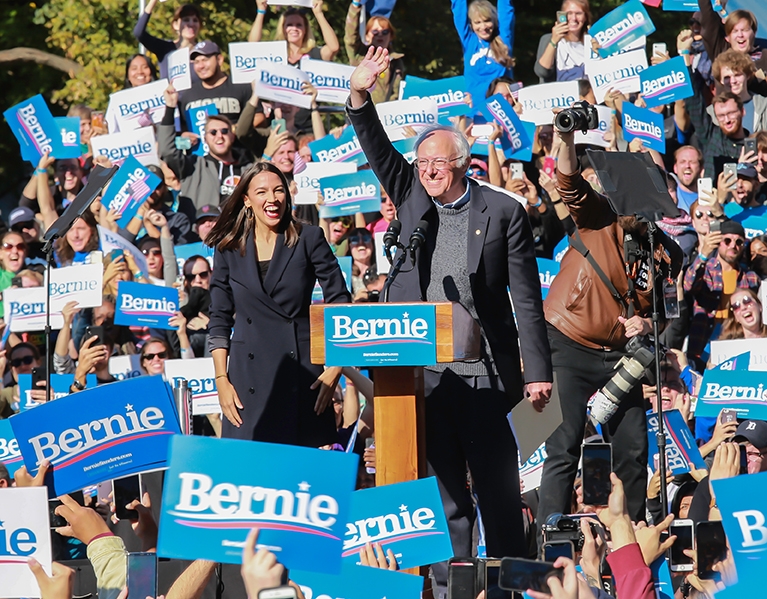
The origins of today’s progressive movement can be traced to Bernie Sanders’ campaign for president in 2016. Sanders, surging in the polls against Hillary Clinton, was portrayed by much of the Democratic establishment and liberal media institutions as an ideological outlier whose politics were incompatible with the values of the national electorate and who they accused of fostering an army of rabid, misogynistic “Bernie-Bros” to attack Clinton.
The playbook proved effective. It helped cut both of Sanders’ presidential campaigns off at the knees and ultimately handed the nominations to moderates Hillary Clinton and Joe Biden.
After Hamas’ October 7, 2023, attack, these attacks on progressive candidates’ character often expanded to include accusations of antisemitism over their positions on the war in Gaza. The American Israel Public Affairs Committee (AIPAC), a major donor to candidates in both parties, spends tens of millions of dollars each cycle attacking prominent critics of Israel, most often progressive Democrats. Their efforts helped to topple two progressive congressmembers in 2024; Cori Bush and Jamal Bowman.
The lesson for the establishment seemed straightforward: With enough money, institutional support and attacks on a candidate’s perceived electability, progressive challengers could be smothered in the cradle.
The new iconoclast
Then came Zohran Mamdani.
In 2025, Andrew Cuomo deployed much of the same playbook against Mamdani in the New York City mayoral primary. Cuomo portrayed Mamdani as dangerously extreme, repeatedly attacked his positions on Israel and accused him of antisemitism. Cuomo came from a political dynasty he had built alongside his father, frequently using racial and sexual divisions to steer voters away from his opponents.
Despite Cuomo throwing every trick and political maneuver learned over a long career at the top of New York’s Democratic establishment at the young assemblyman, Mamdani prevailed. He remains popular in New York City and has flourished into a national political figure. More importantly, he won without significantly moderating the views that made him popular in the first place.
Since Mamdani’s victory, progressive candidates have continued to challenge the assumption that moderation is synonymous with electability. In 2026, progressive insurgents won congressional primaries in Pennsylvania, Colorado, New Jersey and New York. These candidates prevailed despite their opponents receiving significantly more institutional and corporate support and while facing persistent attacks accusing them of extremism and anti-semitism.
Perhaps the most important of these victories came earlier this month in Michigan, where the progressive, Israel critical candidate Abdul El-Sayed overcame a nearly $40 million spending deficit to defeat his establishment-backed opponent, Haley Stevens.
Stevens, who went viral on the campaign trail for her heavy midwestern accent and somewhat odd demeanor, saw her campaign buttressed by over $60 million dollars in outside spending, with more than half of that coming directly from a subsidiary of AIPAC. Her reliance on this corporate PAC money to keep her campaign afloat defanged her and left El-Sayed open to attack Stevens for being too subject to corporate interests.
While the margin of El-Sayed’s victory was narrow, its significance cannot be understated.
A Muslim man who is unabashedly critical of Israel winning a Senate nomination in a state that Trump has carried twice fundamentally changes the political calculus around who—and what kind of positions—are considered electable by Democratic voters.
For a Democratic establishment that has spent the better part of a decade warning that candidates like El-Sayed cannot win in places like Michigan, there could hardly be a more uncomfortable result.
This does not mean America is on the brink of a fundamental social revolution that will usher in guaranteed victories for progressives across the country. On the contrary, El-Sayed faces a difficult general election against Mike Rogers in November.
It does mean that the old assumptions about what makes a Democrat electable are becoming increasingly difficult to defend. Voters struggling to pay rent or afford health care may be less interested in whether a candidate is sufficiently moderate to win a general election than in whether that candidate appears genuinely willing to address the problems affecting their daily lives.
The emerging generation of progressive candidates has also matured considerably from those who challenged the party establishment a decade ago. They have inherited the organizational infrastructure built by two Sanders campaigns, the Democratic Socialists of America, the Working Families Party, Justice Democrats, the Sunrise Movement and dozens of other grassroots organizations. These groups have provided progressives with the infrastructure to communicate directly with voters without relying on traditional party institutions or mainstream political media to validate their campaigns.
Most importantly, they have become more attuned to translating progressive ideology into a political language with broad appeal among both Democrats and independents.
Rather than asking voters to care about abstract ideological concepts—think Biden’s famous “restoring the soul of America” slogan—they talk about rent, health care, wages, child care, groceries, housing and the cost of simply surviving in America today. Their politics are often explicitly progressive, but their message is fundamentally material.
They reject the culture-war issues that have bogged down both progressive and centrist Democrats alike over the last decade.
If El-Sayed and his fellow progressives go on to win their general elections in swing states this November, the argument that a fundamental realignment has occurred within the Democratic party will become even harder to ignore. It would provide perhaps the clearest evidence yet that the politics of Sanders’ insurgent campaigns have matured into something much larger than the candidacy of one Vermont senator ten years ago.
Will the stars align for AOC?
Progressive victories in November would also turn national attention back to New York and to potential presidential contender Alexandria Ocasio-Cortez.
AOC has spent years insisting that she is focused on her work in Congress rather than a presidential campaign. But the political environment around her is changing rapidly. The progressive movement that helped propel her from a little-known Bronx organizer to Congresswoman is now producing victories across the country. NYC-DSA co-chairs Grace Mauser and Gustavo Gordillo have already publicly called for her to run in 2028.
Whether Ocasio-Cortez actually wants the job remains an open question.
A Senate campaign in New York would offer a considerably safer political path. A presidential campaign would mean entering what is sure to be a crowded and fiery primary to become the party’s next leader in the aftermath of Trump’s second term.
But the stars seem to be aligning, and soon the calls for an AOC 2028 campaign may grow too loud for the congresswoman to ignore.
Discover more from Red Hook Star-Revue
Subscribe to get the latest posts sent to your email.