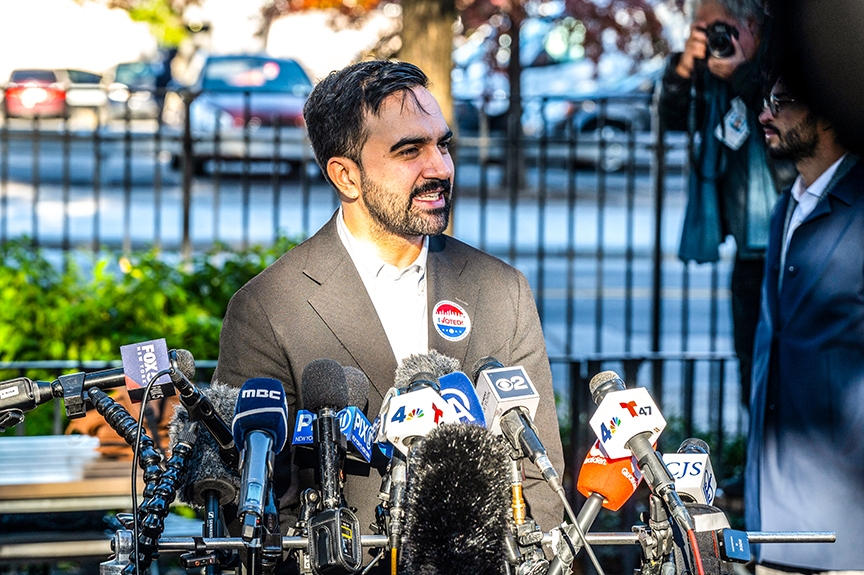
It’s late morning on May 26, and Mayor Zohran Mamdani, standing in front of a posse of New York City media outlets, announces his new “Block by Block” housing plan at Powerhouse Arts in Gowanus. He has just come from a tour of some of the new housing developments popping up along the Gowanus Canal, the same posse of journalists following in his tracks. Camera shutters click, the mayor smiles, the housing advocates who flank him stand quietly, sternly, with their signs.
Probably. Other than the date, location, and Mamdani’s schedule, this is all conjecture based on photos from the press conference. I don’t actually know how it exactly went down, because the Star-Revue—which for over a decade has reported on the Gowanus rezoning, the cleanup of the canal and surrounding properties, and the new developments—wasn’t invited.
This omission of our paper stirred something within me. It wasn’t the first time we hadn’t been invited to one of the mayor’s pressers—getting on his press list is notoriously difficult for community and ethnic media outlets—but this case seemed like one where, had Mamdani’s team just done an iota of research, they’d have found out there is a local paper in the area which has covered the housing issue in South Brooklyn for years.
The Journey begins
It set me on a mission: to get us on that elusive list, and to find out if this was merely an effect of the Mamdani administration’s apparent focus-shift from traditional media to social media and influencers, or if it was a sign of a broader trend in media access to elected officials.
Turns out I wasn’t the only one who’s grappled with these questions: Back in January, an influencer-only summit at City Hall sparked all sorts of pushback from both legacy and community outlets, which questioned the mayor’s “new media” strategy, and Mamdani’s inauguration ceremony was an utter mess for anyone not part of the city’s big media organizations.
A couple of weeks after the inauguration, Taylor Jung, digital producer and reporter at EpicenterNYC, a multi-platform community news organization, put pen to paper, if not purposefully then inadvertently speaking on behalf of all community and ethnic media that for some time now has struggled to get access to the city’s elected officials.
“Yes, it’s savvy of Mamdani to invite influencers into a privileged space to share your political message. Such access has always been a smart comms strategy, and social media can amplify your platform. But wouldn’t it be equally smart if our outlets were centered in announcements such as street redesigns or socioeconomic policies—issues we’ve been covering and living with for years?” she wrote in an article that highlights local media’s continued battle for access.
Part of the issue, in my experience, really does seem to be Mamdani’s media strategy. I have no evidence, but anecdotally, it seems like supporting local and ethnic media isn’t a priority. I, other reporters at the Star-Revue, and even our publisher George Fiala, have tried to get comments from one of the many mayor’s offices, with no response.
In March, URL Media and the Center for Community Media at the Craig Newmark Graduate School of Journalism invited members of hyperlocal, community and ethnic media to meet with Jagpreet Singh, first deputy commissioner at the Mayor’s Office of Mass Engagement (OME), and Samer Nasser, executive director of the Press Credentials Office at the Mayor’s Office of Media and Entertainment (MOME). One of the three discussion topics was “community and ethnic media access to press briefings, press passes, and direct communication channels.”
But the day before, the event was postponed, because Singh had “an unavoidable scheduling conflict.” (Unclear why it couldn’t proceed with Nasser only.) An update on this meeting came in May, but only to announce that no new date had been found. Nothing further has been shared about when the event may take place. (Ed. note: a new tentative date has just been announced).
As those of us chronically online would say: If they wanted to, they would.
Getting on the mayor’s press list—which you must be on in order to receive his daily schedule updates—is, as noted earlier, notoriously challenging. When I spoke to Jung and EpicenterNYC’s Co-founder and Publisher S. Mitra Kalita, Jung said that getting a response from the Mayor’s Office has become a bit of a crowdsourcing exercise.
“A lot of us smaller outlets came together and figured out, ‘Okay, this is who you reach out to,’” she said.
Kalita added that in some cases, longtime sources have been elevated to high-ranking positions under the Mamdani administration, something that has proven useful.
“The people who’ve been in the city and kind of in the guts of how this city works, have been generally pretty helpful,” she said.
Julie Holstein, veteran journalist behind the newsletter Ward 6 Brooklyn, told me she finally got on the press list after “begging for months and radio silence.”
But Jung and Kalita agreed that the issue is broader than the Mamdani administration.
“I feel like this is a perennial issue for small and local outlets: how do you get access to politicians or to certain events?” Jung said.
More difficult than ever
In many ways, it has never been more difficult to access our elected officials. Communications teams are more determined than ever, it seems, to control the narrative, managing outside access and carefully crafting messages from within. But with social media, power balances have shifted; newspapers are no longer necessary for our legislators to spread news of bills they have sponsored, rallies they’re speaking at, or causes they champion.
My “field study,” which has included repeated attempts to establish more frequent and open communication between the Star-Revue and our local electeds, has led me to the (completely unscientific) conclusion—it’s more of a feeling, really—that many nowadays, including our local elected officials and their teams, simply don’t remember that local, old-school, print news can be used to communicate with constituents. (It should be noted that at least some of South Brooklyn’s representatives remain available for quotes—often on short notice; this article deals singularly with communication the other way, i.e. from politician to us.)
I reached out to Council Members Alexa Avilés (District 38) and Shahana Hanif (District 39), along with State Senator Andrew Gounardes.
A visit to Avilés’s office yielded a promise to follow up on my request to be put on her press list, a promise that so far hasn’t been followed through on despite multiple attempts on my end. According to one staff member, however, Avilés doesn’t actually have a “press list.” His understanding was that it was a matter of capacity: the staff doesn’t have time to curate a list of what reporters to invite to the council member’s various outings.
Hanif’s press representative Simone Lavin said over email that she’d include me on the District 39 rep’s press list going forward, but I have not received any event announcements yet.
Aug. 13 update: following publication, Lavin reached out to clarify that no event announcements had gone out to any press since I reached out, and that rallies and events become less frequent for council members and other local electeds during the summer months. She also invited the paper to a rally co-organized by Hanif on Friday, Aug. 14.
But as June turned into July and July approached August, I still hadn’t bagged the whale: Zohran himself. I knew I had to do something. I decided to try Jung’s method: crowdsourcing. I asked Holstein for the mayor’s schedule, and at 11 a.m. on July 29, I found myself at the Robert F. Wagner Jr. Park, on the southern tip of Manhattan for a mayoral presser on worker protections.
Surrounded by the New York City media elite—one PIX11 journalist complained that his $3 million brownstone had ended up on the list of homeowners targeted by the pied-à-terre tax (turned out it was actually just the property assessment, which includes all of the city’s homeowners and is made public every year)—I felt thoroughly out of place. But I had a mission, and before sitting down I made sure to get a moment with Cassio Mendoza, Mamdani’s deputy press secretary. He took my name, email, and publication, and ensured that he’d put me on the list of those who are notified of the mayor’s schedule.
After the presser, I caught Mendoza again, just to etch my face into his memory. No way he forgets to add me to the list now, I thought.
It’s been a week, and my inbox echoes emptily. The mission continues.
Aug. 13 update: Following publication and a post on X (formerly known as Twitter) on Aug. 11, the story picked up steam, receiving support from multiple prominent New York City journalists. The story must have reached the mayor’s press team, because sometime in the morning of Aug. 12, we were added to the press list. Our work makes a difference, people!
Aug. 17 update: Following publication, but not necessarily because of it, the deputy press secretary for ethnic and community media of the Mayor’s Office reached out to schedule a meeting with us.
News from the neighborhood.
Red Hook & Gowanus
Want more news and features like this straight to your inbox? Subscribe to our newsletter below.
No spam · Unsubscribe anytime · Privacy policy
Discover more from Red Hook Star-Revue
Subscribe to get the latest posts sent to your email.
One Comment
Oh boohoo. Do you not know how to use any social media?