The planned demolition of the Fulton Elliot-Chelsea (FEC) NYCHA houses is once again underway after a New York State Appellate Court found that a lawsuit brought by tenants was not legally sound.
“It is undisputed that the tenants have been guaranteed appropriate and accessible relocation apartments, units in the new buildings once complete, and packing and moving assistance,” reads the decision handed down by the First judicial department of the New York State Appellate Court. “While relocation may be inconvenient and difficult, particularly for seniors, petitioners have not demonstrated that it rises to the level of irreparable harm.”
The redevelopment had been on hold since a coalition of tenants filed suit against NYCHA, arguing the agency failed to complete the Uniform Land Use Review Procedure (ULURP) and that the inclusion of market-rate housing violates Section 402(b) of New York’s Public Housing Law, which requires privately developed housing on public housing sites to serve low-income residents.
NYCHA officials say they’ll now move forward making contact with the remaining residents in the Chelsea Addition and Fulton 11 buildings, many of whom are senior citizens, who have yet to sign their new leases, according to a statement made by the agency.
Deeply disappointed
“I’ve lived in Fulton for 24 years,” said Jackie Lara, a tenant leader at Fulton Houses. “We are deeply disappointed that the temporary restraining order (TRO) has been lifted, but this is not the end of our fight. Our homes are worth fighting for, and so are our families and communities. A lifted TRO does not lift our hope, determination, or resolve. This fight is far from over.”
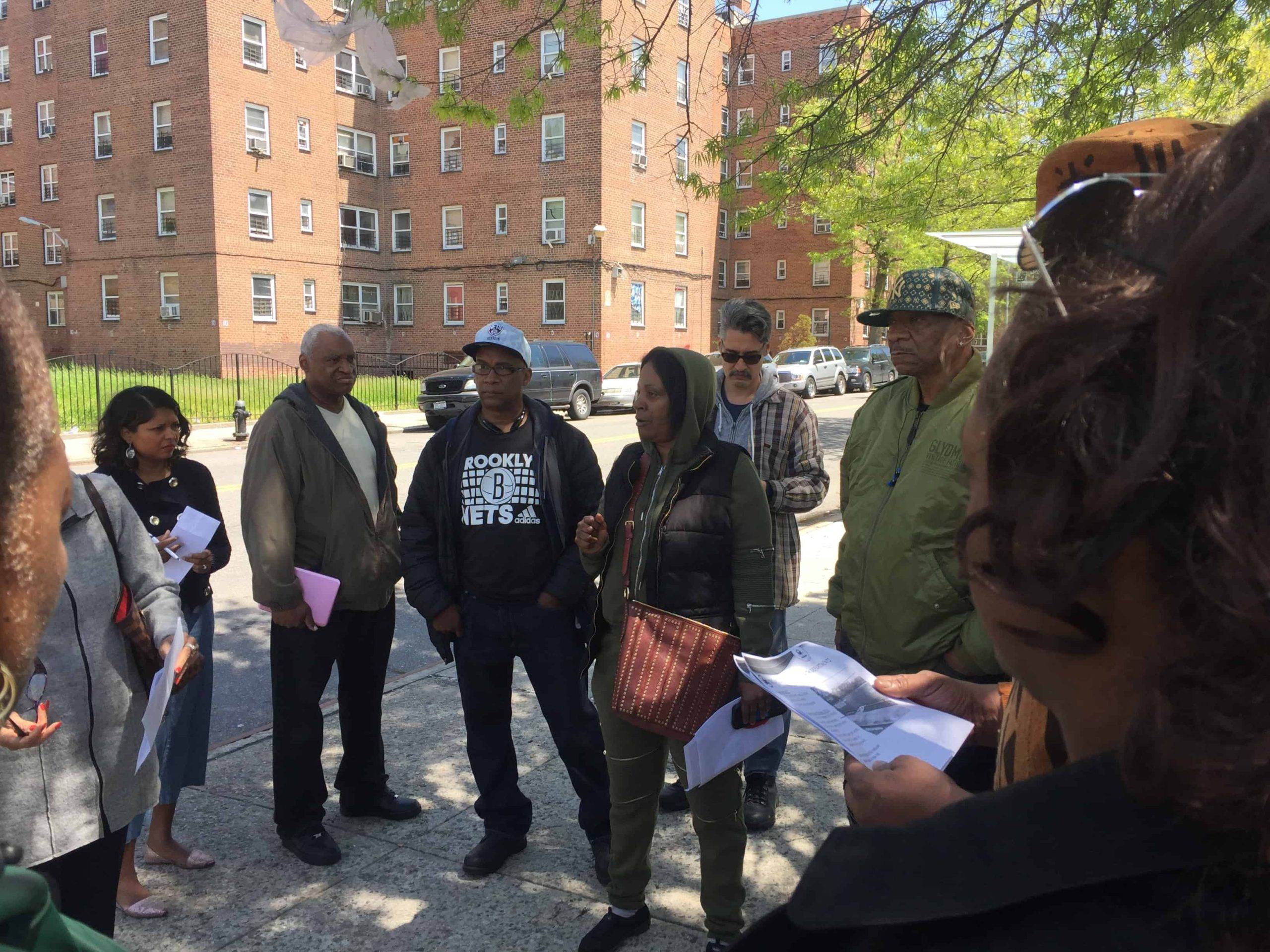
On June 17, more than two dozen residents of FEC and advocates with the Chelsea Public Housing Coalition confronted city housing officials over the planned demolition of the complex during a “NYCHA in Your Neighborhood” event in East Harlem.
The demonstration was the latest in a series of protests sparked by NYCHA’s May 2023 announcement that revitalizing the Chelsea campus would require demolishing all 18 residential buildings. The project, being led by developers Essence Development and Related Companies, would convert all 2,056 public housing apartments from Section 9 to project-based Section 8 and add thousands of new market-rate and luxury units on the property.
“My house is beautiful, and there’s no reason for demolition,” FEC resident Yu Zhen Story told Deputy Mayor for Housing Leila Bozorg and Director of the Mayor’s Office to Protect Tenants Cea Weaver during the event. “Our buildings only need to be repaired.”
Dispute over privatization
City officials argue that fully rehabilitating the aging buildings would be prohibitively expensive after decades of federal disinvestment in Section 9 public housing. Tenant advocates dispute that claim, arguing NYCHA has overstated repair costs to justify a mixed-income redevelopment plan.
“Project-based Section 8 destabilizes families by introducing you into a program that leads to double evictions, increases in rent, and tenant displacement,” said Ramona Ferreyra, a NYCHA resident and founder of Save Section 9. “So we’re asking tenants at Fulton Elliott-Chelsea to accept a program that’s already been proven to be bad in the name of giving Essence and Related more land.”
Under the city’s proposal, all current residents would be guaranteed a new apartment, and most would remain on-site during construction. A cadre of senior citizens living in the Chelsea Addition and Fulton 11, however, would be temporarily relocated to vacant apartments elsewhere on the campus while their building is rebuilt.
According to Marni Halasa of the Chelsea Public Housing Coalition, many of those residents have spent years building a close-knit community that they fear will be fractured by relocation. She also noted that many elderly tenants have medical conditions that could make moving especially difficult.
Officials attending the event included Bozorg, Weaver, NYCHA CEO Lisa Bova-Hiatt, and Chair Jamie Rubin.
“I understand there’s a lot of fear,” Bozorg told Story and Ferreyra. “The goal really is to bring new investment into the homes.”
Bozorg is one of the few senior housing officials retained by Mayor Zohran Mamdani after he took office in January. She previously worked at the U.S. Department of Housing and Urban Development during the Obama administration before serving in several housing policy roles in New York City. In 2024, then-Mayor Eric Adams appointed her executive director of housing, where she helped advance three successful 2025 ballot measures aimed at streamlining housing development, including reforms to the ULURP process.
Since the 1980s, federal funding for public housing has steadily declined. Congress compounded those challenges by passing the Faircloth Amendment in 1998, which effectively barred municipalities from expanding their public housing stock beyond existing levels.
Weaver argued that project-based Section 8 offers a practical solution to chronic underfunding and should still be viewed as a form of public housing, even if developments are no longer directly managed by NYCHA.
“Section 9 has been consistently underfunded by Democratic and Republican administrations,” Weaver told Elliott-Chelsea Houses Tenant Association President Renee Keitt. “I really believe that the path forward is to replace the public housing with a new form of public housing that is more sustainable into the future.”
Public housing in the United States generally refers to Section 9 developments, which are owned and operated by local housing authorities with direct federal support. Under project-based Section 8, properties typically remain publicly owned but are managed by private companies that receive federal subsidies.
Critics argue that tenants lose important protections after conversion.
“One big difference is the right to relocate,” Manhattan Community Board 5 member and anti-demolition advocate Layla Law-Gisiko told the Star-Revue. “Let’s say a member of a family living in a Section 9 building becomes the victim of domestic abuse. NYCHA will actually relocate that family and give them priority. Under Section 8, you don’t have that.”
Law-Gisiko made opposition to the demolition a central issue in her City Council campaign earlier this year. Although she ultimately lost the race, she carried the election districts encompassing the Fulton and Elliott-Chelsea Houses by a wide margin.
A 2024 investigation by then-New York City Comptroller Brad Lander found that eviction rates at NYCHA developments converted through the city’s Permanent Affordability Commitment Together (PACT) program were significantly higher than those at traditional Section 9 developments.
Since the PACT program launched nearly a decade ago, more than 39,000 NYCHA apartments have been converted—or are in the process of being converted—to project-based Section 8. This year’s city budget allocates $1.5 billion over the next two years to support the conversion of approximately 62,000 additional apartments, representing nearly 40 percent of NYCHA’s remaining Section 9 housing stock.
“The federal government has historically disinvested in Section 9, which is why the buildings are not in the shape they should be,” Law-Gisiko said. “But the law says the federal government must support Section 9. There is also an obligation at the state and city levels to adequately fund Section 9, so the rights and stability of tenants are much more secure.”
Despite the defeat in Court, tenants and advocates are still vowing to fight the demolition through any means available to them, including through several harassment suits against NYCHA that are still ongoing in housing court, and, if necessary, refusing to vacate their apartments.
“We have a good portion of tenants saying now that they are just not going to move,” Halasa told the Star-Revue. “We have tenants that are saying that they will chain themselves to their radiators before they move out.”
Author

Discover more from Red Hook Star-Revue
Subscribe to get the latest posts sent to your email.