There’s something I’ve said frequently while writing about classical music for the last couple decades, which is that there’s no such thing as difficult music. Sure, there’s some music that may have less general appeal than others, but that doesn’t make it difficult. What “difficult” means in music is that it is unfamiliar in some way, from an unusual style—like minimalist music in the 1960s—to a unique conception, like the dense, mystical micro tonality of Giacinto Scelsi or Alvin Lucier using his voice and a tape recorder to wring the acoustical response out of a room. The idea of presenting this music is frighting to arts administrators, but that doesn’t make it difficult for audiences. Give an audience a way into the unexpected, and they usually follow.
With jazz, and a lot of other non-jazz, non-classical music, non-commercial music, there’s the same kind of thing, music that’s inside a familiar style or method, and music that’s outside the changes. In jazz that’s improvisation in a way that works against or outside a set of chords, that doesn’t even bother with harmonies or song form, or straight rhythms and tempos, or even the common sounds of instruments. In a strictly technical sense, that’s free music. And free music isn’t difficult, it just often Thwarts common expectations. The idea of it, though, is in a way more common than jazz itself.
Another way to put it is that when jazz started to come together as an identifiable music 100 or so years ago, other than the style and phrasing and rhythms, the fundamental concept behind it was already ancient. That’s the way music has been made and passed down through cultures for thousands and thousands of years, a way that is fundamental and ubiquitous and mostly outside of the documentation of sheet music and audio recordings. That way was on the stage at Pioneer works for twenty-four straight hours in the middle of October for the annual Ragas Live festival.
Sold out, dozens of people with sleeping bags staying for the duration, live streamed on YouTube and WKCR, it’s a unique and often amazing experience, even if you just dip in or out of the broadcasts or take a few hours off to sleep in your own bed. On site, there’s also a wonderful social feeling, part of it an impromptu community coming together, the other the musicians bringing their ideas about Indian classical music from their own communities, near and far, to the stage. It is a community of storytelling and sharing via these traditions that are ancient, yes, because they’ve been around since before civilization began, but really are immortal because they never lose their relevance, freshness, nor grow old.
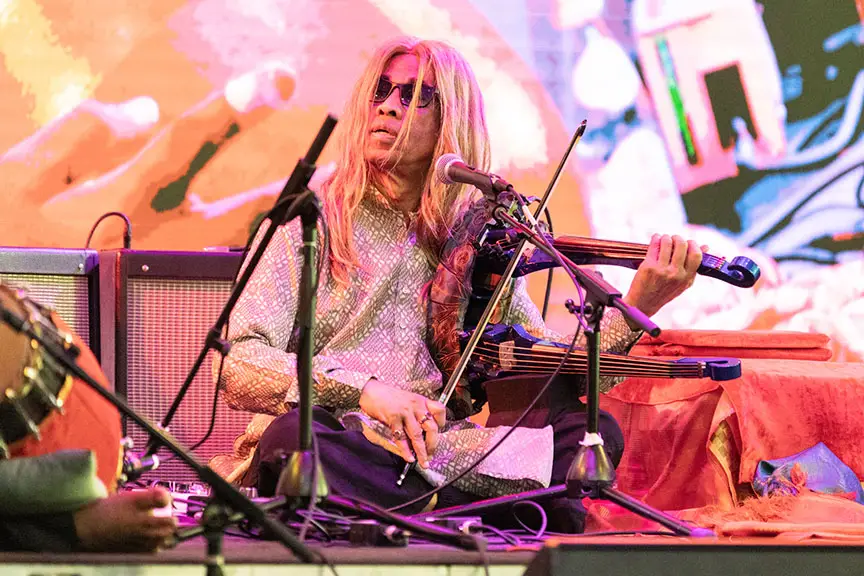
This year’s version had did have a more traditional lean than previous ones. There were fewer East-West hybrids, much less in the way of electronics, no raga-metal (unfortunately!). There were established masters like violinist Charumathi Raghuraman, vocalist Priya Purushothaman, and sitarist Shahid Parvez, and rising stars like tabla player Ishaan Ghosh. Violinist Arun Ramamurthy was back with his excellent jazz trio (you can hear this group on a fine 2024 Greenleaf release, New Moon), and “Mandolin” U. Rajesh played traditional music on his modern, electric, Western instrument. Sitarist Purbayan Chatterjee dropped a cheeky reference to the Get Smart theme and interpolated Chick Corea’s “Spain” into his set.
All of this was a thrill to hear. Like jazz, this is music that takes immense skill just to play at a mediocre level, and the festival was one top-level set after another. Raghuraman’s playing was virtuosic, but with her and others the dazzlement of the long runs of fast and clearly articulated notes were the hook, the sinker was how each repeat of each raga, each touch of ornamental variation, each improvisation, opened up an ever widening portal into what is best described as the experience of human culture. Sure, music is a universal language, and what that means is that music making is as fundamental to homo sapiens as walking upright and spoken language. It is the ur-language born in our genes.
Indian classical music isn’t an abstract music like post-baroque Western classical music, it is part of social and personal culture, with ragas for different ceremonial purposes, different times of the year, even different times of the day. It is music for human use. So adapting to it is nothing at all, and can be a profound experience. Philip Glass became the composer of Einstein on the Beach and Koyanisqaatsi because by chance he got hired to sit in a studio and transcribe Ravi Shankar improvisations, and through that literally learned that he could make music using repeated patterns that lay outside normal Western bar lines. And so history is made.
The penultimate set of Ragas Live was a return to history, or the revealing that the past isn’t even passed. This was the appearance for violinist L. Shankar, with percussionists (Vinayakaram) Selvaganesh, Swaminathan Selvaganesh (like Gosh, both played more than one set through the twenty-four hours), and Amit Kavthekar. Their playing was astonishing, full or intense but light-footed interplay, sections and solos building to points of maximum heat and light, taking dramatic pauses, and then building further. And all of this with immense joy.
For anyone with passing familiarity with Shankar, and Selvaganesh, the flash of history should be there. Both have been colleagues with English guitarist John McLaughlin, including but not confined to their fantastic Western jazz/Indian classical hybrid band Shakti. That band also included the fabulous and important tabla player Zakir Hussain, a hugely influential musician who passed away in December of last year.
A multilayered tribute to personal and musical history, and future possibilities, this was phenomenal to experience. There was the feeling of something enormous and beautiful rising from up inside the body, something beyond the description of mere words but exactly what music can trigger and explain, that expression of the inexpressible that Aldous Huxley noted. The set was original and ragas, but ended with playing Shakti. Not the last hour of the festival, but the pinnacle of the possibilities of this kind of storytelling.
Language means talking, orality. This was music that lives and grows through oral tradition, the practice of hearing and repeating back music until it is so deep in the hands and mind that it becomes new strands of cultural DNA. That’s a wildly different method than what’s usual in the West. But from our materialist, Western perspective, this is the concept of a classical music, one that’s not only ancient but is made in contemporary times with ideas and tools that have been around for a millennia or more. When a Western composer in 2025 uses counterpoint, they’re using an ancient idea, and when an Indian classical musician adds their own embellishment to a raga, or creates their own, that is also an ancient tradition. Each comes alive again in the present.
Jazz is a modern music that exists because recording technology preserved and spread it as a commercial, song-based music. There are ancient ideas inside every musician, and the blues at the foundation of jazz is an aesthetic and expressive idea that is certainly one of the first kinds of music that humans made, 100,000 or more years ago. Records are barely a sliver in the timespan of human history, but they carry voices from the past into the present, and future. It is one of the great oral cultures and histories in America, and here’s hoping it, and we, last long enough to build something even close to the Indian tradition.
Author

Discover more from Red Hook Star-Revue
Subscribe to get the latest posts sent to your email.