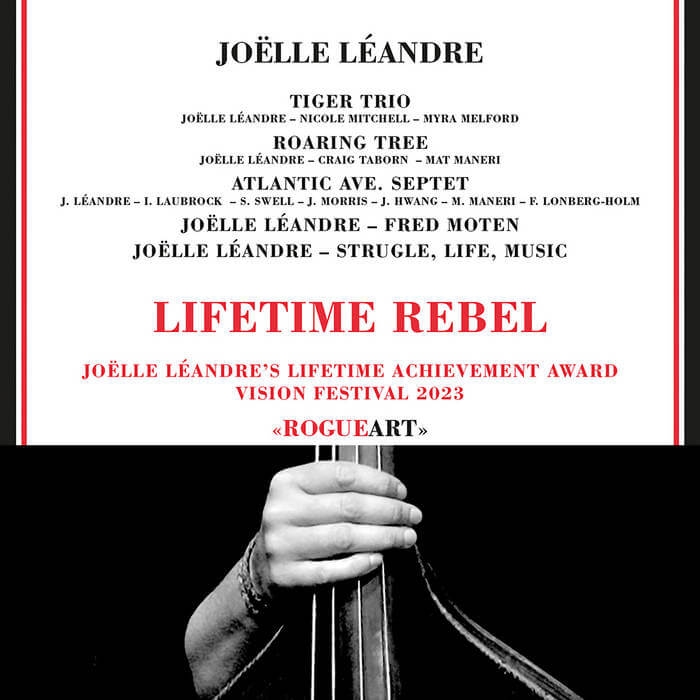
Every year, the Vision Festival opens with a concert dedicated to one musician who is honored with a Lifetime Achievement award. That’s an evening of three or four sets, each one featuring this figure. In 2023, that was French bassist Joëlle Léandre, one night at Roulette with four sets in four different grouping around her playing and artistry.
That, June 13th, was a memorable night, and one that was documented by the RogueArt label and released this past summer as LIFETIME REBEL. The four sets are collected on an equal number of CDs, with a bonus DVD that has Joëlle Léandre – Struggle, Life, Music, a documentary about her. Expertly recorded with a sound that is clear and full of presence by Stephen Schmidt, this is one of the finest and most important releases of the year.
This recording’s existence creates a unique and special listening situation. Hearing jazz boils down to two different mediums, the home stereo and the live venue—you play an album you know, one that’s the same each time you put it on, or you hear music in a constant stream of present moments, playing that disappears once it passes. You don’t have to remember the music on the album because you can play it any time, though do that often enough and you will remember it. You will not remember the music you heard live (maybe a couple of details, or the titles of the tunes) but you will preserve a general sensation of the experience.
As a live album LIFETIME REBEL falls into the home listening category. Except for the 200 hundred or so who where at Roulette that night in June (including myself), for whom it’s a third, hybrid thing, the live experience that can be recalled and repeated in detail, the memory of the sensations, the glow brought out onto the street at the end of the night colored in with every musical moment that produced that feeling. Like pictures or home movies but more vivid because of the impact of sound. And it’s indeed the whole night, not the best live movement edited together to make a studio-type live album. This is a special thing.
Don’t underestimate that specialness, or its depths. Being at an event like this, then being able to hear it all again, can make it something embedded into the fabric of life. A similar experience I’ve had is worth mentioning: Steve Lacy used to bring his Sextet to America every year and play for a week at Sweet Basil. That was the highlight of my jazz-going and I’d scrape together the cash to be able to go for a night. One year I found a $20 bill on the C train, and so could go two nights, and I sat across from the same guy each night. We started talking, and he told me that he would take his vacation from work when Lacy was in town and go see him every set.
In 1992, RCA put out a Live at Sweet Basil album from Lacy, the tracks collected from two nights in July, 1991. I can’t tell if I was there when they played any of the specific tunes—I don’t remember which day I went that week—so I can’t revisit the exact in-the-moment feelings, but I can read the liner notes where Lacy is quoted talking about a fan who would spend his week’s vacation coming to see the band play, and think “yeah, I was there, for the same reason, talking to the same guy.” It’s not just an album, it’s personal—it’s my life.
So is LIFETIME REBEL. This is a document of a stunning memory, and it’s deeply exciting to be able to revisit the evening in detail. You can hear exactly why this left such an impression.
The opening Tiger Trio set is fantastic. Léandre plays with flutist Nicole Mitchell and pianist Myra Melford, and there’s an incredible quickness to the playing. Quick thinking and dexterity are two of Léandre’s hallmarks, and it’s simply exciting to hear the three musicians listen and respond to each other with lighting reflexes and phrases that come out as clearly articulated and fully thought through, even as they are being improvised in the moment. Léandre’s arco playing is its own pleasure as she gets a warm, grainy tone out of her bass, with perfect intonation. Mitchell counters with an enormous range of timbres and tone colors.
There’s an amazing moment at the start of track 4 of the second set from Roaring Tree where pianist Craig Taborn introduces the playing with an extended quote of one of Cecil Taylor’s main ideas, which is a thrilling moment in the course of music, the influence and extension of a past great master not just in spirit but actual materials—there are no CT standards in the sense of the Great American Songbook, but there are discrete bits of music that can be passed on, repeated, then used as foundations for new explorations. That’s how music thrives as time proceeds into the future.
This trio also includes violist Mat Maneri (both he and Léandre played with Taylor) and is a fine complement to the first set. The thinking her is just as quick, but the ideas explore a denser and darker sensation of musical substance, earth to the Tiger Trio’s air. The third of the four sets is the only one that’s not completely satisfying, the ad hoc Atlantic Avenue Septet playing music that mixes specific compositional segments with free playing, and that includes extensive and impressive soloing from Léandre. Already two sets in, and with a 40+ minute piece, she continues to pull out ideas from what seems like a bottomless well of imagination about the expressive possibilities of technique. She plays around with different bowing timbres in the middle of fluid lines—the bass sings and nearly talks—and there are gorgeous harmonies and slowly shifting chords from the ensembles.
But compared to the rest, there are too many clichés, especially the kind of angular, awkward way of stating a musical line that wore out it’s usefulness as an avant-garde compositional device decades ago—what musicians aim at by getting away from their strengths and gesturing with these signifiers is a constant puzzle to me. Overall, there are painterly colors and a good shape, but also too many stretches where the energy flags.
The final set, Léandre accompanying poet Fred Moten and his deceptively gentle, iron-fist-in-a-velvet-glove delivery, is tremendous and both in my memory and on this recording the high point of the night. Moten’s pace is as unrushed as can be—but not static—and Léandre subdivides this with an invigorating torrent of techniques and ideas. Moten talks about Hughson’s Tavern, where “The great slave conspiracy of 1741” took place. He talks about “Jazz, as Ken Burns… / fuck it if that’s what it is or he made it that / the light and the sound was a Black light animal … Thank you Jesus for the criminal burn of the very idea … keep fucking up the music in the tradition of great Black queens / Pops, Cecil, Joey Ramone … pirates who are smooth sailors / The ones who got took / The ones who got left …” Through collective memory, he recalls the spirits that have been so essential to the Vision Festival, free jazz, and the greatest parts of American culture. Subtle and insinuating, this is great art.
Author

Discover more from Red Hook Star-Revue
Subscribe to get the latest posts sent to your email.