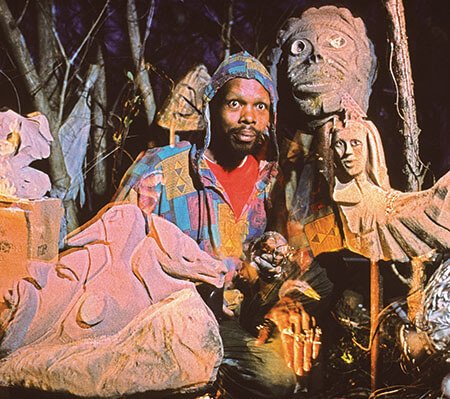
It’s easy to think of Lonnie Holley as a bluesman. He fits the type: rural, Southern, self-educated, quick with folksy wisdom and deep, dark truth. But Holley is a philosopher poet, more like Son House when he put his guitar down, more like Van Morrison casting ruminations over flowing, nebulous music. Van Morrison had his blues, too, of course. The guy recorded with John Lee Hooker. Lonnie Holley has his blues as well, and his new, five-song National Freedom is his bluesiest record yet.
It might be a matter of efficiency. As interest in Holley’s music has grown over the last half decade or so (his reputation as a visual artist well preceded his musical career), he has been playing more and touring more. It would only make sense if he started repeating himself, or if the musicians he plays with needed something to repeat. His musical monologues have evolved into songs and songs suggest form. And the form of National Freedom is a rural, contemporary, free-floating blues.
The download-only album (streaming in full on Bandcamp) clocks in at a solid, LP-length 37 minutes, and is a deep well of discovery for the versed or the curious. The opening “Crystal Doorknob” shows the simple pleasure Holley finds in observing the world. “In It Too Deep” displays his metaphysical quest from birth to death. “Like Hell Broke Loose” is a good, swampy, my-baby-left-me grouse. And “Do T Rocker” is almost a feel-good jam, although nothing’s ever that easy with Holley.
It’s a shame National Freedom isn’t getting a vinyl release (at least not at present) because it’s a perfectly sequenced album, with each side getting one solo track. Holley’s thumb piano is the only accompaniment on “In It Too Deep,” breaking up side one. Side two closes (or would close) with the 11-minute “So Many Tears (the First Time).” It’s Holley at his most powerful, crying in the darkness, speaking truth to the void, and is surprisingly delicate. His piano (the big kind, 88 keys and a wooden box) is delicate and nuanced in a way not heard on his various electric keyboards.
What’s not to be found on National Freedom is a song with the bite of “I Woke Up in a Fucked Up America” from 2018’s Mith. Given the title, given the times, that comes as a surprise. But the nation in the title isn’t the same nation as the one he woke up in two years ago. He sings of the Nile and the Congo, of other planets and of Martin Luther King. Maybe he’s found a new nation of freedom, somewhere, a better place to wake up—even if it’s a nation of his own imagination.
Author

Discover more from Red Hook Star-Revue
Subscribe to get the latest posts sent to your email.


One Comment
Recorded before Mith.