
Heirs to the Court of the Crimson King. Pardon my imprudence but I fail to get excited about one or two former members peddling again what a band they were in did 20 or 30 years ago. As crucial to my young listening as Talking Heads and XTC were, the Remain in Light and EXTC revival bands mean little to me. And while Adrian Belew, Steve Vai, Tony Levin and Danny Carey are out touring with their Beat, playing music from the essential ’80s King Crimson records, I’m more interested in the newer bands that follow in the King’s stead.
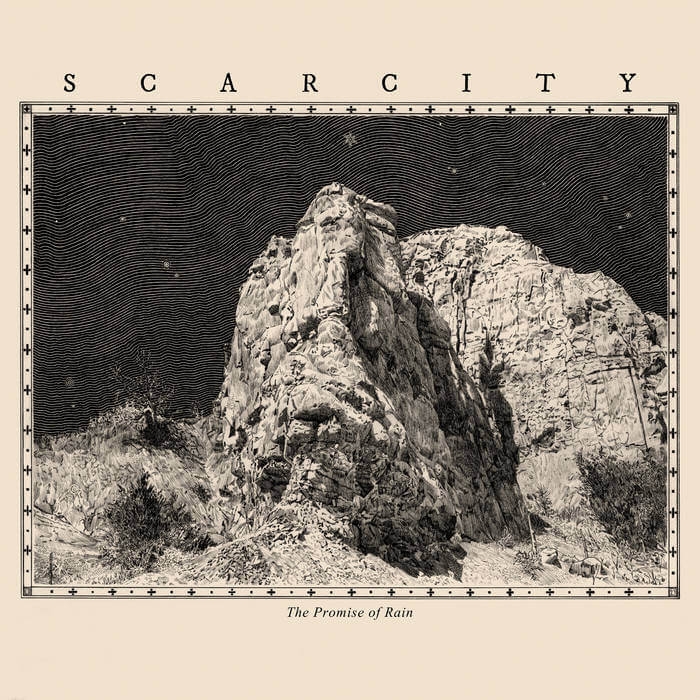
NYC’s Scarcity takes Crimson’s precision and overlaid riffs and puts them into a solidly black metal setting. (I suppose that makes them prog metal but I’m loathe to use the term.) Launched as a recording project by Brendon Randall-Myers (conductor of the Glenn Branca Ensemble and a member of the new music electric guitar quartet Dither) and vocalist Doug Moore (Pyrrhon, Weeping Sores, Glorious Depravity, Seputus), they became a real, live band with the addition of Tristan Kasten-Krause (Sigur Ros, Steve Reich, LEYA) on bass, Dylan Dilella (Pyrrhon) on guitar and Lev Weinstein (Krallice) on drums. Their second album, The Promise of Rain (CD, LP, cassette and download out from Flenser July 12) sharpens the intricacies, patterns and colors of King Crimson into a gleaming growl. Mid tempo, repeating guitar lines float above relentlessly fast, rolling drums while the strain in Moore’s scream might give you laryngitis just from listening to him. The new album is a scathing and scintillating set of songs. Another New York outfit, Paragnosis, released their second album last month. The self-titled, self-released, download-only collection of six instrumentals clocks in at just under half an hour. The trio’s sound is cleaner than Scarcity’s, with more room given to showboating solos, executed quite skillfully. Robert Fripp’s King Crimson, at least at times, leaned into the metallic, whether or not their fans want to admit it. The band came together in 1968, the same year as Black Sabbath (although the Londoners of Crimson were perhaps a bit more erudite than the Brummies of Sabbath). Fans have often tried to build a wall between the two camps, but such bands as Paragnosis and Scarcity proudly walk both sides of the divide.
Everything old is punk again. I don’t mean to be imprudent and I certainly don’t want to be insouciant. Maybe summertime makes me feel nostaligic, or maybe punk is especially good at reinventing itself with only minor changes. All forms steal from their own histories, but punk burned fast and has continued to smolder for decades. Bob Mould sang of squandered youth 40 years ago on “Celebrated Summer” from New Day Rising, the apogee of Hūsker Dū’s brilliant arc. I found myself singing that song through the minute and 57 seconds of “Escape,” the first song on Hayes Noble‘s sophomore album, As it Was, As We Were (CD, LP and download from Two Two One Press last month). It doesn’t really fit in melody or meter, but it does in mood, and that’s what matters. Noble’s all of 19 years old and recorded the album the summer after his high school graduation with his younger brother on bass and dad on drums. Like the Hūskers (from Minnesota), the northern Illinois native son (since relocated to the Pacific Northwest) plays solidly upper Midwest punk, full of the existentialism and angst of the flatlands and, even at his age, some wistfulness. Noble crafts some strong songs here. Never mind that there’s nothing all that new going on. It’s powerful, impassioned and catchy, and that’s what punk’s supposed to be.
Meanwhile, the Granada, Spain, five-piece Palmar de Troya put me in mind of Sonic Youth at their yellingest and punkiest. Singer keyboardist Llulaby attacks the five songs on their second album, named simply II (10” vinyl and download from Reptilian Records July 5) with a Kim Gordon take-no-prisoners urgency. The album is full of hooks strategically placed within a nest of fuzzed out guitars. The band named itself for the Palmarianos, a 1970s Spanish religious that founded its own monatery and declared its own pope. But I imagine it’s more the rebellion than the religion they found inspiration in. The automated voice in “Cold Snakes” that repeats an admonition against questioning authority isn’t there to offer helpful advice. It’s there for mental target practice.
Author

Discover more from Red Hook Star-Revue
Subscribe to get the latest posts sent to your email.