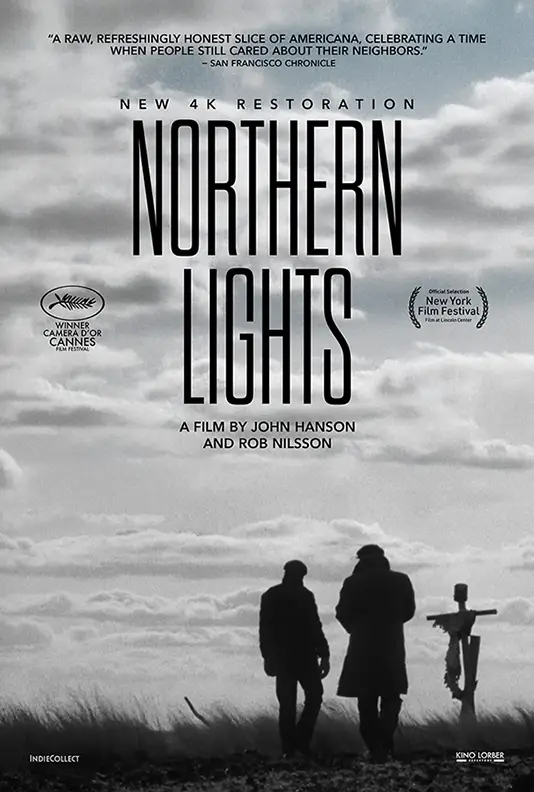
Cinema is a lattice of miracles. Consider Northern Lights, a 1978 black-and-white film about a 1916 labor movement in North Dakota made for roughly $300,000 by John Hanson and Rob Nilsson. It’s a small miracle the directors raised the money for a pro-union period piece; that they found a group of (mostly) non-professional actors to commit themselves to a multi-year shoot; that their equipment didn’t freeze in the brutal North Dakota winters; that they completed the film; that they found theaters in and around North Dakota that would show it; they it was submitted to the Cannes Film Festival; that it won the 1979 Camera d’Or for best first feature; that nearly 50 years later it has been restored, revived, and rediscovered, just as America needs a wake-up call when it comes to organizing, class struggle, and self-worth. There were so many ways Northern Lights could have been snuffed out. And, for decades, it has dodged them.
Told as an extended memory of a 90-year-old recalling the experiences of long ago, the film’s emotional core is a love story concerning two young farmers. But their romance ultimately becomes secondary to the effort in 1915-16 to establish the Nonpartisan League, a union and political party composed of small, mostly immigrant Norwegian farmers agitating to snatch farming industries away from landlords and banks and establish state control of them. Shot on 16mm and blown up to 35mm, Northern Lights often resembles a lost Ingmar Bergman film or a kind of American Neorealism. The magnificent cinematography by Judy Irola, coupled with the guileless performances, gives the film a raw, mad-as-hell-and-no-longer-taking-it power that crackles and envelops you. It’s the kind of solidarity, agitprop filmmaking we rarely get in the U.S., the kind of film that, when it arrives — be it a documentary like Brett Story and Steve Maing’s Union or a narrative work like John Sayles’ Matewan — you want to never let it go.
Yet after its initial release, Northern Lights went missing for decades. But after being restored by IndieCollect in collaboration with Metropolis Post and the Academy Film Archive, it got a revival screening at the 2024 New York Film Festival and is now touring the country, beginning at Lincoln Center. Directors Hanson and Nilsson spoke with the Star-Revue about making the film, why it disappeared, and their hopes for its impact today.
The conversation has been edited for length and clarity.
After seeing the film, I was astounded and angry that I had never heard of it. How is it possible that this was so hidden for so long?
John Hanson: The problem is that we sold it off to New World Pictures at one point, and then it got lost into that vast library of Hollywood. They didn’t do anything about it, and we couldn’t get it back. We tried for many years so we could bring it out. It’s never been released officially on DVD, for example. But that’s going to change now with Kino Lorber; it’s now going to be showing in theaters around the country. It’s wonderful to have it back in this new restoration. I can’t tell you how satisfying that is.
Rob, in your book Wild Surmise, you write that filmmakers like you and John and others were the direct inheritors of an American version of the French New Wave. What was the state of filmmaking in North Dakota when you made this?
Rob Nilsson: My grandfather was the first filmmaker in North Dakota in 1907 or 1908. A lot of his footage survived, and you can find it on the internet today. That’s the past.
Hanson: There were two things in our favor. One is that I got to be friends with the executive director of the North Dakota Humanities Council. I had made a documentary that they had funded called Western Coal, about the effects of strip mining in Montana.
Also in North Dakota at the time farmers were fairly well off and they gave themselves to the film.
We discovered this incredible Norwegian community up on the Canadian border. One of the farmers had an oil well in his backyard. Of course, they came from nothing and while they had a little money in their pocket now they had no problem identifying with the stories of the Nonpartisan League.
We were at a time when many of those people were still alive, including Henry Martinson, who’s the storyteller, who was an organizer. He was in his 90s. There were other people that we met in their 80s who we interviewed. We did oral history, we went all around the state. We got to know these people.
For this story, what was the starting point? Did it come out of those oral histories that you were collecting? Did it come out of a personal experience, family lore, something like that?
Hanson: It came from the stories my grandfather told me. He was a poor farmer out there in the prairie in the early part of the century. He lost about 20 farms over the course of his life. He ended up with a small farm, which I spent a lot of time on as a kid, and he would tell me about this. He hated the bankers. He hated the railroad guys. When he would talk about that time, he said, “But there was one time Johnny, we beat the hell out of him.” One time, he said. Of course, 1916 was prehistory for me as a kid. But his face would light up and he would shake his fist in the air. He was back there telling the story. So that was the seed of the whole thing. I wanted to go back to North Dakota and tell that story.
This came out of Cine Manifest, our film collective in San Francisco. I’d gotten to know Rob and knew he had roots in North Dakota, so we joined forces. The roots of the Democratic Party are in the Nonpartisan League. But nobody would look back to that time, because history gets forgotten, right? It gets buried. People don’t remember when there was a victory, and the whole union victory disappears from our culture.
You have this great line in the film from the storyteller who says, “Not everyone forgets.” That feels really resonant now, when so much of the government and culture is oriented toward uprooting memory.
Nilsson: I can’t thank you enough for bringing that up. It’s our plan to speak whenever we’re in front of audiences to show the parallels, that this is perhaps the most pertinent film that could be shown at this time in America.
There’s a Studs Terkel book “The Great Divide,” where he writes about photographs of the ‘30s, and how you could see the same faces when you looked at people in the ‘80s. He writes, “When people are down and out, they always look the same.” The faces you capture could have come out of the Depression, I remember people looking like that in Pittsburgh after the steel mills closed, you can see them today.
Nilsson: You can go to the early Soviet cinema and see faces like that. That’s one of the great sources. And Dorothea Lange. But the thing is that we didn’t want it to look like, look like actor actors. We tried very hard to make sure that the faces all worked.
Hanson: They’re genuine people and they bring an authenticity to the character. We also cast them in roles that fit them. For example, the banker was actually the banker at the time in Crosby; foreclosed on many farms.
Nilsson: He would say, “I don’t know what you’re doing to me, but I’m going to do it anyway.”
Hanson: He was happy to be made fun of because, of course, the local people had been victimized by him. What the hell? The faces we were… The other thing that happened when we released the movie, some of the Puritans out there said, “How come nobody ever shaved? They’re looking grizzled. “Well, my grandfather, the only time he shaved was Saturday night, his only bath of the week. These are people — they’re in the earth. These are people who are laboring. They don’t get up in the morning and think, “How do I look?” They’ve got plenty of other things on their mind.
Where do you see Northern Lights fitting into the larger conversations we’re having today about work, labor, organizing, memory, culture, community — all these things you touch on in the film?
Nilsson: Why would it not be important for anybody that understands what’s happening? Voting is about if you get enough votes, you get to win. And if you don’t get enough votes for too long, then you become irrelevant. It’s important somehow to forget about the purity of the thing and go for the practicality of the thing. We need to do something about these people who are mean and cruel and unempathetic, and not only that, bad business people who around the world are being seen as dupes and dopes. And somehow, America doesn’t see it. Let’s say maybe a third of America doesn’t see it — the rest of the people on our side didn’t vote. So I don’t know, other than to try to encourage every time we go to the screenings to say, look, this is what they did. We can do it, too.
Hanson: The thing about Northern Lights is that, from the beginning, it’s been used as an organizing tool for a lot of labor unions, a lot of farm groups. Willie Nelson, at one point, used it. I hope that happens again.
Northern Lights is now playing at Film at Lincoln Center. Visit filmlinc.org/films/northern-lights for information and showtimes. The film will also be released for the first time on Blu-Ray on July 22.
Author

Discover more from Red Hook Star-Revue
Subscribe to get the latest posts sent to your email.