In case you’ve been sleeping for the past six weeks, the United States has undergone yet another transformation. No, I’m not talking about the pandemic, although it could be that it is the disaster of COVID, combined with a really sick example of police brutality towards a black person, that has pushed the civil rights/social justice movement to what seems like a new level.
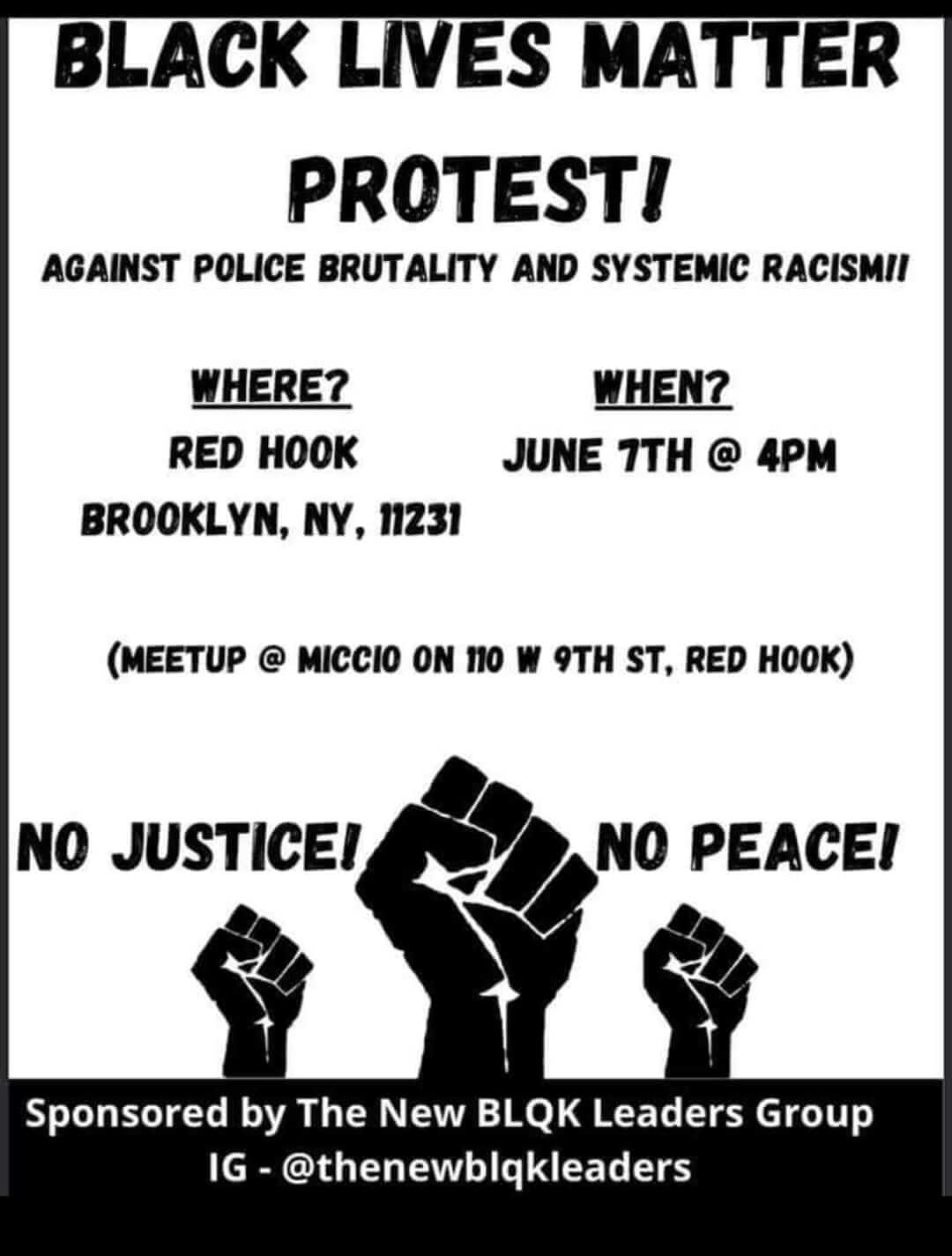
There have been daily protests since the police killing of George Floyd at the end of May. On June 7, a peaceful and well attended Red Hook protest peacefully wended its way from the Miccio Center through Red Hook, into the Columbia Waterfront District, and beyond. I marched with them and took photos from the Miccio to Hicks Street, and waved as they marched down Hicks Street after a momentary roadblock at Union.
[slideshow_deploy id=’11446′]
I’ve seen a lot of the Civil Rights movement firsthand. I grew up a NY Mets fan. One of their early stars was an outfielder named Joe Christopher. As a ten-year-old kid from Queens in 1963, I had no idea that white and black ballplayers were treated any differently. Anybody who could be on a baseball card was, for me, deserving of special consideration as a human being. Of course, I was a naive ten, so I couldn’t believe when I found out that Christopher wasn’t allowed to stay at the same hotel as the rest of the team during spring training in Florida. I had wrongly thought that Jackie Robinson had ended all that .
Then came 1969. I was a senior in high school and starting to read subversive literature such as Rolling Stone and the Voice. This continued as I went to college, and at some point I read a few articles about something called “COINTELPRO.” This was, as now explained by Wikipedia, “a series of covert and illegal projects conducted by the United States Federal Bureau of Investigation (FBI) aimed at surveilling, infiltrating, discrediting, and disrupting American political organizations.”
Fred Hampton was who today would be called a leader in the Black Lives Matter movement, but at that time was a Black Panther. At the age of 21 he was murdered in cold blood by Cointelpro operatives while asleep in his Chicago apartment. At first the police maintained that “violent and vicious Black Panthers” attacked the FBI during a 4 AM raid, but the truth eventually came out, and Hampton was by 1990 recognized as a movement hero in Chicago and other places.
So maybe by then one might have thought that social justice had been achieved, but just a couple of years later Rodney King was filmed being beaten mercilessly by LA cops. And so it went until in 2008, a black president was elected, but of course, discrimination and brutality continued as chokeholds and police killing of blacks far outnumbered police killing of whites.
Having just written that as an assumption, I checked Google and quickly found this study:
Deaths Due to Use of Lethal Force by Law Enforcement, Findings From the National Violent Death Reporting System, 17 U.S. States, 2009–2012
Sarah DeGue, PhD,1 Katherine A. Fowler, PhD,1 and Cynthia Calkins, PhD2
Victims were majority white (52%) but disproportionately black (32%) with a fatality rate 2.8 times higher among blacks than whites. Most victims were reported to be armed (83%); however, black victims were more likely to be unarmed (14.8%) than white (9.4%) or Hispanic (5.8%) victims.
[slideshow_deploy id=’11450′]
And so it took a pandemic and a particularly brutal videotaped death to finally get people into protest mode like I’ve never seen before. It seems like a real social change might actually be on the verge of happening. What I mean is that white people might give blacks the same presumption of innocence that they do for themselves. Maybe.
In the end it will be economic equality that is the ultimate goal.
Regardless of what eventually happens, as someone who last marched for Mumia Abu-Jamal, a black journalist still rotting in jail for a murder I don’t believe he committed, back in 1982, I was pretty proud to watch the Red Hook marchers on June 7.
Author

Discover more from Red Hook Star-Revue
Subscribe to get the latest posts sent to your email.