Braving a rainy and cold lower Manhattan, 40-or-so people, primarily members of the maritime industry, gathered on Nov. 19 in a conference hall in the back offices of Manhattan’s Staten Island Ferry Terminal. The occasion: the Blue Highways Freight Ferry Field Day, organized by the NYC Department of Transportation. The reason I was there was that the Brooklyn Marine Terminal (BMT) redevelopment, the enormous and heavily criticized transformation of New York City’s last working waterfront, may at some point be a key hub for the Blue Highways program.
Blue Highways is a venture led by the city’s Economic Development Corporation, with the goal of shifting how goods are moved in and out of New York City, from the road to the water. (Short-sea shipping, in industry terms.) Today, 90 percent of all freight entering New York City does so by truck, which takes a heavy toll on the city’s streets and bridges, and causes congestion and pollution. Given that the city has over 520 miles of waterfront (two-thirds of which is publicly controlled), a full-fledged Blue Highways program could radically transform life for many New Yorkers.
But we’re not there yet. Blue Highways was originally introduced in 2015 by Mayor Bill de Blasio, but as was brought up to me multiple times at the field day, reviving short-sea shipping has been talked about in the city’s maritime community for two decades, and so far, little has happened. Blue Highways has gained steam in the past few years, however, with several pilot programs launched and federal funding secured for various projects. In the “Blue Highways Action Plan,” released in October, EDC highlighted a doubling of the six Blue Highways sites planned initially.
Next year, the BMT is scheduled to become a pilot landing site, but it will not become a permanent micro freight hub until 2030. There is currently a request for expression of interest out regarding how to optimize the BMT site for maritime operations. I tried, unsuccessfully, to probe the EDC representatives present at the field day about the progress of the RFEI; neither of them knew, they claimed, as they work on other Blue Highway and BMT-related projects.
What will Mamdani do?
It is, of course, uncertain what plans the incoming mayoral administration has for the city’s short-sea shipping program. Mayor-elect Zohran Mamdani did not speak much about climate change during his campaign. He has also not commented on the BMT and he did not participate in the Waterfront Alliance’s Five Borough Waterfront Mayoral Forum in May, where four other mayoral candidates shared plans for the city’s waterfront.
When I spoke to State Assemblymember Marcela Mitaynes in early November, she said that Mamdani is not concerned with the BMT site, something that was echoed by Councilmember Shahana Hanif, who told me it is “not his priority.” Both Mitaynes and Hanif are, just like Mamdani, members of the Democratic Socialists of America, DSA.
It also remains to be seen who Mamdani’s new transportation commissioner will be, and if he will replace the current EDC president, Andrew Kimball; both decisions will impact both BMT and Blue Highways.
As DOT organized the event, Commissioner Ydanis Rodriguez opened with a presentation. While he spent a significant portion of the time speaking about his accomplishments, he did finally note that streets can’t handle the trucks that come into the city every day, and that Blue Highways “is not a privilege, it is a need we have.”
The Blue Highways ferry coordinator, Taylor Takahashi, then detailed the plan for the day, as well as the city’s ferry micro freight program. Notably, the DOT wants to use ferries—not the NYC Ferry Service vessels that crisscross the city’s waterways as they don’t have enough space for both people and goods, but ferries that can take both humans and micro freight—and the city’s ferry landings as part of Blue Highways.
To preserve federal funding, the ferries must still carry at least one non-crew member, but they would primarily carry cargo. These shipments would mainly occur during off-peak hours, the department suggests, when fewer regular ferries are in operation and fewer passengers are on the landings. A pilot program for how this could work is also ongoing, meaning that other options are on the table.
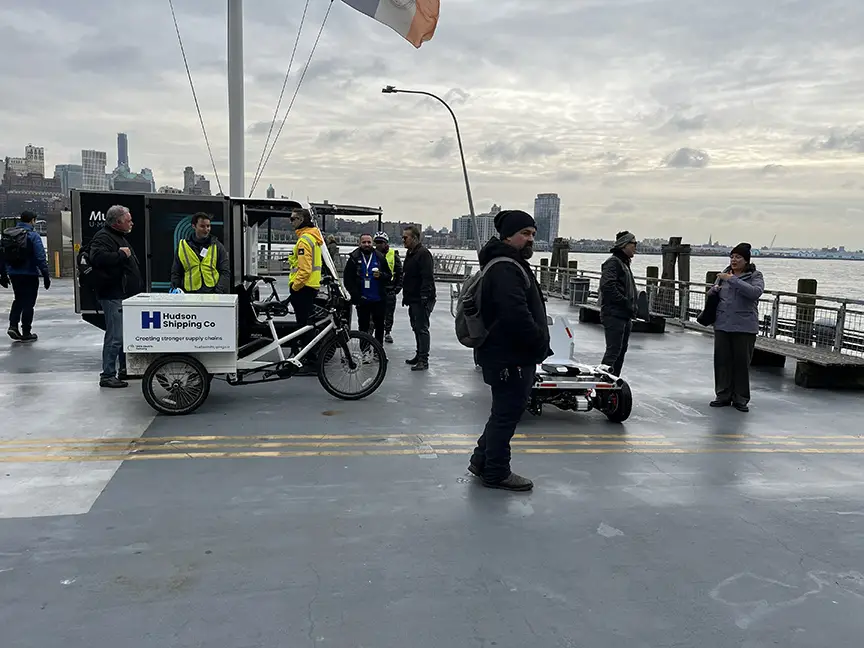
How this would work was then demonstrated to the posse of attendees at Pier 11. Using a few different vessels with varying loading and unloading capabilities—bow, stern, or port—several private operators, including Ilana Mayid-Dennis of US Coastal Service (yes, this is a private enterprise, not a government agency, as the name very much sounds like) which is currently berthed in Red Hook, showed how micro freight transportation could work in the Blue Highways program.
Local representative
In attendance was Red Hook’s own long-time short-sea shipping advocate Jim Tampakis, owner of Marine Spares International, as well as micromobility experts like Stuart Hyden and Mark Chiusano from Net Zero Logistics, and Hudson Shipping Co.
Tampakis told me later that while a people-and-cargo combination is fine for now, it is probably a temporary solution. “Eventually this is going to become so big that it’s going to need to be independent of that,” he said.
He also noted that to scale Blue Highways, there is a need for standardization of containers, something Commissioner Rodriguez agreed on when Tampakis asked him and his deputy commissioner.
Several attendees raised concerns over the efficiency of using ferry landings, noting that the gangways from the pier to the boats were too narrow. The gangways also zigzagged instead of leading straight onto the ships, making it difficult—and, more importantly, time-consuming—for a cargo bike to traverse. One industry veteran who runs a micro freight delivery vehicle company noted that it would take too long for one of his vehicles to get on and off with cargo to make it financially sustainable.
Diesel for now
While electric ferries are in use in some parts of the US and Europe, the technology is still nascent and it is uncertain when it could be used at scale in a system like Blue Highways. One ferry operator said EV technology is the next step, but is a few years away. The landings also don’t have the infrastructure needed to support electric vessels. (A member of a consulting firm that’s designing a landing near Pier 11 said that it, at least initially, will not have charging stations for electric ferries and barges.)
T
hus, a catch-22 unfolds: many vessel operators are reluctant to invest in upgrading their fleets to run on electricity as there is no charging infrastructure in New York City, and neither the city nor private pier operators want to invest in such technology until there are vessels ready to plug in.
So, for the time being, environmentalists will have to settle for biodiesel, which can have up to 60 percent less emissions than regular ship fuel, according to Lauren Kesner O’Brien, policy and partnerships manager at the climate nonprofit Empire Clean Cities, whom I spoke to at the field day. Nevertheless, it is clear based on conversations with attendees that, for the first time in a while, New York City is making tangible progress on Blue Highways.
Author

Discover more from Red Hook Star-Revue
Subscribe to get the latest posts sent to your email.