Strength in numbers confront NYCHA,
by Nic Cavell
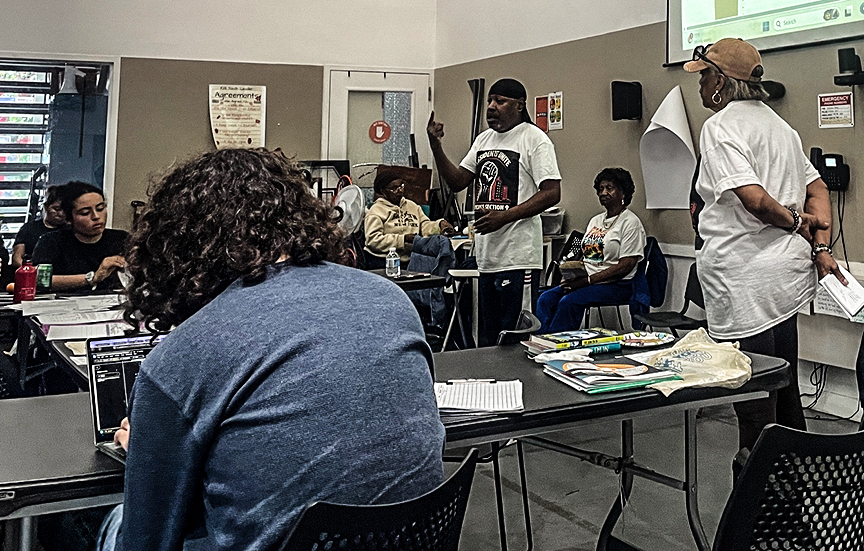
On January 16, representatives from the New York City Housing Authority (NYCHA) conducted the next in a series of bimonthly meetings initiated to discuss Hurricane Sandy relief with tenants of the Red Hook Houses.

In contrast to the January 2 meeting, this meeting was well-attended. And in this meeting, tenants did not spare NYCHA frustration formed in the face of chronic heating problems, lighting failures, safety discrepancies and sanitation issues. Communication and responsiveness remained the biggest issues, residents said.
NYCHA representatives, for their part, stuck to a positive message emphasizing that both the East and West Houses were safe and operational. NYCHA’s Tasha Smith, who has been Property Manager at Red Hook Houses West for nine years, reminded residents that NYCHA employees had gone door-to-door in the hours following the storm, checking in on residents to make sure they had resources like medicine.
But residents like Wally Bazemore weren’t buying Smith’s story, which he and others have refuted in previous NYCHA meetings.
“Nobody from NYCHA helped us for three weeks,” he said. “We were stranded in the cold and the dark.”
In response to Bazemore’s question about plans for new permanent boilers, NYCHA Director of State & City Legislative Affairs, Brian Honan said the new boilers would be protected on upper floors where—as Bazemore pointed out—they could displace up to 32 residents. Honan responded that although plans had not yet been made, they would be thoroughly discussed with both residents and NYCHA’s engineers when they were more concrete.

The absent plans for permanent boilers versus the use of temporary boilers as a stopgap parallel NYCHA’s use sidewalk shedding. Scaffolds for exterior repair board up existing construction while the comprehensive work is left indefinitely for the future. During the questioning period, one resident cited that repairs to individual rooms were often assigned a 6-18 month waiting period.
Despite promises at the previous meeting that representatives from Verizon Wireless, the Houses’ sole phone and internet service provider, would be available to answer residents’ questions, the representatives were nowhere to be found. On communication issues, residents complained that NYCHA had yet to restore intercom service. They also bristled at the idea that the intercom service would only be available through Verizon.
Honan, who had stated early in the session that individual complaints were to be filed with management personally and not aired in discussion, issued numerous reminders, and was numerously denied. Residents generally ignored NYCHA’s request that they limit themselves to one question each.
Sarah Chapman, who lives at 831 Hicks, described living conditions on the 6th floor of her building. The window across from her room, she said, had a crack in it before Sandy. Now, that crack is growing bigger.
“There’s no sidewalk shedding around it?” Brooklyn Property Management Department Director Marguerite Mann asked, incredulously.
In one of the meeting’s most startling revelations, Emelyn Matos suggested that the hot water supply of 82 Dwight Street is being filtered through garbage cans in the basement that are contaminated with asbestos. She also suggested that the basement foundation of 135 Richards Street, where the contractor Belfour had knocked down walls and placed red tape, was unsafe, and provided photo evidence of each. Matos’ photographs, all of which were taken since December 26 and some of which as recently as January 11, are currently being investigated by NYCHA’s engineers. The complex’s basement facilities have been padlocked since Matos took her photographs.
“All testing of the water towers and low-rise buildings was completed and we are happy to say they all came back with a clean bill,” Honan said. Honan believed that Belfour’s red tape was in place as a sanitation warning to other NYCHA employees. Mann believed that the walls knocked down were not essential to building integrity. Both admitted they are not engineers.
After the meeting, Mann took to the floor to personally respond to residents’ complaints, making the necessary phone calls herself to connect them with services. Neither she nor any other NYCHA officials, save Brian Honan, answered the Star-Revue’s questions afterward, citing NYCHA policy.

In what often seemed like a battle to control media message, NYCHA continued to assert its positive record and emphasize improvements in conditions. Residents demurred, offering personal accounts of conditions in Red Hook Houses that leave much to be desired. The objects of their complaints often dated to times well before the hurricane.
“NYCHA staff ought to be moved into that housing and see what it’s like drinking that water and bathing their children in that water,” Matos said after the meeting. “I want to pick the right fights, and I need to get these tenants to help. A lot of people are just happy to be in the building,” said Matos, who resides in a hotel and refuses to move back into the Houses at this time.
Lillian Marshall, Tenants Association President of Red Hook Houses West struck a different note.
“This should be the last meeting, because it’s the same story every time. Just the same people talking, but they never get anything done,” she said.
Author

Discover more from Red Hook Star-Revue
Subscribe to get the latest posts sent to your email.