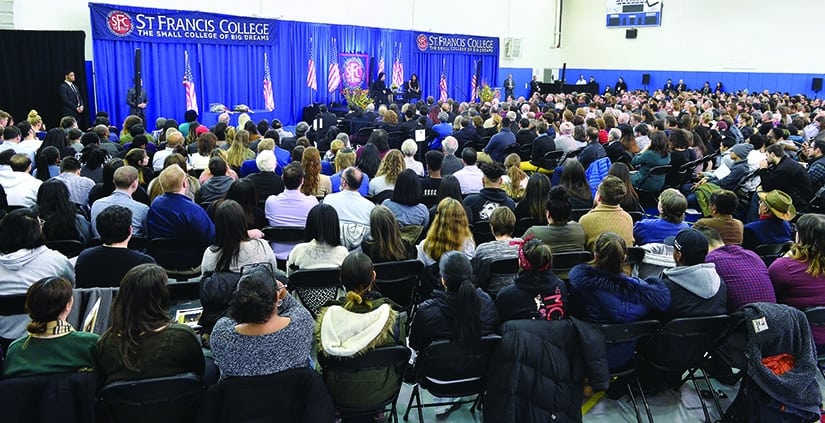
Supreme Court Justice Sonia Sotomayor’s visit to St. Francis College on February 2 provided some much needed reassurance that indeed there still are grown-ups in some of our important seats of power.
Sotomayor appeared in a packed fourth floor gym composed mostly of students. The occasion was the annual Thomas J. Volpe Lecture, and the connection was Sparkle Sooknanan, St. Francis Class of 2002, who clerked for Ms. Sotomayor when she was a judge on the US Court of Appeals, 2nd circuit – a position she held prior to being named to the Supreme Court in 2009 by Barack Obama.
By coincidence, her appearance took place just a couple days after President Trump made his controversial announcement of his proposed replacement for the late Justice Scalia.
However, this was not a subject of discussion this day.
Instead, Sotomayer spoke to the students about the thinking that went behind the career decisions she made that led her to the Supreme Court.
She told the students not to despair – that sometimes it is society that makes one feel inadequate – and that it’s ok to not always be confident in one’s future.
“Explore the things that you don’t know,” she said. “Most of the time, professors are interested in you – and will encourage you to follow what you are interested in, and you will discover what you are good at.”
Her method was analytical – she rejected what she knew what she didn’t like, or did like but wasn’t good at. She was encouraged to go into medicine, but she knew she didn’t like hospitals.
“I liked helping people, and that’s what lawyers do. I knew that from watching Perry Mason.
I also knew that I liked reading and writing, and also courses that were challenging and exciting.”
Of course, having a mother that pushed her to go to college was crucial – she was accepted at Princeton and graduated Summa Cum Laude in 1976. From there she went to Yale Law School, graduating in 1979.
“One afternoon when I was 25, I happened to go to an event featuring NY’s District Attorney Robert Morgenthau. Wine and cheese were to be served afterwards. Morgenthau was there asking the law students to come work for him in the DA’s office. The office was full of cases and there was plenty important work to do.
Afterwards, I went right to the cheese line, and in addition to the cheese I happened to start talking to Morgenthau and he convinced to come work for him.”
Sotomayor explained that the most important thing she learned as a prosecutor was the ability to create a persuasive argument. However, after about four years, she felt the need to move on. She saw that criminal justice was basically a revolving door – in the 1980’s there was little push for rehabilitation. She felt the need to do something different – something that provided an opportunity to learn new skills.
She became a commercial litigator for a private firm, where she was able to practice civil law. There she was able to understand both the needs of employers and employees.
Having practiced law from both sides – defense lawyer and prosecutor, she was ready for something else.
Perry Mason an influence
“I remembered from Perry Mason that no matter how great a job Mason did, it was that person behind the bench – the judge – who had the final say, and that’s where I wanted to be,” she said, smiling.
President George H.W. Bush nominated her to the Second District Court in 1992, and President Bill Clinton named her to the US Second Court of Appeals in 1997.
She explained that cases come to the Supreme Court when there is no clear answer based on competing principles of law that are heard in lower courts. “We order them, and decide which trumps the other in a particular case.”
She then spoke of one of her passions, which is the continuing struggle for equal rights for women. She gave an example of the unthinking discrimination that still exists in society. In some cases, she would file a discrimination brief. In other cases, a simple talking to is what is necessary.
“I’ve come to work, and I’ll be told ‘honey, you can park your car over there.’ I explain that it is not appropriate to call me honey – people may get the wrong idea. If I were a man, you would call me judge – so please stick to judge.”
“When it comes to hiring, people tend to look for people that look like them,” she said, explaining why so many of our positions of leadership are filled disproportionately with white males.
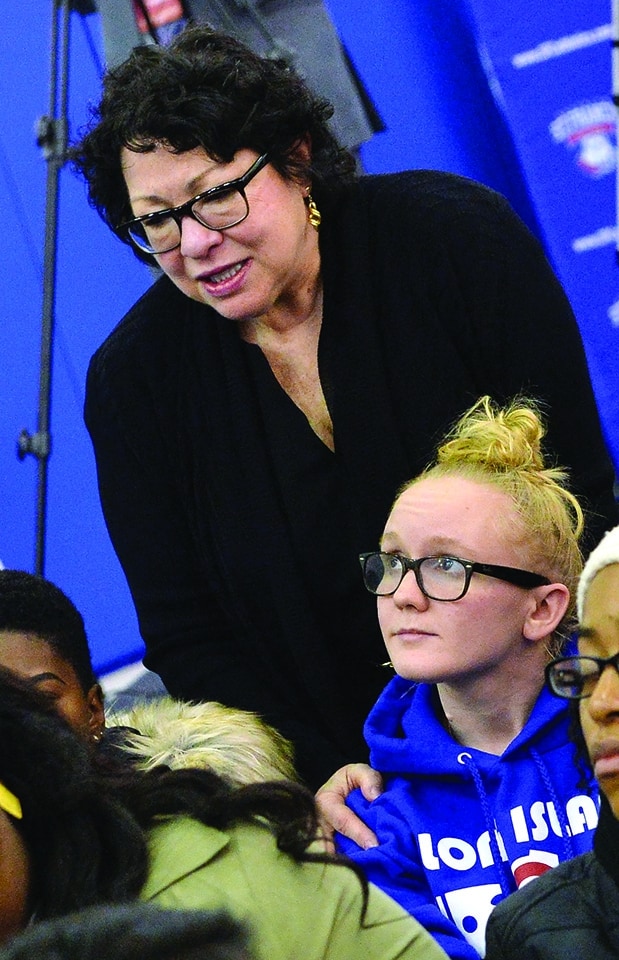
At this point, Sotomayor moved off the dais and began circulating among the audience, answering questions that had been submitted by students.
She spoke of the difficulty of making decisions, and the tremendous responsibility of having to make the ultimate decisions for the country.
“I will look at what bad it would do,” when trying to decide a case. She said it was difficult for her when the rule doesn’t eliminate the bad.
“I’ve learned that reasonable people can disagree, but I’ve learned to respect their sense of passion. There can be legitimacy to both sides of an argument.”
She spoke of the tremendous work involved in researching the cases. “We often end up reading more about the law than the legislators themselves.”
Perhaps the most controversial moment came unwittingly when she was asked about her thoughts on the jury system.
“It’s an imperfect system,” she said. “Jurors are picked from the pool of registered voters, and we all know that certain segments of the population are discouraged from voting.” She suggested that perhaps using driver’s licenses as a jury qualification might provide more representative juries.
Sotomayor’s presentation was punctuated with loud applause, and no doubt more than a couple students left feeling inspired and empowered.
After the talk, Sotomayor was awarded with an honorary law degree from St. Francis, and then was whisked away along with her security contingent.

Author

Discover more from Red Hook Star-Revue
Subscribe to get the latest posts sent to your email.