Many things in Red Hook have surfaced since the flooding that accompanied Hurricane Sandy. One of the most unexpected was Van Gogh’s ear.
This news has been withheld pending verification, but recent DNA testing has confirmed that a piece of earlike looking flesh encased in an old art portfolio is indeed a piece of the old master.
The portfolio was discovered by local artist, Scott Pfaffman floating at the top of his cellar on October 31, 2012. At first, Pfaffman heaped it atop a large green garbage bags full of other ephemera reduced to a wet, stinking pulp by the salty floodwaters. “I didn’t notice it right away, but as I was saying a last goodbye to my artbook collection, I noticed the old case,” Scott said, one recent wintry day.
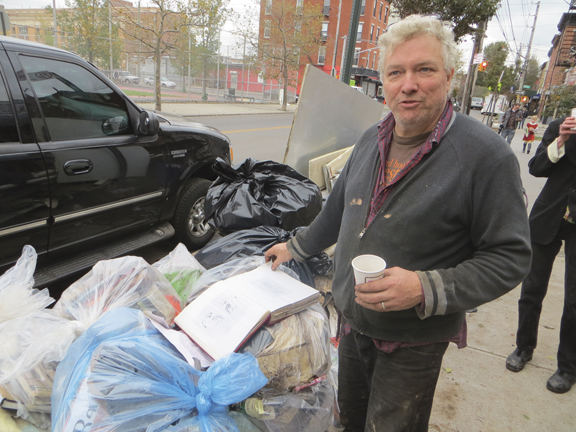
He opened up the case and found a bunch of 19th century colored pencils, some blank sketching paper, and a tin that once contained smoking tobacco. “I opened the tin, as it was a nifty looking antique, and lo and behold, an old, encrusted ear fell out.” Age had hardened it, but it was unmistakenly of human origin. Pfaffman put it back in the tin and took it into his house, and forgot about it for a while.
A few months later, he had some friends over that he knew from the old days in Tribeca. “We started talking about old times at Puffy’s and eventually the conversation drifted to some drunken nights at the Ear Inn, which was over on Spring Street,” explained Pfaffman. “I used to love going to the Ear Inn. One reason was the poetry readings, but another was to stare at the old bottles they had on display behind the bar.”
The Ear Inn, at 326 Spring Street, is an historic building from the 18th century. The bottles were antiques from the 1800s and were discovered by the owners as they dug around inside the basement. As Scott reminisced about the bottles, he got to thinking about the artist portfolio and the tin with the ear in it. As with the bottles, this portfolio was evidently buried in the basement of his own historic Van Brunt Street building – brought to light by the Sandy floodwaters.
He brought out the portfolio and showed it to his artist friends. They commented on the pencils, which they figured were at least 100 years old and made in France. They looked more carefully at the sketching paper. One of his friends found a faded notation on one of the sheets. It seemed to be some sort of note, and it seemed to be signed “Vincent.”
Scott sat up in his chair with a shout. “What do we have here?” he proclaimed. Colored pencils, a piece of artist paper signed Vincent, and a desiccated ear in a tobacco tin, all wrapped together in an artist’s pouch. “It can’t be!” he exclaimed.
Scott goes to a museum
The next day Scott took the pouch and it’s contents to the Metropolitan Museum of Art. He had a friend who worked there, and together, they worked for the next few weeks putting all the pieces together.

Here is what they found:
Van Gogh is said to have suffered through various phases of mental illness. One day cut off his ear, supposedly after a fight with his fellow artist Gauguin, who he was painting with. He put the ear in a box and went out to give it to a prostitute. He then went home and almost bled to death. The police were called and he was sewn up. He lived long enough afterwards to paint that day’s version of a ‘selfie,’ showing his bandaged head. History does not record what happened to the detached ear.
Armed with what was suspected as the ear, Scott’s friend spent almost a year backtracking to see how, in fact, the ear could have ended up on Van Brunt Street. The Thomas Rechercher, took his savings, his vacation days and his curiosity and set out on a global adventure in search of the truth.
His first flight was to Arles. He visited the local historical society and pored over old newspapers. It was lucky that he knew French, as his diligent searching paid off. In an April 1891 issue of the Arles Revue, Recherchez found an item about a local prostitute named Rachel. It seemed that word had gotten out that she might have the ear.
In an interview, Rachel explained that indeed, she had been acquainted with Van Gogh, and a bleeding Van Gogh did show up at her bordello one night to give her a present, an artist portfolio. She admitted that she didn’t really care for the painter, as he was generally dirty and brusque; she never opened the portfolio, and ended up pawning it for a few francs.
It took Recherchez five months to pick up the trail. After countless inquiries, he tracked down the pawnshop. It had been owned by a gentleman named Pierre Barbarot. In France, it is common for families to lay down roots that last many generations. Using city records, Recherchez tracked down Barbarot’s great grandaughter, Phillipa – and a goldmine. The pawnshop stayed in business until the late 1960’s, and Philippa still had some company records. Recherchez found that the portfolio was never redeemed by Mlle. Rachel, and was put up for sale. A tourist from Mola, Italy purchased the portfolio in 1895.
The tourist eventually moved to the United States, settled in Brooklyn, and opened up a sandwich shop in 1922. He didn’t have a lot of money in the beginning. He liked to play poker in the back of the shop, and one day he ran out of money at the same time that he held a full house. His poker buddies, who were all already stuffed with sandwiches and cokes, let him put an old artist portfolio into the pot to make good.
He lost to four of a kind, and the portfolio went home with a gentleman who had recently built a home at 360 Van Brunt Street. He tossed the portfolio in a corner of the basement, and promptly forgot about it. And there it was to lay for ninety years, until Hurricane Sandy brought it to light.

The ear now sits in a display case in the Metropolitan Museum of Art, with a plaque that acknowledges Scott Pfaffman’s donation. This unusual series of events explains one other mystery, according to Pfaffman. “Now we know why somebody keeps planting sunflowers on Van Brunt. Somebody knew!”
Author

Discover more from Red Hook Star-Revue
Subscribe to get the latest posts sent to your email.