In early August, the New York City Department of Environmental Protection announced they had finished the first phase of the construction of the combined sewer overflow (CSO) tank that will sit between the Gowanus Canal and Nevins Street. This phase, which included building a deep underground concrete perimeter around the site, has been a source of concern for neighbors for months, as noxious odors have evaporated from the excavated soil. In our last issue, we wrote about an email thread between Gowanus residents, agency representatives and elected officials, detailing how questions have gone unanswered, promises have fallen through and frustration has grown.
Because of the criticism of the handling of the first phase, which did not receive any community input prior to work starting, the DEP and the Environmental Protection Agency (EPA) attended the most recent Gowanus Community Advisory Group (CAG) meeting to share with the community the options for phase two.
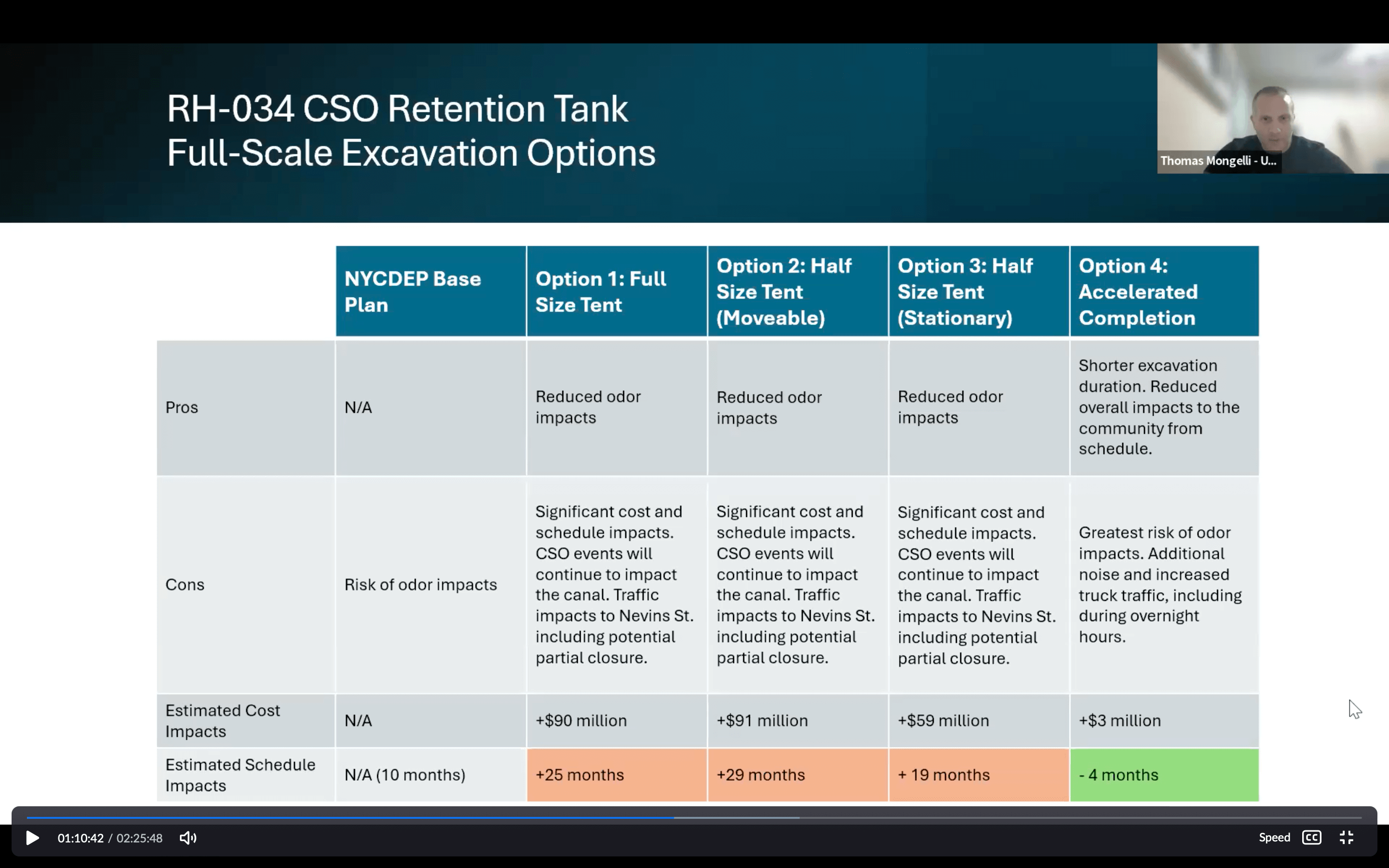
After setting the concrete walls, DEP, the agency in charge of construction (under EPA oversight), plans to excavate the lot to make room for the tank. The city agency claims less contaminated soil will be excavated this time as the digging won’t go as deep as during the first phase. Still, several community members have expressed concern over how phase two will impact the neighborhood. Some have, therefore, asked for a tent to be erected over the site to keep odors from escaping into the neighborhood. A tent covering the entire site is not a viable option, however, according to EPA Remedial Project Manager Thomas Mongelli. It would add 25 months to the current timeline of 10 months for phase two and incur an additional $90 million in costs, based on DEP estimates. The equipment needed to ventilate the tent and clean the air “would not physically fit within the footprint of the site,” said Mongelli.
Similarly, a moveable tent would delay the project almost 2.5 years and cost $91 million more than the DEP’s current plan, which does not include a tent. Covering the southern half — the half with the most contaminated soil — is not as expensive as the other two and would only add 19 months to the current timeline. All three options, Mongelli noted, would reduce odors but likely not eliminate them. Finally, the fourth option to the base plan would be to accelerate the schedule without a tent. This option has the greatest risk of odor impacts but would make the second phase four months shorter than initially estimated. It would mean that about 1,500 tons of dirt would have to be shipped off via truck every day, which is realistic, said Kevin Clarke, portfolio manager at the DEP.
John Prince, deputy director at EPA Region 2, clarified following Mongelli’s presentation that the estimates of additional time and costs are not to be taken as fact. “Don’t take the timeframes as gospel, and don’t take the costs as gospel. They’re the best the city can do to approximate what the cost additions would be to implement these options,” he said.
Prince added that getting the work done so that sewage is kept out of the canal is also important.
The alternatives are still being evaluated and no decision has been made, said Mongelli, indicating that the community, while it has now had the chance to see the different potential routes, will have no say in what plan is chosen. This was not met with a lot of enthusiasm from community members. “The notion that somehow decisions will be made on one of these four options without consulting the community is, quite honestly, shocking. Shocking,” said Dr. Hildegaard Link.
The EPA’s plan is to hold another meeting where the different options are presented to the community in more detail, but the federal agency’s representatives at the CAG meeting did not say when that would be.
Author

Discover more from Red Hook Star-Revue
Subscribe to get the latest posts sent to your email.