How does one make art from catastrophe? Look to Eleanor Kipping for her answer.
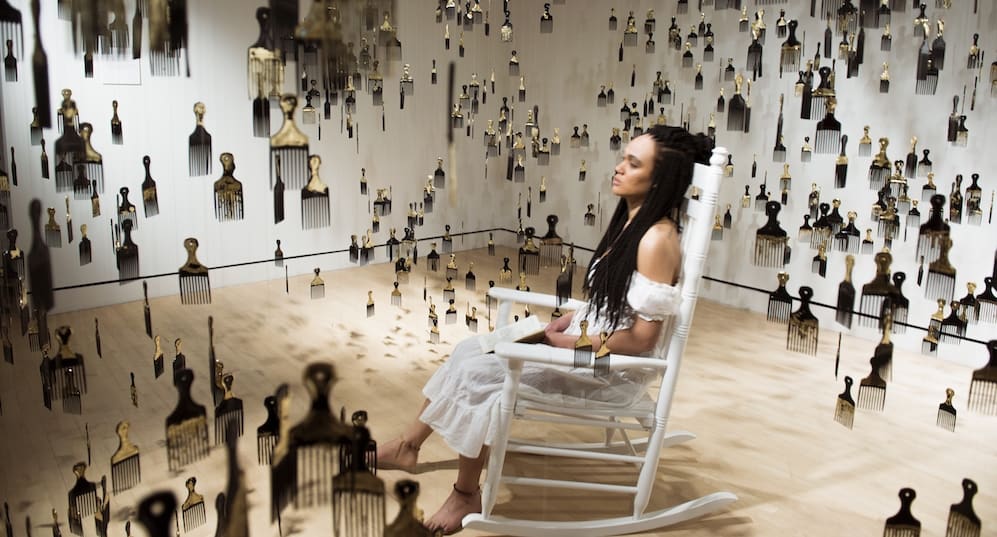
Strange Fruit, a hybridized art performance and installation piece, is a sculptural, theatrical, and poetic representation of Black oppression throughout American history. Hundreds of black plastic afro picks dusted with gold leaf are suspended from the ceiling by transparent fishing line. They hang at various, scattered heights, filling the room like a cloud. Kipping sits at the center in a white Sunday dress, on a white rocking chair. Her back is to the door of the display room. Ambient sounds from outside—the bang of roll-up gates, the bump of a passing car’s stereo—blend into the creaks of her chair and the shuffling of guests circling the exhibit’s edge. For several hours, she reads self-composed poems and sings fragments of songs that interrogate racial identity and the second-class citizenry experienced by generations of African-Americans. Long silences between poems promote reflection and observation. Inside, one has the feeling of having entered the mind of the artist herself.
Kipping’s voice, at times melodic, at times pained, is always gripping, and holds the viewer’s attention, preventing the all-too-common impulse to glance at and pass over visual art. This is part of the power of integrating performance and sculpture, creating many angles from which to engage with the art and its message.
Three Edison lightbulbs glint off the gold leafing and cast distorted and elongated shadows of the hair picks on the ground and walls, exaggerating the dimensions of the space. Each small motion of a hanging pick is doubled and tripled by the corresponding movement of its shadows. After a moment, you realize you aren’t just outside the installation gazing at it but surrounded by its projections.
Sitting around her as Kipping by turns recites and grows quiet, the visitors’ eyes are led to wander through the hanging maze of afro combs. As one stays in the space, the depth of the symbolism emerges. The hair picks begin to appear like human heads and torsos, delicately swaying and twirling, and the reference of Kipping’s title returns to you: Strange Fruit.
The song popularized by Billie Holiday was inspired by a 1937 poem of the same name. Her rendition went on to inspire much music and literature interrogating the morbid imagery. Kipping’s art honors and expands that legacy, incorporating both modern day and ancient materials. Her chair and outfit are reminiscent of an earlier century and the mass-produced plastic products are juxtaposed against the gold, about which the artist says signifies the wealth lying at the root of America’s colonial history and the slave trade itself.
Kipping says her intention for the piece is to be “an ancestral plain – a space in between here and there, past and present, alive and dead. For some it might suggest an altar, for others a grave […] It’s both inside and outside, it’s a meeting place, a place of rest.” Yet despite the atmosphere of sacredness, she doesn’t want bowed head reverence. She wants to break the line between art and the viewer and encourages the space to be interactive.
During the hours she isn’t performing, her notebook and its handwritten poems are left on the rocking chair for others to sit and read, to themselves or aloud. It’s an act of vulnerability, a surrender of artistic control, though without forfeiting the artistic power and impact of the piece. On the contrary, it amplifies it, pulling the viewer in. Here, Kipping is not exposing a concern isolated to herself, but addressing a condition that touches everyone who shares a space, be it a gallery or a nation.
The exhibit is on display at FiveMyles, a non-profit gallery located at 558 St. John’s Place, Crown Heights, through April 28th, with performances by the artist to be held Thursday, April 18th at 6:30pm and Saturday, April 27th at 4pm. For more information, visit www.fivemyles.org/eleanor-kipping
Discover more from Red Hook Star-Revue
Subscribe to get the latest posts sent to your email.