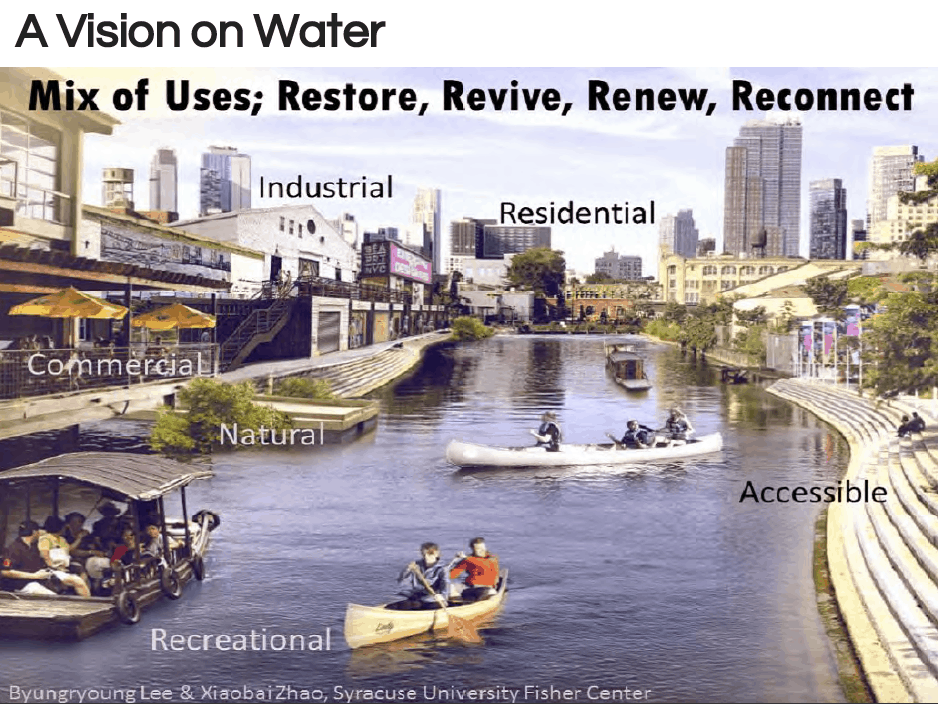
As conversations about the impending Gowanus upzoning and Superfund cleanup continue, ideas are beginning to form about how the Gowanus Canal’s shorelines can be better utilized in the Waterfront Access Plan. The Gowanus Dredgers Canoe Club provided some suggestions during their presentation to CB6’s Economic/Waterfront/Community Development & Housing Committee on March 18.
“Our waterfront is unique in the sense that it’s a canal way – not a river way with large esplanades, bike paths and highways,” said Dredgers’ Treasurer Owen Foote, who is also an urban planner and architect.
To prevent underused amenity space along the shoreline, the Dredgers suggested having cultural and active passageways with, for example, rock climbing walls and mixed-use paths inclusive to slow-paced biking. Additionally, integrated waterfront service facilities (i.e. boathouses, barge docks, floating walkways) and integrated services offering food, marine supplies or boat storage could be in use nearly year-round.
“[This] is trying to find a way to prevent the shoreline from just being a long row of glass and brick that rises up vertically from the path,” said Brad Vogel, the Dredgers’ captain. “You want variety. Otherwise it’s going to seem boring … and no one’s going to find this to be a unique place that they want to go to.”
Other pitches included have charging stations, rumble strips or bollards on low traffic, dead-end streets to create ‘play streets,’ and ground-floor publicly accessible and useable spaces (similar to Whole Foods’ 2nd floor). Plus, since the neighborhood is known for its creativity and artistic talent, rotating art programs and art installations at street ends, bridges and open spaces should be encouraged.
Most importantly, the Dredgers stressed that mandatory access to and from the water at all City street ends and at any development with 100 or more feet of shoreline should be implemented – via ramps leading into the bulkheads.
“It gives people who are using recreational watercrafts the ability to take boats in and out of the canal,” Vogel explained. “But it also doubles as a place where people can be safely taken in and out of the canal.”
The Dredgers also stated that these ideas were not just their own; some overlapped and came from previously brainstorming with locals and other organizations, such the Gowanus Canal Conservancy. Public comments during the March meeting also suggested building more education about the waterfront and establishing collaborations with schools, so students can learn more about the canal and its surrounding environment.
Top photo from the Gowanus Dredgers’ presentation to CB6 on March 18
Author

Discover more from Red Hook Star-Revue
Subscribe to get the latest posts sent to your email.
One Comment
Is it surprising that the important things the community advocated for cannot be found in the DCP rezoning plans?
-no active recreation
-no water access
-no historic preservation
-absolutely no sustainability plans
-nothing for expanding, let alone even maintaining, the artist communities
-no hydrology addressing for regional drainage impacts
-no plans for addressing what will be more concentrated noxious sewage discharges
-no schools or other public institutions like libraries or environmental education facilities
——-just to name some of the things that have been brought to the city and councilman’s attention over the past decade on rezoning discussions.
The only thing that is certain in this rezoning is that developers get to make huge impositions on the existing community at great advantage to them, and great cost to all in the community.
And how easy it is to impose top-down zoning under the city government structure. No need for regime change here. All means for the people to alter, or even dismiss, such unwanted zoning actions have been eliminated from the city charter. The fake community boards will speak for the people, so long as the board does as they have been told to do by the overlords who appointed them.