I’ve been going to Vincent’s Barber Shop on Cortelyou Road in Brooklyn since I moved to the Ditmas Park area in 2003.
Until recently, there has always been a packed crowd waiting for haircuts and shaves.
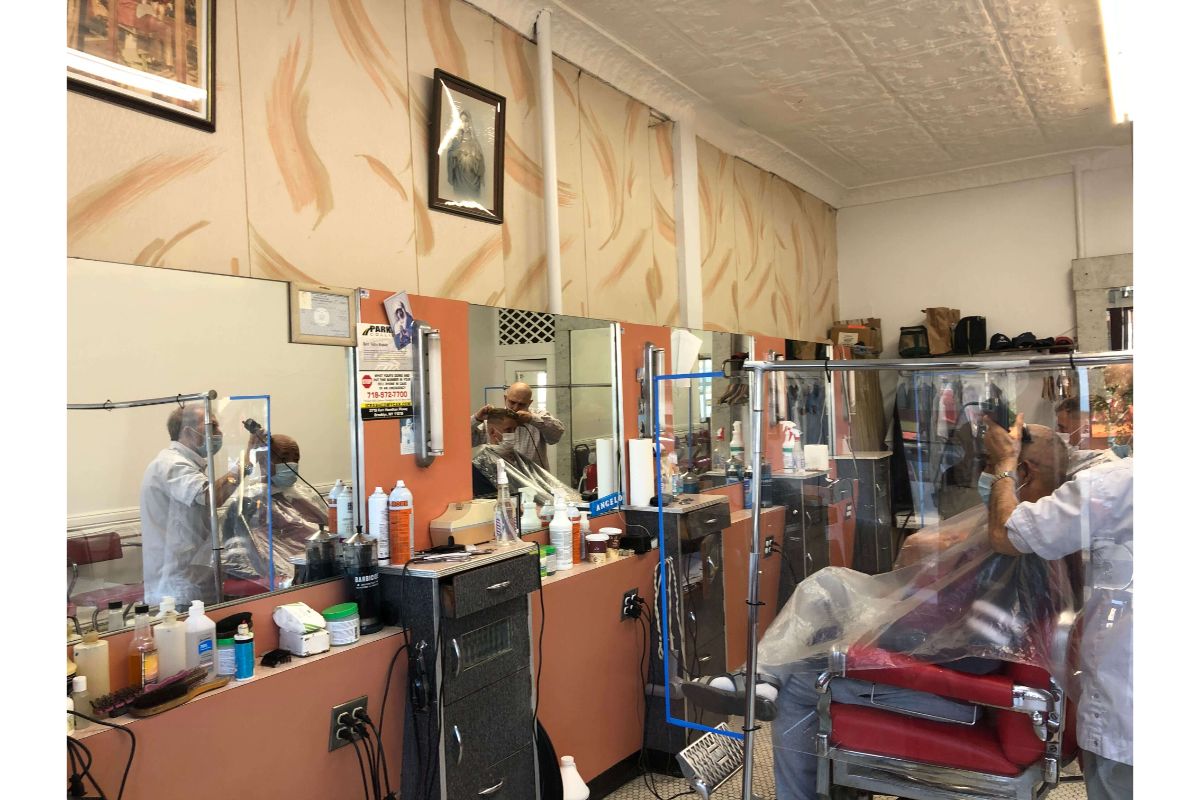
And now, since COVID, when I walk into the shop, I wear a mask. Everyone who enters the shop has to wear a mask, especially while getting a haircut. And when you’re in the barber’s chair, you’re covered in plastic. And each station is separated by fiberglass dividers.
Today there are a few people ahead of me. I sit down to wait my turn.
When I first started going to Vincent’s Barber Shop, what got me hooked was that I could not only get an excellent haircut, but I could practice my not so great Sicilian. Vincent and his son Vinny speak Sicilian the way my grandparents did. Like many Americans, my grandparents only spoke Sicilian to talk to each other, so whatever I learned, I learned by listening closely and asking questions.
Interestingly, Angelo, one of the other barbers, also from Sicily, often doesn’t understand my Sicilian. Of course, this makes me feel even more self-conscious than I already do about how poorly I speak the language.
“You’re close, you just have to work on your diction,” says Vinny, the owner’s son, trying to make me feel better. “Ok, venica, come sit in the chair,” he adds.
Vinny and I sometimes speak Sicilian, mostly in words, as opposed to full sentences, to communicate something we don’t want the other customers to hear. We jokingly use expressions like malducati (rude) or sfachiem (bad person). Before Vinny’s father, Vincent, passed away in 2018, he and I also had similar “conversations” in Sicilian. Vincent was a very gentle and nice man. He gave my youngest son his first haircut. My wife and I even videotaped it.
Originally from Catania, Sicily, Vincent came to New York in 1960. Vincent’s father, Gaetano, and Vincent’s grandfather were barbers back in Sicily.
Now sitting in the chair, looking in the mirror, I say, “My mother says that her grandfather from Sicily was a barber and that he also performed some basic medical procedures. Did your grandfather do the same thing?”
“He pulled teeth,” says Vinny, laughing.
“My mother says that her grandfather did other things, too. Like removing moles.”
“Barbers knew how to use sharp instruments, like scissors and razors. And if you lived in a small village and needed to have something lanced, a tooth removed, you couldn’t wait for a doctor.”
“That makes sense,” I say.
“What do you want today?” asks Vinny, looking back at me in the mirror.
“Today I just want a trim. Let’s do La Grande Cosa next week.” By La Grande Cosa I mean my once a month bigger haircut. Sometimes the distinction between La Grand Cosa and a trim is slight. Being a good barber is about giving people what they ask for, even if what they ask for doesn’t really make sense.
More than just getting a trim today, I’m asking Vinny about the history of the shop.
Vinny tells me that his father came to the United States with an arranged job and a place to live.
“In those days, paisans from the same town in Sicily would help you come over to the States.”
“Did he work in Brooklyn?”
“No, first he worked in Manhattan. But, working for the union, they sent him to work on Saturdays in the shop we’re in today.”
“There was a barbers’ union? I didn’t know that.”
“There used to be, but no longer.”
“Is that when he bought the shop?”
“No, he worked in the shop, then that owner sold the shop. Ironically, a friend that he knew bought the shop from him years later.”
“So your father worked here before he bought the shop?” I ask.
“Yes, then the guy wanted to retire,” says Vinny.
“Was it expensive to buy?”
“Not in those days. He sold my father the chairs,” pointing to the chairs still in the shop, “sold him equipment, and signed the lease over to him.”
“Man, life was different in those days,” I say. “You’ve told me you have brothers. Why did you decide to become a barber?”
“I didn’t want to go to college like my brothers,” replies Vinny, chuckling. “I didn’t know what I wanted to do.”
“Do you think you’ll retire from here?”
“No,” he says emphatically. “First of all, the business has been impacted by COVID. Secondly, if the current landlord sells the building, the new person might raise the rent and kick me out.”
“What do you think you’ll do?”
“I’ll figure that out when the time comes. I have two boys to put through school, so I’ll have to do something. But for now, I will be a barber, like my father was, his father and his father before him.”
Vincent’s Barber Shop: 1505 Cortelyou Rd, Brooklyn, NY 11226, (718) 693-0619
Mike Fiorito: www.callmeguido.com
Author

Discover more from Red Hook Star-Revue
Subscribe to get the latest posts sent to your email.
3 Comments
Pingback: "Brooklyn NY" – Google News: In Sicily, some barbers also pulled teeth, by Mike Fiorito – The Red Hook Star-Revue | The Brooklyn News
Pingback: The Brooklyn Bridge: "Brooklyn NY" – Google News: In Sicily, some barbers also pulled teeth, by Mike Fiorito – The Red Hook Star-Revue | Brooklyn Classifieds - bklynclassifieds.com
Pingback: The Brooklyn Bridge: "Brooklyn NY" – Google News: In Sicily, some barbers also pulled teeth, by Mike Fiorito – The Red Hook Star-Revue | News-Lynx - news-lynx.net