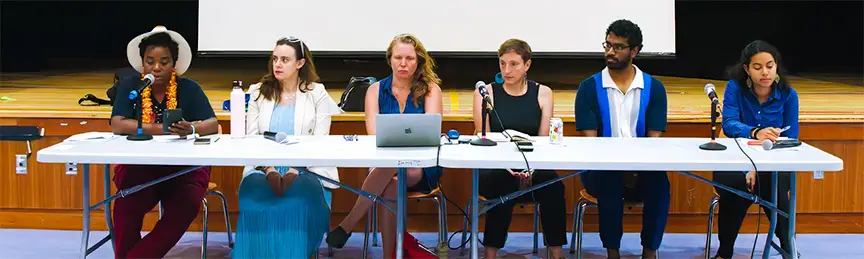
Parents, community members and state officials gathered in the gymnasium of P.S. 372 — the Children’s School — in Gowanus on Thursday, Sept. 19, for a presentation from the state’s Department of Environmental Conservation and Department of Health on the agencies’ soil vapor intrusion investigation, which began last year.
In September 2023, the state launched a Gowanus-wide investigation to uncover how widespread the issue of soil vapor intrusion is in the neighborhood. The first round of testing, conducted during the 2023-2024 heating season, was done in 113 buildings across Gowanus, and it revealed 15 cases where the levels of toxic vapors were so high that the buildings required mitigation.
Ahead of the second round of monitoring, which will happen during the 2024-2025 heating season, the DEC and the DOH called the community to an availability session where Gowanus residents and other concerned New Yorkers could ask agency representatives about the results from the 2023/2024 sampling report.
The meeting drew a crowd to the Children’s School, itself a site connected to the soil vapor intrusion investigation, as it was recently revealed that elevated levels of petroleum-related vapors had been found in the school’s basement.
But ahead of the presentation, community members didn’t exactly exude confidence in what the DEC and DOH would deliver.
“Low,” one parent said and laughed sardonically when asked about her expectations for the night. The parent, who wanted to remain anonymous, had just moved to the neighborhood when she heard about the benzene vapors in the school’s basement. Her son had just begun his first semester in P.S. 372. “Not a fun start, but hopefully, it gets resolved sooner rather than later,” she said.
The presentation was primarily held by the environmental conservation department’s Aaron Fischer and the health department’s Scarlett Messier-McLaughlin. Fischer, the project manager, focused on how the monitoring was conducted and gave insight into how the state agency works with property owners. Notably, mitigation systems for buildings with vapor levels over the state’s guidelines are offered at no cost.
Messier-McLaughlin followed and tried to ease concerns over the health risks of living in a building with toxic vapors in the indoor air. “No substance can harm you unless you come in contact with it. And if you do come in contact with something, it doesn’t mean a health effect will occur,” she said. She explained how the Department of Health sets its guidelines for acceptable limits of toxic vapors in indoor air and how the agency evaluates results from soil vapor intrusion monitoring. She highlighted the DOH’s decision matrices as essential guides for responding to elevated levels of harmful fumes. She clarified that the limits set by the agency for when mitigation is required are set conservatively and are below the amounts required for people to experience health effects. Messier-McLaughlin also noted that chemicals are a part of our lives. “There’s a lot of people who don’t want any chemicals in the air. That’s not practical. It’s not even possible, necessarily, to have zero chemicals in the indoor air for some of these analyses. But that doesn’t necessarily mean that there are health effects associated with it,” she said.
Following the presentation, questions submitted by the audience were answered by DEC and DOH representatives. As expected, many were concerned with the toxic air in the Children’s School. Heidi-Marie Dudek, DEC section chief at the Division of Environmental Remediation, explained that a design for the mitigation system that will be placed in the school’s basement is nearly complete. However, she added, the system won’t likely be installed before Christmas, and the agency is currently aiming for early 2025.
If you live outside the area subject to the investigation, you may still be able to get your building tested, the DEC announced. However, it depends on how close you live to the boundaries of the designated area, and the decision lies with the state.
The two state agencies provided plenty of important information and clarifications, giving the community some much-needed answers. But they also left the audience with a few head-scratchers.
“Good news is, we didn’t see nearly as much contamination as one might expect from an over a hundred-year-old industrial area. It’s not everywhere. It seems to be small, isolated areas,” Dudek said when asked if any patterns had emerged from the first round of the investigation. This claim is somewhat puzzling, given that only about one of six buildings included in the first phase were tested. Several buildings along the Gowanus Canal currently under the state’s brownfield cleanup program, have also been found to have significantly elevated levels of harmful vapors.
After the meeting, Patrick Foster, deputy commissioner of environmental remediation and materials management at the DEC, clarified the claim, explaining, “We haven’t found any concerning hot spots during the first phase beyond what we already understood.”
He wants more properties to be part of the study, he said but admitted that there is a belief that the monitoring could uncover information that would affect property values.
Since this summer, when information about toxic soil vapors became known to the larger public, many community members have criticized the environmental conservation department for not securing the health of the community long-term. Foster said the soil vapor mitigation systems can run for “a long time,” and they will warn the user if they malfunction. He added that the community can trust that the agency adequately protects public health in Gowanus. “We do these types of cleanups all throughout the state of New York. We’ve been doing them for decades. We are experts at them, and we are very confident that our regulations and our standards that we hold everybody to when they are doing a cleanup under one of our programs are sufficient for the protection of public health and the environment.”
Some Gowanus residents were not convinced by the state’s presentation, however.
“It did take a lot of pressure from the community to have them do this testing, and we had to push for that to happen, and I think they realized it needed to happen,” said Joan Salome-Rodriguez, a member of the Gowanus Community Advisory Group. “But my concerns are that they’re always picking this easier, cheaper alternative. I don’t care if a developer has to pay $10 million more, honestly, to really make it clean.”
Author

Discover more from Red Hook Star-Revue
Subscribe to get the latest posts sent to your email.