Jason Moran was the subject of my first column, some five and half years ago. The pianist (and artist, teacher, etc.) had a fascinating and frustrating exhibit/installation at the Whitney, a great honor for anyone, let alone a musician, but an ungainly fit between the fleeting nature of music and the collection of static objects that define a museum. As I wrote then:
“Not that he doesn’t deserve such an honor, nor that jazz should not be recognized by a our important institutions—Moran should be celebrated as widely as Bob Dylan or Beyoncé, and jazz should be at the forefront of American culture, every day of the week, all year round. So a great American musician given a show at a museum for great American art should be a natural fit, a site for the realization of meaning in the branding and synergy that administrators and marketing people chase like cats following a laser pointer along a wall. But Moran is a musician, the Whitney a museum, the alchemy between the two as tricky to pull off us, well, alchemy…
As music, [this] just need[s] a bandstand and space for the audience … they can happen at the Village Vanguard, or Zankel Hall, or Roulette, they don’t require a museum exhibit. And as an exhibit, Jason Moran is disappointing; it feels like a gift the Whitney has given to the pianist, full of specific, personal satisfactions and insider-ish details, but as something for the public it is thin, small, and feels more like polite salesmanship than a display of insight and revelation.”
Moran is all about insight and revelation. Every time he plays, expect not just magic and beauty, but some exploration of the history of Black American music. When he plays pieces by other musicians, his own compositions, and improvises, he’s mining this history and reliably pulls out nuggets of gold—the gold of insight and revelation. The light shining off these nuggets comes from the past and the present, and carves a path toward the future.
The Whitney installation fell halfway into Moran’s tenure programming the Artists Studio series at the Park Avenue Armory. He began that with a solo performance, available as his album The Armory Concert and released himself on his Bandcamp page, jasonmoran.bandcamp.com. He marked his time at the Armory in early January with two ten-year anniversary solo concerts.
Moran spent a key period in his life studying with the late, great pianist Jaki Byard, a musician who took that leap from the 1920s to post-hard bop modern jazz. He had a way of playing with freedom that wasn’t in the manner of the “New Thing” of Cecil Taylor and instead took what Fats Waller, James P. Johnson, and other early jazz musicians were doing and discarded the formal notion that he had to stay exactly within the bar lines and song forms. Waller used to press against those, a joyous stressing and tension of using music as a launching pad to get to someplace a little further, a little more distant technically and expressively. By the time Byard came up, playing with Eric Dolphy, Booker Little, and in the Charles Mingus’ mid-1960s Sextet, one of the very greatest jazz ensembles there has ever been, free jazz was established. What Byard did in his playing was channel stride and barrelhouse through the freedom that Taylor, Dolphy, and Ornette Coleman were codifying.
Perhaps that type of playing isn’t to everyone’s taste, but it is among the most important ways of making jazz. There’s very little that matches Byard—and by extension Moran and, in a similar vein, Sullivan Fortner—in what he showed jazz could be, a complete balance of form and freedom, structure and spontaneous invention, vernacular and abstract. Moran and Fortner build on this. It’s in their pianism.
The instrument is key. A saxophonist like David Murray can channel past greats like Ben Webster through the way they create and adjust the timbre on the instrument. But a pianist, with two hands and ten fingers, can pull out harmonies and chord voicings, contrapuntal melodies and rhythms from the past, they can use one hand for history and another for modernism. Both Moran and Fortner have exceptional harmonic sense and alter the original harmonies of classics like “Body and Soul,” changing chords here and there but maintaining the overall shape. The source is clear, and just as clear is how it’s no longer a tune from 1930, it’s music of the here and now.
There’s tremendous appeal to this way of playing jazz, a personal expression of the moment and the path that got us all to it. Playing like this collapses time into the now. Light- and bright-feeling music, like the fifty-year old Allen Toussaint title track on Fortner’s 2025 album Southern Nights (Artwork) doesn’t gain weight but it gains historical mass, it expands through so many dimensions. There’s joy there, and it reaches further, as if each year added another inch to it.
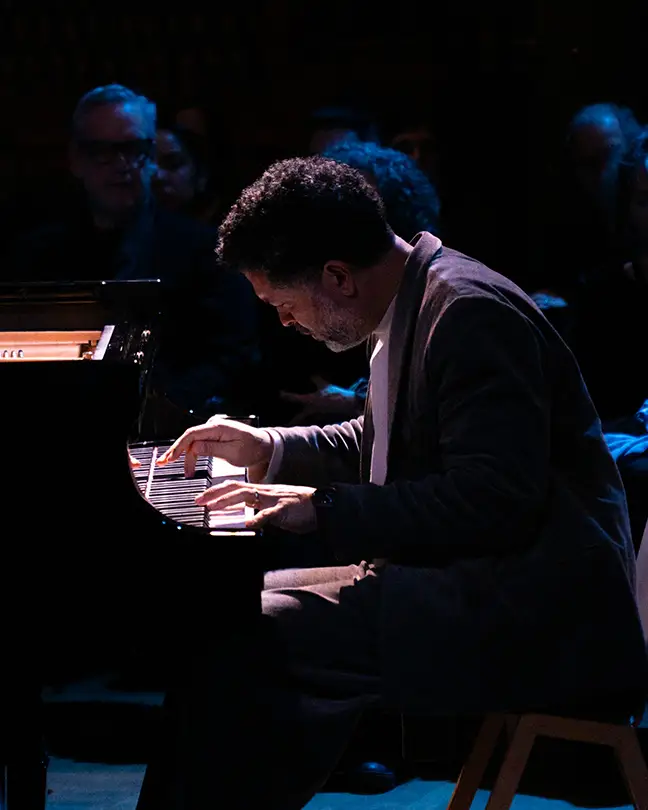
At the Armory, Moran played some music from The Armory Concert recording, like “Reanimation,” his fascinating ostinato that sounds like a mix of Robert Schumann and Radiohead. The high point, and a truly astounding musical experience, was when he started playing Duke Ellington’s “Black and Tan Fantasy” (it’s worth a small sidebar here to bring Ellington into the Byard context, because the great composer and bandleader was always pushing at the limits of form in a way that Byard clearly learned from). Moran’s playing was elegant, wise, touching. As he built up an improvisation that extended from the song, he worked his way down to the bass register of the keyboard and segued into his own “Magnet.” This is a completely abstract exercise in rolling, roiling drone, his two hands cycling through a tremolo-arpeggio and producing a rumbling from the piano.
This went on for several minutes, past the point of wondering how long he could play this while keeping it making sense, to wondering how long he would play it—with the exciting possibility that he would play it for a long, long time and then end with it. A slight movement upward hinted at some sort of modulation, and then Moran simply popped back into “Black and Tan” fantasy, but at the perfect moment in tempo, rhythm, and time, an extended drone as an interlude in a 1927 composition that not only sounds like the era and place of the Harlem Renaissance, but that brings that time and place to life again 100 years later. Because Ellington, Harlem, Byard, Fortner, Moran, the history of Black American music and jazz, are never out of time nor place. These cats are never out of style.
Discover more from Red Hook Star-Revue
Subscribe to get the latest posts sent to your email.