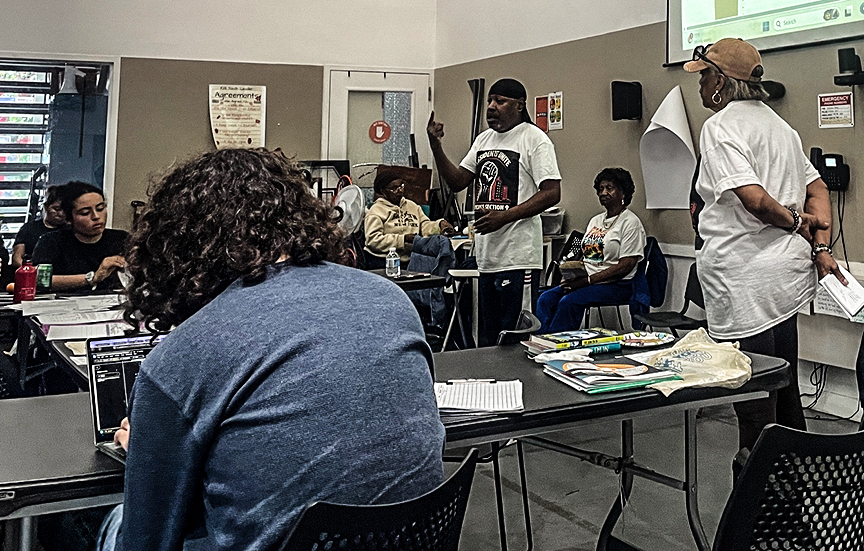
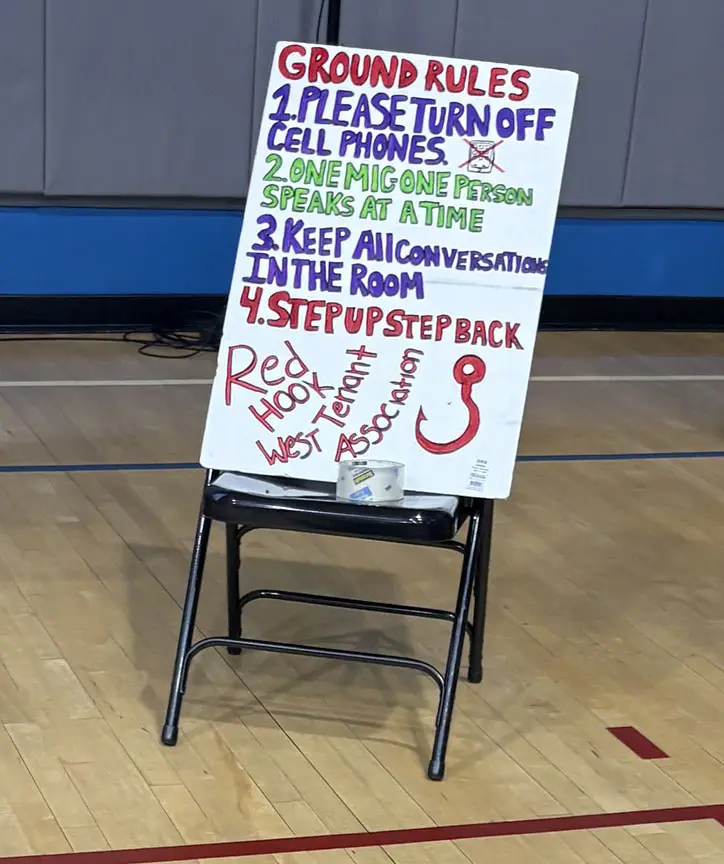
At the second residents-only community meeting to discuss Red Hook West’s PACT conversion on Oct. 21, Resident Association President Karen Blondel said that these meetings were being gatekept due to frequent outsider desires to influence the housing complex.
“We got too many outsiders trying to make decisions for my residents, and it’s not about that on my block,” said Blondel at the meeting, in a recording obtained by Red Hook Star-Revue. “If these non-profits go ‘Hey Karen, can I send somebody?’ [to the meetings], if they don’t live in Red Hook West, they can’t come.”
While it’s not clear which non-profits Blondel was alluding to, the meeting at the PAVE Academy gymnasium remained off-limits to the general public.
The meeting was another chance for residents to learn about the federal program to convert NYCHA complexes to federally-funded Project-based Section 8 housing, which allows developments to access federal dollars for repairs. Complexes would receive extensive renovations and be managed under private companies, but still remain under NYCHA ownership.
Jonathan Martin from BFJ Planning, a firm consulting the planning process at Red Hook West, gave a recap of the first meeting in September, going over the key issues residents said they dealt with during the engagement session from that event. The largest issues residents wanted remedied were upgrades to the complex grounds and improved safety, security and cleanliness within the buildings and grounds.
Some of the top two quality of life concerns included issues with vermin and holding dog owners accountable for their canines’ behavior. Others called for improved lighting, on-campus security and more social services. Social services are part of the package in a PACT conversion, where complexes are granted partnerships with social service providers on site.
NYCHA representative Edward Carmody then took over and led residents through what would change and what would remain at the houses under the conversion. He stressed that rents would remain at 30% of their income, and what it means for individual residents once the property transitions to Project-based Section 8.
“Everyone here who’s living here legally is automatically eligible — you don’t need to apply.”
Carmody also addressed temporary relocation, which is necessary in some cases due to the amount of construction that might take place in a building. In this case, the selected development partner would cover the relocation costs.
Martin from BFJ then turned to a survey conducted in partnership with NYCHA and BFJ Planning, displaying resident satisfaction at developments that underwent PACT. According to the survey which took place at four unnamed developments, 77% of respondents said they were “very satisfied” with building renovations. Almost 90% percent were “likely or very likely” to recommend PACT at other developments, in addition to recommending their own converted complex as a place to reside. Almost 70% said their complex now has better management, and about 80% said the campus is cleaner than before.
Martin added that the first campus surveyed was Ocean Bay Apartments in Queens, where “a lot of them [responses] were positive, some were negative, some were sort of in between.”
Ocean Bay was one of several PACT complexes that saw a rise in eviction rates post-conversion, according to a report from the New York City Comptroller’s office. The Arverne, Queens complex saw a 363% increase in evictions between 2021 and 2023. While the rate of evictions dropped between 2023 and 2024, the pace of them at Ocean Bay was well above those happening at non-PACT developments.
In an email to NYCHA asking about evictions at PACT-converted complexes, a spokesperson told the Star-Revue that there was a huge drop between the amount of cases where pre-eviction outreach is initiated and the number of cases where eviction starts, and again when eviction is completed. The spokesperson added that eviction rates at PACT developments have remained under one percent.
At the end of the meeting, residents were invited to sign up for a tour of the PACT-converted 572 Warren Street on Nov. 8 at 10:30 a.m. According to a flyer for the event, free round trip transportation will be provided from Red Hook West, with residents meeting at the Resident Association office at 428 Columbia Street, Apt. 1C.
The next meeting on Red Hook West’s PACT process will be on Nov. 18th at 6 p.m., focusing on the design of the project.
Discover more from Red Hook Star-Revue
Subscribe to get the latest posts sent to your email.