Thank you for the opportunity to respond to the recent interview with Gersh Kuntzman and Kevin Garcia “Opponents of BQE tunnel think trucks and cars are the problem…” by Eric Newstrom. This is probably one the most important issues facing the communities along the BQE corridor, so thank you to the RED HOOK STAR for facilitating this public dialog especially as we are right at a critical fork in the road. The need to fix the Triple Cantilevered Roadway (TCR) to prevent it’s failure is driving the need to make really big decisions that will have long term consequences now.
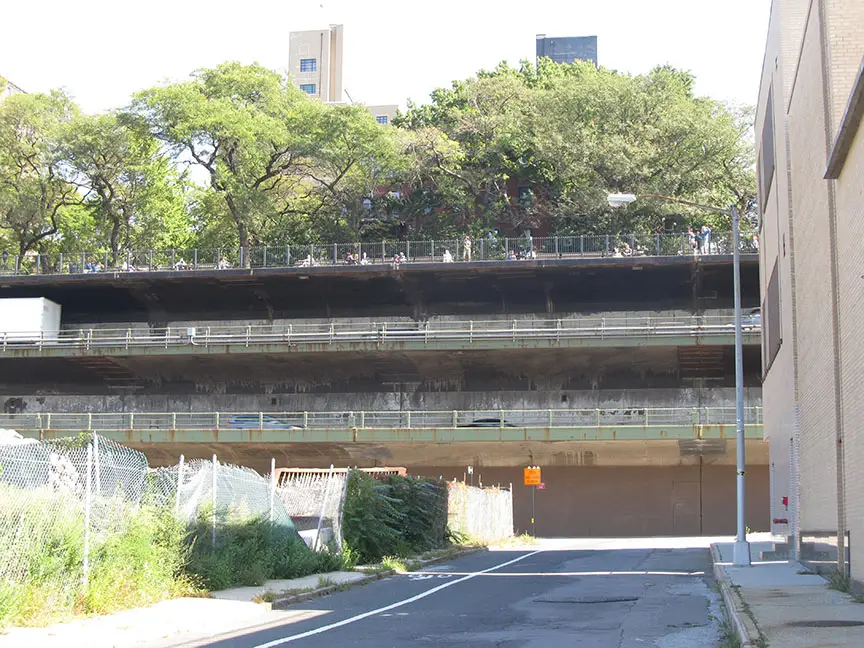
We could choose to pursue a transformative solution that actually addresses the issues or we can pursue a painful, costly reconstruction of the Triple Cantilevered Roadway (TCR) section of the BQE only to maintain the current and projected future volume of I278 traffic on the current BQE Central alignment— a choice that guarantees that all problems along the BQE corridor will get worse as traffic volume on the BQE corridor continues to increase.
Unfortunately the City has chosen the latter. NYC DOT is planning to spend more than $5 Billion and will detour 150,000 cars and truck through residential communities and downtown Brooklyn streets for 3-5 years for a TCR replacement that provides no actual transportation benefit, adds no additional capacity, provides no quality of life improvement, no Transportation Related Air Po
llution (T.R.A.P.) reduction or improvements for any underserved communities— zero.
The one benefit of the City’s plan is to prevent the TCR from collapsing (due to many years of insufficient maintenance). We all agree the TCR needs to be safe, but we all must face the reality that even with a brand new high speed 3-lane TCR, there is simply no way that BQE Central can be re-engineered into a modern, Federal interstate highway capable of processing the current volume, let alone handle the projected increase.
The real problem is that the original BQE— now called BQE Central was built in the wrong location for a major interstate highway. It is too narrow, too curvy, has too many elevation changes and pinch points to be modernized. The original BQE was originally designed to handle 47,000 vehicles per day. Today, that volume is over three times the designed capacity and is projected to grow dramatically. The world’s finest engineers can not create a modern, high volume interstate highway along the current path of BQE Central— even with a completely rebuilt TCR.
Fortunately, Arup, one of the world’s most prominent infrastructure engineering firms, was commissioned by the NYC Council in 2019 to recommend best solution for the BQE and to review all proposed solutions. After considering all alternatives, Arup supported my proposal to dig a new, deep bore tunnel underneath downtown Brooklyn to become the new alignment for I278— connecting BQE North to BQE South. The tunnel, as Arup points out in their 2020 report “The Future of the BQE” is the only truly transformational solution that makes revisioning BQE Central possible.
The tunnel delivers immediate benefits. In 2010, NYS DOT estimated that 60% of all traffic on the BQE is “through traffic” — meaning that these vehicles are just passing through Brooklyn for destinations north and south of Brooklyn. If 50% chose to take the shorter 2.74 mile tunnel instead of the current 4.47 mile surface route, this would remove up to 70,000 cars and trucks from surface roadways, would save each vehicle between 12 and 20 minutes per trip and millions of gallons of fuel. 50% less traffic on BQE Central means less overflow traffic on our neighborhood streets along with fewer pedestrian and biker deaths. It also means a 50% reduction in T.R.A.P., CO2 and UFPM for all the neighborhoods in BQE Central. And smoothing the flow of traffic through BQE Central could also help reduce congestion, overflow traffic, T.R.A.P., CO2 and UFPM emissions for the neighborhoods living adjacent to BQE North and BQE South. The tunnel could also be used for large scale carbon recapture as this new technology emerges. There would be a big financial benefit for taxpayers as well— tunnels are paid for by tolls on roadway users. And finally, the disruption caused by tunnel construction would be a 1 or 2 on the Construction Disruption Richter Scale compared to a 9 or 10 for rebuilding the TCR.
But the most important benefit the reduction of volume and elimination of heavy trucks on the TCR is that it makes possible a dramatic re-visioning and transformation of BQE Central. Let’s sketch out some of the possibilities:
• The TCR could be made safe as a 2-lane highway in line with the recommendation made by the BQE Expert Panel. This would save $ Billions, preserve the Promenade, prevent the immense community disruption reconstruction would entail and eliminate the multi-year need to detour highway traffic through downtown Brooklyn.
• The highway north of the TCR — the highway section between Sands Street and Flushing Avenue adjacent to Ingersoll Houses— could be turned into an urban boulevard by removing the entire elevated structure. Traffic volume and T.R.A.P could be reduced for these residents by more than 50%. The improved access, health and safety of Commodore Perry Park would be a huge benefit to the residents of the adjacent public housing as well as Downtown Brooklyn and the entire Brooklyn Navy Yard area.
The Cobble Hill/Carroll Gardens Trench could be revisioned as an urban boulevard or reconnected by bike/pedestrian bridges that would improve access and restore mobility. The 50% reduction in volume and elimination of most heavy trucks in the trench would cut T.R.A.P and CO2 by half for many thousands of residents right now. This was studied in 2011 with a generous grant from Congresswoman Nydia Velázquez.
• The section located between the Prospect Expressway and the Hugh Carey Tunnel might be the most challenging and probably the most costly— but could be the most transformative. Cutting the volume in half would result in a huge reduction in TRAP. It might make it possible to remove the elevated Gowanus Viaduct structure. Opening up the sky would be a major game changer for Red Hook and Gowanus! Plus eliminating the elevated structure would also save the State a fortune in maintenance costs.
I hope the Gersh and Kevin would agree that, while not completely eliminating cars and trucks, the Cross Downtown Brooklyn Tunnel and the transformation of the BQE that it would make possible would be major quality of life improvements for all who reside along the BQE corridor— far better than a complete reconstruction of the TCR.
It may also that only path forward that delivers any benefits at all!
Discover more from Red Hook Star-Revue
Subscribe to get the latest posts sent to your email.